1991 India-Pakistan Agreement Latest News
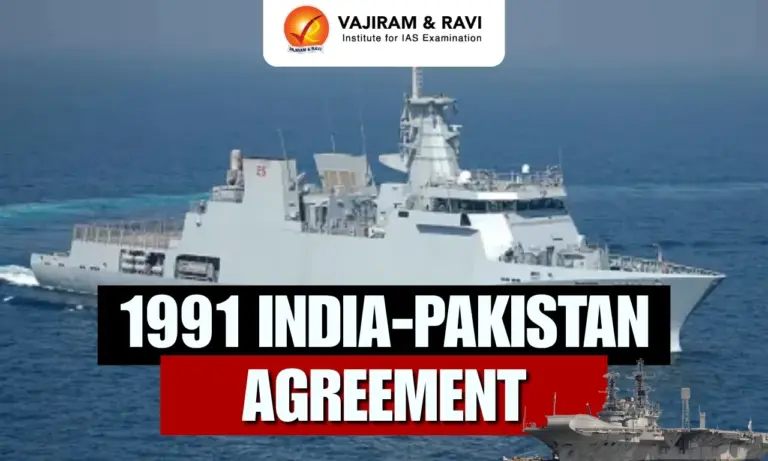
- Recently, Pakistan Naval Ship (PNS) Hunain, a Yarmook-class corvette, approached an Indian Navy warship at high speed in international waters and manoeuvred unsafely, causing a minor collision.
- The incident occurred about 120 nautical miles from the Gulf of Oman in the North Arabian Sea.
- The Indian warship was on a routine surveillance mission and suffered no damage, continuing its mission. PNS Hunain was damaged.
- India called the conduct “unacceptable and unprofessional” and a direct violation of Article 10 of the 1991 bilateral agreement on advance notice of military exercises.
The 2011 Precedent
- This is the second such incident since 2011. In June 2011, the Pakistani warship PNS Babur brushed past the Indian Navy frigate INS Godavari in the Gulf of Aden, causing minor damage to the Indian vessel’s helicopter safety net.
- That incident was also taken up diplomatically.


Maritime Zones under UNCLOS
- The incident occurred in international waters. Under the UN Convention on the Law of the Sea:
- A country’s territorial sea extends 12 nautical miles from its coast.
- One nautical mile equals 1.852 km.
- The Exclusive Economic Zone (EEZ) extends up to 200 nautical miles, where the coastal state has rights to explore and manage seabed resources.
- A country’s territorial sea extends 12 nautical miles from its coast.
The 1991 Agreement Explained
- The Agreement between India and Pakistan on Advance Notice on Military Exercises, Manoeuvres and Troop Movements was signed in April 1991.
- Its purpose was to prevent any crisis arising from misreading the other side’s intentions.
- Key provisions:
- Major military exercises close to each other’s territory should be avoided. If held, they must follow set regulations and the other side must be informed.
- Advance notice periods: 15 days for certain air and naval exercises, 60 days for corps-level exercises, 90 days for army-level exercises.
- Either side can seek clarification on assembly of forces, direction, extent and duration of an exercise.
- Naval definition: A major naval exercise involves six or more ships of destroyer or frigate size and above, exercising together and crossing into the other’s EEZ.
- Article 10: Naval ships and submarines of the two countries must not close within three nautical miles of each other in international waters, to avoid accidents. This is the provision India says was violated.
- Aircraft rules: Combat aircraft must not fly within 10 km of each other’s airspace, including Air Defence Identification Zones.
- Exceptions apply for aircraft operating from Jammu, Pathankot, Amritsar and Suratgarh (India) and Pasrur, Lahore, Vehari and Rahimyar Khan (Pakistan), where a 5 km distance applies.
- On the same day, a companion treaty was signed: the Agreement on Prevention of Air Space Violations and for Permitting Over Flights and Landings by Military Aircraft.
Why the 1991 Agreement Was Signed
- The 1980s saw a series of confidence-building measures between the two countries.
- Contributing factors included both nations’ nuclear weapons programmes, which raised the cost of war, and the Soviet invasion of Afghanistan in December 1979, which made Pakistan and the US keen to avoid tension on Pakistan’s eastern border.
- The immediate trigger was Exercise Brass Tacks IV in January 1987, a massive Indian military exercise in Punjab and Rajasthan.
- It involved two opposing corps-level forces, including two armoured divisions and a mechanised division, with simultaneous Air Force and Navy exercises. About 150,000 troops were mobilised.
- The scale rattled Pakistan and led to mechanisms for reducing uncertainty.
Ramming as a Naval Tactic
- Ramming is almost as old as naval warfare. The Greeks and Romans used it as a core weapon.
- The first modern instance came in 1862 at the Battle of Hampton Roads during the American Civil War, when CSS Virginia sank the Union frigate Cumberland.
- The tactic resurfaced in both World Wars, including the sinking of PT-109 commanded by John F. Kennedy.
- It also featured in the Cod Wars between Iceland and the UK over fishing rights.
Grey-Zone Warfare in the Arabian Sea
- The incident mirrors China’s grey-zone tactics in the South China Sea, where Beijing uses its Coast Guard and maritime militia to ram vessels and fire water cannons.
- These tactics stay below the threshold of open conflict while advancing strategic goals, exploiting legal ambiguity, similar to salami slicing in Eastern Ladakh.
- Analysts argue that this ambiguity must end: ramming with reinforced hulls or close-range water cannons causing damage comparable to kinetic force should be treated as a grave use of force justifying proportionate self-defence.
Conclusion
- The PNS Hunain collision violates Article 10 of the 1991 Agreement and signals the arrival of grey-zone tactics in the Arabian Sea.
- For two nuclear-armed neighbours, robust rules of engagement at sea are essential to prevent accidents from escalating into crises.

 Last updated on Sep, 2026
→ UPSC 2027 Notification will be released on 13 January 2027 at upsconline.nic.in.
→ Check out the latest UPSC Syllabus here.
→ Download UPSC Model Answers for Mains 2026
→ UPSC Mains Question Paper 2026 is out now for Essay & GS Paper 1, 2, 3 & 4.
→ UPSC Calendar 2027 has been released.
→ Enroll in Vajiram & Ravi’s UPSC Mains Test Series 2027 for structured answer writing practice, expert evaluation, and exam-oriented feedback.
→ Join Vajiram & Ravi’s UPSC Mentorship Program 2027 for personalized guidance, strategy planning, and one-to-one support from experienced mentors.
→ Go through the UPSC Mains Previous Year Papers to enhance your preparation.
→ UPSC has released UPSC Toppers List 2025 with the Civil Services final result on its official website.
→ Also check Best UPSC Coaching in India
1991 India-Pakistan Agreement FAQs
Q1. What happened between the Pakistani and Indian naval vessels?+
Q2. What does the 1991 India-Pakistan Agreement regulate?+
Q3. What is Article 10 of the 1991 Agreement?+
Q4. Why was the 1991 India-Pakistan Agreement signed?+
Q5. What are grey-zone tactics in maritime conflicts?+
Tags: 1991 India-Pakistan Agreement mains articles upsc current affairs upsc mains current affairs