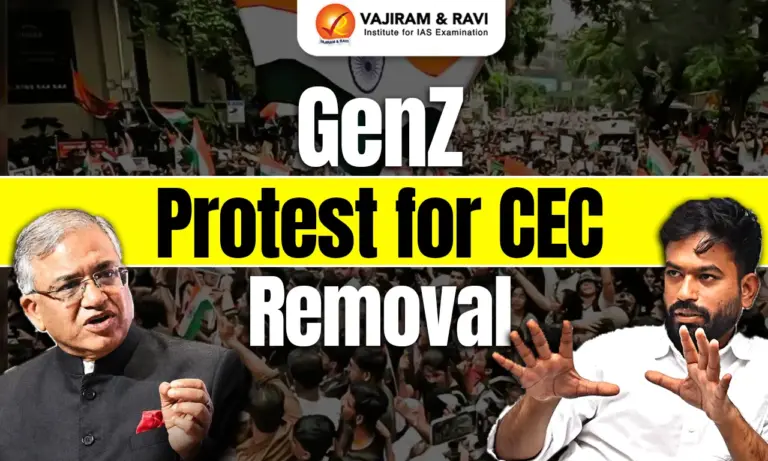
The GenZ Protest for CEC Removal has emerged around demands for the resignation of Chief Election Commissioner Gyanesh Kumar and concerns over the Special Intensive Revision (SIR) of electoral rolls. The Cockroach Janta Party (CJP) organised a major protest at Mumbai’s Shivaji Park on October 2, 2026. Opposition parties, student groups and youth organisations also held demonstrations in Delhi. The protests have raised questions about electoral transparency, institutional accountability and youth participation.
GenZ Protest for CEC Removal
The GenZ Protest for CEC Removal centres on allegations of irregularities in SIR and demands for greater transparency in the functioning of the Election Commission of India. CJP founder Abhijeet Dipke announced another protest Jantar Mantar 2.0 on October 10 if Gyanesh Kumar does not resign.
GenZ Protest for CEC Removal Background
The current GenZ Protest 2.0 developed around SIR related concerns and reported internal disagreements within the ECI. The following factors explain the background of the protests.
- SIR Electoral Roll Concerns: Protesters have alleged irregularities in the Special Intensive Revision of electoral rolls. Their concerns include alleged deletion of eligible voters and demands for greater transparency in the revision process.
- Demand for Gyanesh Kumar’s Resignation: The protest’s main demand is the resignation of CEC Gyanesh Kumar. The organisation has also demanded greater transparency in the appointment and functioning of election commissioners.


Who is Chief Election Commissioner (CEC)?
Gyanesh Kumar is the present CEC of ECI. The Chief Election Commissioner (CEC) heads the three member Election Commission of India (ECI), which is responsible for conducting elections. The CEC is constitutionally described as “first among equals” within the Commission. The other two Election Commissioners are Sukhbir Singh Sandhu and Vivek Joshi. The Commission is expected to take decisions unanimously as far as possible.
Process of Removal of CEC
The Constitution establishes a high threshold for removing a CEC. The process for the removal of the CEC is detailed below:
- Constitutional Provision: Article 324(5) states that the CEC can be removed only “in like manner and on the like grounds as a Judge of the Supreme Court.” Section 11(2) of the 2023 Act follows the same principle.
- Grounds for Removal: Removal requires proved misbehaviour or incapacity. Misbehaviour can include corrupt practices, abuse of office or conduct incompatible with the office. Incapacity means inability to perform official duties.
- Motion in Parliament: Members of Parliament must submit a motion alleging misbehaviour or incapacity. At least 100 MPs in the Lok Sabha or 50 MPs in the Rajya Sabha must support the motion for admission.
- Inquiry Committee: After admission, a committee investigates the allegations and examines relevant evidence. The inquiry is an important stage before Parliament considers the removal motion.
- Two Thirds Majority: The motion must receive a two thirds majority of members present and voting in both Houses of Parliament. The requirement makes removal procedurally difficult.
- Presidential Order: After Parliament passes the motion, the President issues the removal order. At this stage, the President acts on Parliament’s advice.
- No Previous CEC Removal: No Chief Election Commissioner has ever been impeached in India. In March 2026, Opposition parties submitted motions supported by 130 Lok Sabha MPs and 63 Rajya Sabha MPs.
- Earlier Motions Rejected: In April 2026, the Rajya Sabha Chairman and Lok Sabha Speaker rejected those motions.
Who are GenZ?
Gen Z generally refers to people born from around 1997 onwards, although the exact boundaries differ across studies. India’s National Youth Policy, 2014 defines youth as persons aged 15 to 29 years.
- Electoral Presence: The 2024 electoral roll depicted approx. 1.85 crore electors were of age 18-19 and about 19.74 crore electors were aged 20-29. This gives young citizens a substantial presence in the electorate.
- Education Expansion: Higher education enrolment reached to approx. 4.50 crore in 2023-24. The Gross Enrolment Ratio reached 30%, reflecting wider participation in higher education.
- Employment Pressure: PLFS 2025 placed unemployment among persons aged 15-29 at 9.9%. Urban youth unemployment was 13.6%, making employment a major concern for younger citizens.
- Skill Gap: Only about 5% of people aged 15-29 reported receiving or having received formal vocational or technical training in 2025.
- Digital Connectivity: India had about 1.066 billion broadband subscriptions by March 2026. Rural tele density remained substantially below urban tele density.
- Political Representation: The average age of MPs in the 18th Lok Sabha was 56 years. Only 11% of MPs were aged 40 or below.
GenZ Protest India Background
Youth Mobilisation in India has changed from campus based ideological movements to digitally connected campaigns around education, employment, governance and accountability.
- Early Youth Movements: The Anti Hindi Agitation of 1965 and Naxalbari Movement of 1967 involved significant student participation. Language, education and ideology were major concerns.
- 1970s Mobilisation: Nav Nirman Andolan in Gujarat in 1974 and the Jayaprakash Narayan Movement of 1974-75 expanded youth mobilisation towards corruption, inflation and governance.
- Social Justice Movements: The Assam Agitation of 1979-85 and Anti Mandal Commission protests of 1990 brought regional identity, migration, reservation and social justice into youth politics.
- Rights Based Activism: The Anna Hazare Movement of 2011 and Nirbhaya Protests of 2012 showed the growing role of young citizens in campaigns on corruption and gender justice.
- Other Mobilisation: Anti CAA/NRC protests and Agnipath protests represent newer forms of issue based youth mobilisation.
- NEET Paper Leak Protest: The 2026 Youth Movement began over alleged NEET paper leak irregularities and demands for examination reforms. The protest continued at Jantar Mantar for 36 days. It ended after Education Minister Dharmendra Pradhan resigned.
- Delhi Women’s Safety Protests: In September 2026, hundreds of students, many of them women, protested after the alleged gang rape of a 17 year old girl at Aastha Kunj Park. Students from several colleges demanded safer public spaces, stronger policing and accountability for sexual violence.
GenZ Protests in India Impacts
Recent Youth Protests have connected digital participation with demands concerning institutional accountability, employment, education and democratic rights.
- Issue Based Mobilisation: GenZ campaigns can form around specific issues instead of permanent political affiliations. Examination integrity, recruitment, employment and electoral accountability are examples.
- Online to Offline Shift: Digital discussion can create networks, spread messages and support physical demonstrations. This creates a hybrid model of political participation.
- Greater Institutional Attention: Sustained protests can bring public attention to administrative decisions and institutional processes. The CJP movement has focused attention on SIR and the role of the ECI.
- New Protest Language: Satire, memes, film references and slogans have become important communication tools. The CJP Protest illustrates this combination of digital communication and street mobilisation.
- Youth Participation: The protests show how younger citizens can participate in public affairs through student groups, social media, civil campaigns and street demonstrations.
GenZ Protests Across World
GenZ led movements in several countries have focused on employment, taxation, corruption, economic pressures and governance, with different political and institutional outcomes.
- Bangladesh 2024: Student protests initially focused on government job quotas and wider economic and political grievances. The mobilisation eventually contributed to the fall of Sheikh Hasina’s government.
- Kenya 2024: Youth led online mobilisation opposed proposed tax increases. President William Ruto withdrew the Finance Bill and called for dialogue with young protesters.
- Nepal 2025: Protests followed concerns over corruption and social media restrictions. Large GenZ demonstrations were followed by the Prime Minister’s resignation.
- Indonesia 2026: Students protested fuel price increases, public spending decisions and other governance concerns. The government acknowledged the protests and indicated willingness to listen.

 Last updated on Sep, 2026
→ UPSC 2027 Notification will be released on 13 January 2027 at upsconline.nic.in.
→ Asian Games 2026 are being held in Aichi-Nagoya, Japan, from 19 September to 4 October.
→ Check out the latest UPSC Syllabus here.
→ Download UPSC Model Answers for Mains 2026
→ UPSC Mains Question Paper 2026 is out now for Essay & GS Paper 1, 2, 3 & 4.
→ UPSC Calendar 2027 has been released.
→ Enroll in Vajiram & Ravi’s UPSC Mains Test Series 2027 for structured answer writing practice, expert evaluation, and exam-oriented feedback.
→ Join Vajiram & Ravi’s UPSC Mentorship Program 2027 for personalized guidance, strategy planning, and one-to-one support from experienced mentors.
→ Go through the UPSC Mains Previous Year Papers to enhance your preparation.
→ UPSC has released UPSC Toppers List 2025 with the Civil Services final result on its official website.
→ Also check Best UPSC Coaching in India
GenZ Protest for CEC Removal FAQs
Q1. What is the GenZ Protest for CEC Removal?+
Q2. Why are GenZ protesters demanding CEC Gyanesh Kumar’s resignation?+
Q3. How can a Chief Election Commissioner be removed in India?+
Q4. What is the main issue behind the GenZ Protest for CEC Removal?+
Q5. What is the role of the Election Commission of India in elections?+
Q6. What does Article 324 provide for the Election Commission?+
Q7. Why is removing the Chief Election Commissioner difficult?+
Q8. How are GenZ protests changing political participation in India?+
Tags: cec removal genz protest genz protest for cec removal