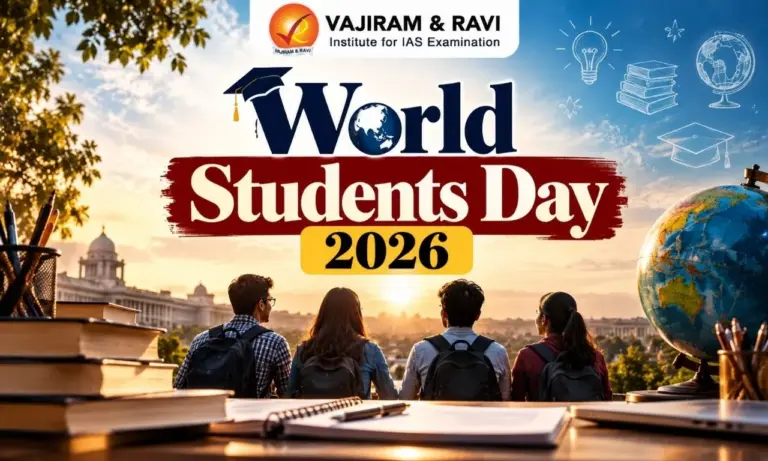
World Student’s Day 2026 will be observed on 15 October to mark the birth anniversary of Dr. APJ Abdul Kalam, the 11th President of India. The occasion highlights the role of education, scientific thinking, youth empowerment and innovation in national development. It reflects Kalam’s commitment to teaching and student development. However, World Student’s Day is not an officially declared United Nations observance.
World Student’s Day 2026
World Student’s Day 2026 falls on Thursday, 15 October. It honours Dr. Kalam’s contributions to education and his belief in the potential of young learners.
- Purpose: The observance promotes access to education, creativity, scientific curiosity, leadership and the development of students as responsible citizens.
- International Recognition: Despite its name, World Student’s Day has no official recognition outside India as an international observance. The United Nations has not declared it as a designated day.
- United Nations Clarification: The United Nations observes 15 October as the International Day of Rural Women. An official UN observance requires a formal process involving a member state and the General Assembly.
- Educational Focus: The occasion draws attention to educational equality, digital literacy, practical skills and student participation in social and economic development.
World Student’s Day Theme 2026
There is no officially announced theme for the World Student’s Day 2026. The day is observed primarily to honour the contributions and celebrate the Birth Anniversary of Dr. Abdul Kalam and improve the status of Students in India. The observation is celebrated with several events organized at schools, colleges, NGOs, etc. The day highlights:
- Education and Innovation: The day highlights the importance of developing knowledge, creativity and problem solving abilities to prepare students for changing social and economic needs.
- Youth Empowerment: It reflects the need to provide young people with opportunities to develop leadership skills, pursue research and contribute to national development.
- Inclusive Learning: Equal access to quality education remains essential for students across different economic backgrounds, geographical regions and social groups.
- Value Based Education: Kalam’s educational vision emphasised integrity, discipline, responsibility and respect alongside academic knowledge and technical skills.


Dr. APJ Abdul Kalam
Dr. APJ Abdul Kalam was an aerospace engineer, scientist, teacher and national leader. His work in space research, missile development and education shaped his lasting contribution to India.
- Early Life: Avul Pakir Jainulabdeen Abdul Kalam was born on 15 October 1931 in Rameswaram, Tamil Nadu.
- Education: He graduated in Physics from St. Joseph’s College, Tiruchirappalli, in 1954 and studied aerospace engineering at the Madras Institute of Technology.
- Scientific Career: Kalam joined the Defence Research and Development Organisation (DRDO) in 1960 and later moved to the Indian Space Research Organisation (ISRO).
- First Satellite Launch Vehicle: He led the development of India’s first Satellite Launch Vehicle, which successfully placed the Rohini satellite into near Earth orbit in July 1980.
- Missile Development: He played a leading role in the Integrated Guided Missile Development Programme. His contribution to the development of Agni and Prithvi missiles earned him the title “Missile Man of India”.
- Pokhran II Nuclear Tests: In May 1998, Kalam served as a chief project coordinator for the Pokhran II nuclear tests. His responsibilities included important technical, organisational and coordination work.
- President of India: Kalam became the 11th President of India on 25 July 2002 and served until 25 July 2007. Widely known as the “People’s President”, he maintained a strong connection with students and young people.
- Awards and Recognition: In 1997, he received the Bharat Ratna, India’s highest civilian honour, for his contributions to scientific research and defence technology modernisation.
- Contributions to Healthcare: In 1998, Kalam worked with cardiologist Bhupathiraju Somaraju to develop the low cost Kalam Raju stent. In 2012, they designed the Kalam Raju tablet for healthcare workers in rural areas.
- Books and Vision: His books include Wings of Fire, India 2020 and Ignited Minds. He advocated transforming India into a knowledge driven, developed nation through education, technology, healthcare and self reliance.
- Commitment to Teaching: After his presidency, Kalam returned to teaching and interacted with students at educational institutions. On 27 July 2015, he collapsed while delivering a lecture at IIM Shillong and died at the age of 83.
Also Read: Education Schemes in India 2026
Status of Students in India
India’s education system serves millions of learners across school and higher education institutions. Recent enrolment figures show the scale of the sector and the importance of improving learning outcomes and skills.
- School Student Population: According to UDISE+ 2024-25, India had 24.69 crore students enrolled across 14.71 lakh schools, supported by more than 1.01 crore teachers.
- Gross Enrolment Ratio: The Economic Survey 2025-2026 reported a Gross Enrolment Ratio (GER) of 90.9 at the primary stage, 90.3 at the upper primary stage, 78.7 at the secondary stage and 58.4 at the higher secondary stage.
- Higher Education Enrolment: The All India Survey on Higher Education 2022-23 (provisional) recorded 4.46 crore students in higher education, compared with 4.33 crore in 2021-22.
- Growth in Institutions: India’s higher education institutions increased from 51,534 in 2014-15 to 70,018 by June 2025. The country had 23 Indian Institutes of Technology (IITs), 21 Indian Institutes of Management (IIMs) and 20 All India Institutes of Medical Sciences (AIIMS).
- Digital and Academic Flexibility: The Academic Bank of Credit covered 2,660 higher education institutions, with more than 4.6 crore IDs issued. Additionally, 153 universities introduced flexible entry-exit pathways and admissions twice a year.
- Learning Outcomes: PARAKH Rashtriya Sarvekshan 2024 showed that Grade III mathematics proficiency increased to 65% from 42% in 2021. Language proficiency rose to 57% from 39% during the same comparison.
- Key Challenges: Students continue to face unequal digital access, gaps in vocational training, differences in educational quality and barriers to employment. Strengthening foundational learning, teacher training, counselling and practical skills can help address these issues.
- Policy Framework: The Right to Education Act 2009 and the National Education Policy 2020 support wider access, educational equity and improvements in teaching and learning. Continued implementation is important for building a skilled and inclusive workforce.
World Student’s Day 2026 Significance
World Student’s Day 2026 highlights the relationship between education, human capital and inclusive national development. It also draws attention to the challenges affecting students in India.
- Promotes Educational Equality: The occasion stresses the importance of reducing differences in educational access and quality across rural and urban areas and among different socioeconomic groups.
- Supports Youth Development: Education helps students develop the knowledge, confidence and practical abilities required for employment, entrepreneurship, research and public service.
- Highlights India’s Demographic Dividend: India has a large student population that can contribute to economic growth if supported by quality education, relevant skills and employment opportunities.
- Encourages Scientific Temper: Kalam’s career demonstrates the value of scientific inquiry, technological development and evidence based thinking in addressing national challenges.
- Strengthens Skill Development: Linking classroom learning with vocational training can improve employability. The PLFS 2023-24 reported that only 0.97% of people aged 14-18 had received institutional skilling, while nearly 92% had received none.
- Advances Inclusive Education: The occasion reinforces the need to address digital inequality, gender barriers, student stress and differences in access to educational resources.

 Last updated on Oct, 2026
→ UPSC 2027 Notification will be released on 13 January 2027 at upsconline.nic.in.
→ Check Nobel Prize 2026 Winners List here.
→ Download PIB PRiSM Monthly Magazine 2026 here.
→ Check UPSC Monthly Current Affairs Magazine The Recitals here.
→ Check out the latest UPSC Syllabus here.
→ Download UPSC Model Answers for Mains 2026
→ UPSC Mains Question Paper 2026 is out now for Essay & GS Paper 1, 2, 3 & 4.
→ UPSC Calendar 2027 has been released.
→ Enroll in Vajiram & Ravi’s UPSC Mains Test Series 2027 for structured answer writing practice, expert evaluation, and exam-oriented feedback.
→ Join Vajiram & Ravi’s UPSC Mentorship Program 2027 for personalized guidance, strategy planning, and one-to-one support from experienced mentors.
→ Go through the UPSC Mains Previous Year Papers to enhance your preparation.
→ UPSC has released UPSC Toppers List 2025 with the Civil Services final result on its official website.
→ Also check Best UPSC Coaching in India
World Student’s Day 2026 FAQs
Q1. When is World Student’s Day 2026 celebrated?+
Q2. What is the theme of World Student’s Day 2026?+
Q3. Why is World Student’s Day celebrated on 15 October?+
Q4. Is World Student’s Day recognised by the United Nations?+
Q5. What is the significance of World Student’s Day?+
Q6. What is the birth anniversary of Dr. APJ Abdul Kalam celebrated as?+
Q7. What was Dr. APJ Abdul Kalam popularly known as?+
Tags: world student day 2026 world student’s day world student’s day 2026