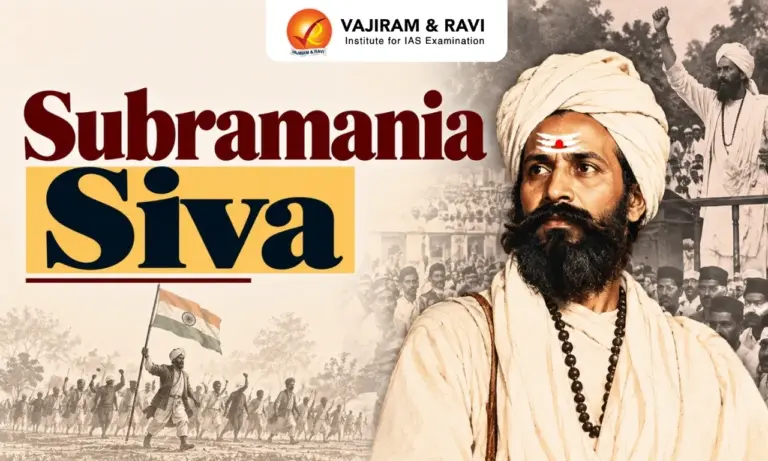
Subramania Siva (1884-1925) was a fiery orator, writer and Swadeshi-era freedom fighter from the Madras Presidency. Working closely with V.O. Chidambaram Pillai and Subramania Bharati, he took the message of freedom to workers and ordinary people through his speeches and writings. He was jailed for sedition and contracted leprosy in prison, yet kept working for the cause until his death in 1925. He also founded the journal Gnanabhanu and laid the foundation of the Bharat Mata Temple.
Subramania Siva Biography
Subramania Siva was a nationalist speaker, author and organiser who made the idea of freedom meaningful to everyday people. He is remembered in Tamil Nadu as a fearless voice of radical nationalism.
- Subramania Siva was born on 4 October 1884 at Batlagundu, Dindigul district, Tamil Nadu. His parents were Rajam Iyer and Nagalakshmi.
- He studied in Madurai and later in Trivandrum. He worked briefly as a clerk in the Trivandrum police department before giving it up for the freedom movement.
- In 1902, he became a disciple of Sadananda Swami and adopted the name “Sivam”. This shaped his spiritual-nationalist outlook.
- He was fluent in Tamil, English and Sanskrit. He followed Bal Gangadhar Tilak as his political guru and drew inspiration from Swami Vivekananda and Ramakrishna Paramahansa.
- He is also known as Siva, Sivam, “Swatantra Sivam” and was honoured as “Veeramurasu”.
- He is often called the first recognised political prisoner of the Madras Presidency for sedition.
- He belonged to the same circle as V.O. Chidambaram Pillai, Subramania Bharati and Pasumpon Muthuramalinga Thevar, the freedom fighters of the Pandya land.
Role of Subramania Siva in the Indian Freedom Struggle
Subramania Siva’s main weapon was his voice. He travelled from town to town, turning big political ideas like Swaraj, boycott and self-reliance into simple messages people could connect with.
- Two events lit the spark for him: Japan’s victory over Russia (1904-05), which gave Asians hope against European powers, and the partition of Bengal (1905), which triggered the Vande Mataram wave.
- In 1906, while in Thiruvananthapuram, he was drawn to the movement after hearing the speeches of Arya Samaj leaders such as Thakur Kahan Chandra Verma. He began organising rallies and speeches, and was soon asked to leave Travancore, which was under British control.
- In 1906-07, he founded the Dharma Paripalana Samajam to promote social reform, self-reliance and patriotism.
- He used Tamil speeches, poems and articles to reach traders, workers and rural people, well beyond the educated urban class.
- He also helped spread Subramania Bharati’s poems among the masses.
- In 1908, he was arrested for sedition and sentenced to ten years’ transportation, later reduced to six years of rigorous imprisonment. He was kept in the Trichy, Salem and Vellore jails and forced into hard labour, including pulling an oil press like cattle.
- Later he was released in 1912 a broken man. His wife Meenakshi died in 1915.
- He returned to public life, mobilised workers for better pay and conditions, started the magazine Indian Desantheri (1919), and took part in the Non-Cooperation Movement (1920).
- In 1921, he went to Kolkata, joined protests, and was again arrested for sedition and jailed for about two and a half years.
- Jail left him with leprosy, and the British banned him from using public transport. He walked from place to place to keep spreading the message.


Subramania Siva and the Swadeshi Movement
The Swadeshi years were the high point of Siva’s public life. In Tirunelveli and Tuticorin, he and VOC turned a boycott campaign into a mass movement.
- In 1907, Siva moved to Tuticorin and met V.O. Chidambaram Pillai, who was then setting up the Swadeshi Steam Navigation Company.
- The two divided the work well. VOC handled the organisation and business side, while Siva was the chief propagandist, speaking at rallies on the banks of the Thamirabarani River.
- Their speeches backed national enterprise and challenged colonial economic control. They also organised many meetings in Tirunelveli on British exploitation and the value of freedom.
- In February 1908, they organised about four thousand workers at the British-owned Coral Mills in Tuticorin. The workers demanded higher wages, better conditions and weekly holidays.
- The nine-day strike ended with the management accepting all the demands, a major early win for organised labour in South India.
- In March 1908, Siva and VOC organised celebrations for the release of Bipin Chandra Pal. On 12 March 1908, District Collector Robert Ashe arrested Siva, VOC and Padmanabha Iyengar for sedition.
- The arrests sparked the Tinnevelly Riots, and police firing killed four civilians.
- Siva was tried under Section 124A of the IPC. His speeches had made Tirunelveli one of the strongest centres of nationalist activity in the South.
Contributions of Subramania Siva to India’s Independence Movement
Siva’s contribution went beyond speeches. He worked as a writer, journalist, labour organiser, social reformer and institution builder.
- Writer and author: He wrote over 30 books, including Ramanuja Vijayam and Madhva Vijayam (on two Vaishnava saints), Sachidananda Sivam, Gnanaratnam, and Vitutalaipporil Tamil Valarnta Varalaru.
- Journalism: He launched the monthly Gnanabhanu in 1913, covering literature, nationalist thought and social reform, with writers like Subramania Bharati contributing. He also started the weekly Prabhanja Mithran (1916) and wrote under the pen name Naradhar.
- Theatre: He wrote historical plays to build national pride, using performances as a way around limits on public gatherings.
- Tanittamil movement: He was a pioneer of the Pure Tamil movement, which urged Tamil free from excessive Sanskrit influence.
- Labour rights: He helped lead the 1908 Coral Mills Strike, linking the Swadeshi movement with workers’ demands.
- Social reform: Through the Dharma Paripalana Samajam, he promoted reform along with patriotism.
- Bharat Mata Temple: He dreamed of a temple to Bharat Mata as a symbol of unity across caste lines. On 23 January 1923, he founded the Bharat Mata Ashram at Papparapatti in Dharmapuri district.
- Final years and legacy: He died on 23 July 1925, aged 40. The Dindigul district collector’s office is named Thiagi Subramanya Siva Maaligai after him, and so is the Batlagundu bus stand.
- Wider significance: His life shows how regional languages, print culture and local networks widened the base of Indian nationalism.

 Last updated on Oct, 2026
→ UPSC 2027 Notification will be released on 13 January 2027 at upsconline.nic.in.
→ Check Nobel Prize 2026 Winners List here.
→ Download PIB PRiSM Monthly Magazine 2026 here.
→ Check UPSC Monthly Current Affairs Magazine The Recitals here.
→ Check out the latest UPSC Syllabus here.
→ Download UPSC Model Answers for Mains 2026
→ UPSC Mains Question Paper 2026 is out now for Essay & GS Paper 1, 2, 3 & 4.
→ UPSC Calendar 2027 has been released.
→ Enroll in Vajiram & Ravi’s UPSC Mains Test Series 2027 for structured answer writing practice, expert evaluation, and exam-oriented feedback.
→ Join Vajiram & Ravi’s UPSC Mentorship Program 2027 for personalized guidance, strategy planning, and one-to-one support from experienced mentors.
→ Go through the UPSC Mains Previous Year Papers to enhance your preparation.
→ UPSC has released UPSC Toppers List 2025 with the Civil Services final result on its official website.
→ Also check Best UPSC Coaching in India
Subramania Siva FAQs
Q1. Who was Subramania Siva?+
Q2. When and where was Subramania Siva born?+
Q3. What was Subramania Siva’s role in the Swadeshi Movement?+
Q4. Why was Subramania Siva arrested?+
Q5. What is the Coral Mills Strike of 1908?+
Q6. What did Subramania Siva write?+
Q7. How did Subramania Siva die?+
Tags: subramania siva