Waterspout Latest News
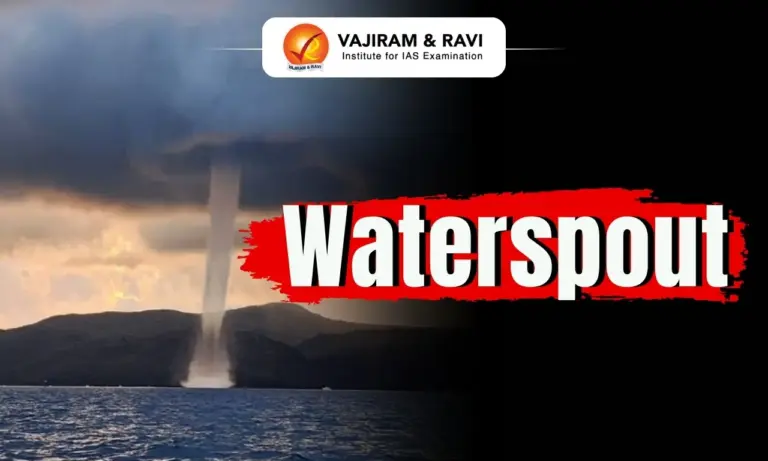
Recently, a rare weather phenomenon resembling a waterspout was observed over the Brahmaputra in Assam’s Barpeta district.
About Waterspout
- A waterspout is a large column of air and mist rotating over a water body.
- It is less intense and typically lasts for around five minutes — occasionally it can last up to 10 minutes.
- The average waterspout can be around 165 feet in diameter, with wind speeds of 100 kilometres per hour.
- They occur when there are high levels of humidity and relatively warm water temperatures compared to the overlying air.


Types of waterspouts
- Tornadic waterspouts
- These are tornadoes that form over water, or move from land to water.
- They have the same characteristics as a land tornado.
- They are associated with severe thunderstorms, and are often accompanied by high winds and seas, large hail, and frequent dangerous lightning.
- Fair-weather waterspouts
- These are usually formed under calmer conditions along the dark flat base of a line of developing cumulus clouds.
- It is generally not associated with thunderstorms.
- It is developed from the water’s surface upward. (While tornadic waterspouts develop downward in a thunderstorm)
- Typically move very little due to light wind conditions.
Source: IT

 Last updated on Oct, 2026
→ UPSC 2027 Notification will be released on 13 January 2027 at upsconline.nic.in.
→ Asian Games 2026 are being held in Aichi-Nagoya, Japan, from 19 September to 4 October.
→ Check Nobel Prize 2026 Winners List here.
→ Download PIB PRiSM Monthly Magazine 2026 here.
→ Check UPSC Monthly Current Affairs Magazine The Recitals here.
→ Check out the latest UPSC Syllabus here.
→ Download UPSC Model Answers for Mains 2026
→ UPSC Mains Question Paper 2026 is out now for Essay & GS Paper 1, 2, 3 & 4.
→ UPSC Calendar 2027 has been released.
→ Enroll in Vajiram & Ravi’s UPSC Mains Test Series 2027 for structured answer writing practice, expert evaluation, and exam-oriented feedback.
→ Join Vajiram & Ravi’s UPSC Mentorship Program 2027 for personalized guidance, strategy planning, and one-to-one support from experienced mentors.
→ Go through the UPSC Mains Previous Year Papers to enhance your preparation.
→ UPSC has released UPSC Toppers List 2025 with the Civil Services final result on its official website.
→ Also check Best UPSC Coaching in India
Waterspout FAQs
Q1. How many types of waterspouts are there?+
Q2. What is Waterspout?+
Tags: prelims pointers upsc current affairs upsc prelims current affairs waterspout