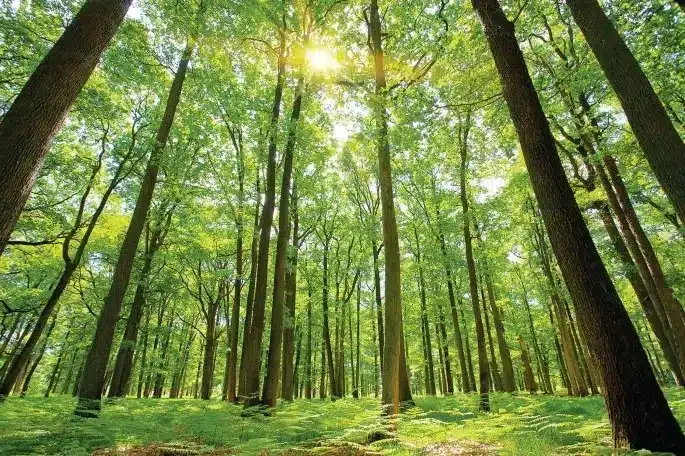
About Global Forest Watch (GFW)
- It is an open-source web application to monitor global forests in near real-time using satellite data and other sources.
- It is a project of the Washington-based nonprofit research organization, the World Resources Institute (WRI). Most of the data is compiled by the University of Maryland researchers.
- It is free and simple to use, enabling anyone to create custom maps, analyze foresttrends, subscribe to alerts, or download data fortheir local area or the entire world.
- It refers to tree cover when talking about forest extent, loss, and gain. Tree cover is a convenient metric for monitoring forest change because it is easily measurable from spaceusing freely available, medium-resolution satellite imagery.
- Highlights of the GFW’s annual forest loss data:
- The loss of primary forests–those untouched by people and sometimes known as old-growth forests – in the tropicsdeclined 9% last year compared to 2022.
- The world last year lost about 37,000 square kilometers (14,000 square miles) of tropical primary forest, an area nearly as big as Switzerland.
- Brazil, the Democratic Republic of Congo, and Bolivia topped the ranking of tropical countries with the most primary forest losses.
- Deforestation globally rose by 3.2% in 2023.
- India has lost 2.33 million hectaresof tree cover since 2000, equivalent to a six percent decrease in tree cover during this period.
- The country lost 4,14,000 hectaresof humid primary forest (4.1 percent) from 2002 to 2023, making up 18 per cent of its total tree cover loss in the same period.
- Between 2001 and 2022, forests in India emitted 51 million tons of carbon dioxide equivalent a year and removed 141 million tons of carbon dioxide equivalent a year. This represents a net carbon sink of 89.9 million tons of carbon dioxide equivalent a year.
- An average of 51.0 million tons of carbon dioxideequivalent per year was released into the atmosphere as a result of tree cover loss in India.
- The data showed that 95 percent of the tree cover loss in India from 2013 to 2023 occurred within natural forests.
- The GFW data showed that five states accounted for 60 percent of all tree cover losses between 2001 and 2023.
- Assam had the maximum tree cover loss at 324,000 hectares, compared to an average of 66,600 hectares. Mizoram lost 312,000 hectares of tree cover, Arunachal Pradesh 262,000 hectares, Nagaland 259,000 hectares, and Manipur 240,000 hectares.
Q1: What is the World Resources Institute (WRI)?
It is a research institute established in 1982 to promote environmentally sound and socially equitable development. It is headquartered in Washington, D.C.They organize their work around seven global challenges: Food, Forests, Water, Energy, Climate, the Ocean and Cities.
Source: India Lost 2.33 Million Hectares Of Tree Cover Since 2000: Global Forest Watch


 Last updated on Oct, 2026
→ UPSC 2027 Notification will be released on 13 January 2027 at upsconline.nic.in.
→ Asian Games 2026 are being held in Aichi-Nagoya, Japan, from 19 September to 4 October.
→ Check Nobel Prize 2026 Winners List here.
→ Download PIB PRiSM Monthly Magazine 2026 here.
→ Check UPSC Monthly Current Affairs Magazine The Recitals here.
→ Check out the latest UPSC Syllabus here.
→ Download UPSC Model Answers for Mains 2026
→ UPSC Mains Question Paper 2026 is out now for Essay & GS Paper 1, 2, 3 & 4.
→ UPSC Calendar 2027 has been released.
→ Enroll in Vajiram & Ravi’s UPSC Mains Test Series 2027 for structured answer writing practice, expert evaluation, and exam-oriented feedback.
→ Join Vajiram & Ravi’s UPSC Mentorship Program 2027 for personalized guidance, strategy planning, and one-to-one support from experienced mentors.
→ Go through the UPSC Mains Previous Year Papers to enhance your preparation.
→ UPSC has released UPSC Toppers List 2025 with the Civil Services final result on its official website.
→ Also check Best UPSC Coaching in India