What’s in Today’s Article?
- Why in news?
- What is Multidimensional Poverty?
- What is National Multidimensional Poverty Index (MPI)?
- MPI Parameters & Methodology:
- News Summary: NITI Aayog’s Discussion Paper – Multidimensional Poverty in India since 2005-06
- Key highlights of the report
Why in news?
- As per the NITI Aayog’s Discussion Paper ‘Multidimensional Poverty in India since 2005-06’, 24.82 crore people escaped multidimensional poverty in last nine years.
- The National Multidimensional Poverty Index (MPI) by Niti Aayog measure the multidimensional poverty in India.


Multidimensional Poverty
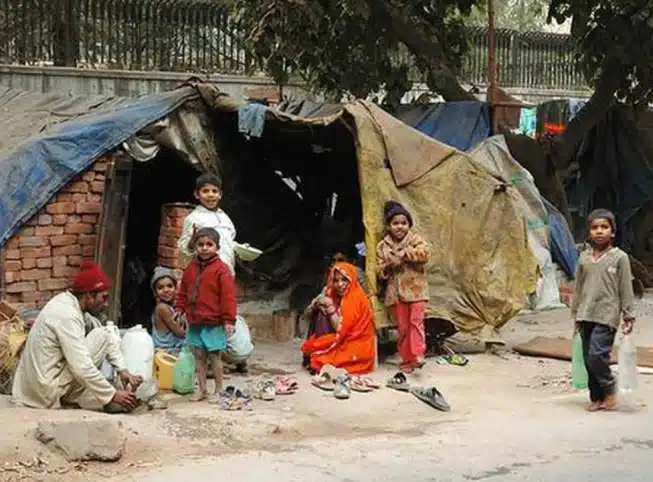
- A person who is poor can suffer multiple disadvantages at the same time – for example they may have poor health or malnutrition, a lack of clean water or electricity, poor quality of work or little schooling.
- Focusing on one factor alone, such as income, is not enough to capture the true reality of poverty.
- Multidimensional Poverty is a measure of poverty that captures deprivations in education and access to basic infrastructure in addition to income or consumption at the $2.15 international poverty line (as per World Bank).
- World Bank defines the international poverty line at USD 2.15 (in 2017 purchasing power parity terms) daily to measure monetary value.
National Multidimensional Poverty Index (MPI)
- MPI has been used by the United Nations Development Programme (UNDP) in its flagship Human Development Report since 2010.
- In this context, NITI Aayog had published the first edition of national Multidimensional Poverty Index for India in 2021.
- Purpose –
- A national MPI statistic for a country is tailored to the national priorities and therefore, countries choose their own set of dimensions, indicators, weights, and cut-offs, according to their plans and contexts.
- The report presents an in-depth analysis of the headcount ratio and intensity of multidimensional poverty at the national, State/UT, and district levels.
- The first report was based on the reference period of 2015-16 of the National Family Health Survey (NFHS)- 4.
MPI Parameters & Methodology
- The Index is based on the Alkire-Foster (AF) methodology and has three equally weighted dimensions –
- These three dimensions are represented by 12 indicators as given in the fig:
- The index is calculated by first setting the deprivation cut-offs for each indicator, i.e., the level of achievement considered normatively sufficient for an individual to be considered not deprived in an indicator.
- For example, the individual has completed at least six years of schooling. Such a cut off would be applied to determine whether the individual is deprived in each indicator.
- Weights are attached to each indicator and a composite metric is then used to calculate the index.

News Summary: NITI Aayog’s Discussion Paper – Multidimensional Poverty in India since 2005-06
Key highlights of the report
- Significant decline in multidimensional poverty in India
- From 29.17% in 2013-14 to 11.28% in 2022-23 i.e. a reduction of 17.89 percentage points.
- States with largest decline
- Uttar Pradesh topped the list with 5.94 crore people escaping poverty followed by Bihar at 3.77 crore and Madhya Pradesh at 2.30 crore.
- India likely to achieve SDG Target 1.2 (reducing multidimensional poverty by at least half) well before 2030.
- Government’s goal
- Government has a goal to bring down multidimensional poverty to below 1% and all efforts are being made in that direction.
- The report said India is all set to reach single-digit poverty levels during 2024.

- Report highlighted noteworthy initiatives
- Initiatives like Poshan Abhiyan and Anemia Mukt Bharat have significantly enhanced access to healthcare facilities, leading to a substantial decrease in deprivation.
- Operating one of the world’s largest food security programs, the targeted public distribution system (PDS) under the National Food Security Act covers 81.35 crore beneficiaries, providing food grains to rural and urban populations.

Q1) What is Target 1.2 of the Sustainable Development Goals (SDGs)?
Target 1.2 of the Sustainable Development Goals (SDGs) is to reduce poverty by at least 50% by 2030. This target applies to men, women, and children of all ages, and is based on regional definitions.
Q2) What is the main aim of NITI Aayog?
To evolve a shared vision of national development priorities, sectors and strategies with the active involvement of States. To ensure, on areas that are specifically referred to it, that the interests of national security are incorporated in economic strategy and policy.
Source: Over 24.8 crore people moved out of poverty in India in nine years: NITI report | PIB | NITI Aayog

 Last updated on Oct, 2026
→ UPSC 2027 Notification will be released on 13 January 2027 at upsconline.nic.in.
→ Asian Games 2026 are being held in Aichi-Nagoya, Japan, from 19 September to 4 October.
→ Check Nobel Prize 2026 Winners List here.
→ Download PIB PRiSM Monthly Magazine 2026 here.
→ Check UPSC Monthly Current Affairs Magazine The Recitals here.
→ Check out the latest UPSC Syllabus here.
→ Download UPSC Model Answers for Mains 2026
→ UPSC Mains Question Paper 2026 is out now for Essay & GS Paper 1, 2, 3 & 4.
→ UPSC Calendar 2027 has been released.
→ Enroll in Vajiram & Ravi’s UPSC Mains Test Series 2027 for structured answer writing practice, expert evaluation, and exam-oriented feedback.
→ Join Vajiram & Ravi’s UPSC Mentorship Program 2027 for personalized guidance, strategy planning, and one-to-one support from experienced mentors.
→ Go through the UPSC Mains Previous Year Papers to enhance your preparation.
→ UPSC has released UPSC Toppers List 2025 with the Civil Services final result on its official website.
→ Also check Best UPSC Coaching in India