What’s in today’s article?
- Why in News?
- Key Features of Section 479 of BNSS
- Steps Taken by the Supreme Court to Ensure the Implementation of Section 479 of BNSS
- India’s Undertrial Population
- Conclusion
Why in News?
- Union Home Minister recently emphasised the need to release undertrial prisoners who have spent more than one-third of the maximum prescribed sentence for their accused crimes before Constitution Day (November 26).
- This directive aligns with the newly introduced provisions under the Bharatiya Nagarik Suraksha Sanhita, 2023 (BNSS).


Key Features of Section 479 of BNSS:
- About Section 479 of the BNSS: It revises bail norms to address the prolonged detention of undertrial prisoners, particularly first-time offenders.
- General rule for bail:
- Undertrials accused of non-capital offences (not punishable by death or life imprisonment) are eligible for bail if they have served half of the maximum sentence for the offence.
- The provision builds on Section 436A of the CrPC, which allowed release after serving half the sentence.
- Relaxed standard for first-time offenders: First-time offenders, defined as individuals without prior convictions, must be released on bond after serving one-third of the maximum prescribed sentence.
- Exceptions: The relaxed provisions are not applicable to cases involving multiple offences or pending investigations for other crimes.
Steps Taken by the Supreme Court to Ensure the Implementation of Section 479 of BNSS:
- Retrospective application: In August 2024, the Court ordered that Section 479 applies retrospectively to cases before the BNSS came into effect on July 1, 2024.
- Implementation measures:
- Jail superintendents are required to identify eligible prisoners and report to courts for their release.
- State governments and Union Territories (UTs) were directed to submit detailed affidavits (within two months) on eligible undertrials and their release status.
- Recent developments:
- As of October 2024, only 19 of the 36 states and UTs complied with the Court’s directives.
- On November 19, the Court reiterated its directive, prioritising the identification of women undertrials for bail eligibility.
India’s Undertrial Population:
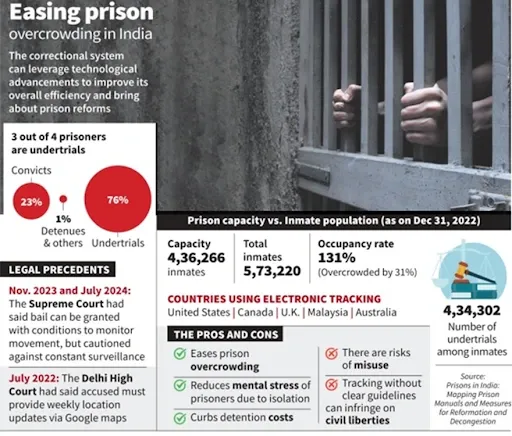
- NCRB’s report: The National Crime Records Bureau’s (NCRB) Prison Statistics India 2022 report highlights the staggering proportion of undertrials in Indian prisons.
- Overall numbers: Out of 5,73,220 inmates, 4,34,302 (75.8%) are undertrials. Women undertrials constitute 18,146 out of 23,772 (76.33%) of incarcerated women.
- Long-term detentions: Around 8.6% of undertrials have been in prison for more than three years as of December 31, 2022.
- Challenges: The report does not detail how many undertrials are first-time offenders, which is crucial for the effective implementation of Section 479.
Conclusion:
- The BNSS and the Supreme Court’s proactive stance underscore a critical attempt to decongest prisons and expedite justice for undertrial prisoners.
- However, consistent implementation and thorough reporting by state governments and jail authorities remain imperative for meaningful reform.
Q.1. What is the Bharatiya Nagarik Suraksha Sanhita, 2023 (BNSS)?
The BNSS is an Act that consolidates and amends the criminal procedure law in India. It replaced the Criminal Procedure Code (CrPC) of 1973. It aims to simplify the criminal procedure, reduce trial duration, and ensure timely justice.
Q.2. What is the National Crime Records Bureau (NCRB)?
NCRB is an Indian government agency responsible for collecting and analysing crime data as defined by the Indian Penal Code (IPC). NCRB is headquartered in New Delhi and is part of the Ministry of Home Affairs (MHA) under the Government of India.
News: India’s undertrial prisoners | HT

 Last updated on Oct, 2026
→ UPSC 2027 Notification will be released on 13 January 2027 at upsconline.nic.in.
→ Check Nobel Prize 2026 Winners List here.
→ Download PIB PRiSM Monthly Magazine 2026 here.
→ Check UPSC Monthly Current Affairs Magazine The Recitals here.
→ Check out the latest UPSC Syllabus here.
→ Download UPSC Model Answers for Mains 2026
→ UPSC Mains Question Paper 2026 is out now for Essay & GS Paper 1, 2, 3 & 4.
→ UPSC Calendar 2027 has been released.
→ Enroll in Vajiram & Ravi’s UPSC Mains Test Series 2027 for structured answer writing practice, expert evaluation, and exam-oriented feedback.
→ Join Vajiram & Ravi’s UPSC Mentorship Program 2027 for personalized guidance, strategy planning, and one-to-one support from experienced mentors.
→ Go through the UPSC Mains Previous Year Papers to enhance your preparation.
→ UPSC has released UPSC Toppers List 2025 with the Civil Services final result on its official website.
→ Also check Best UPSC Coaching in India