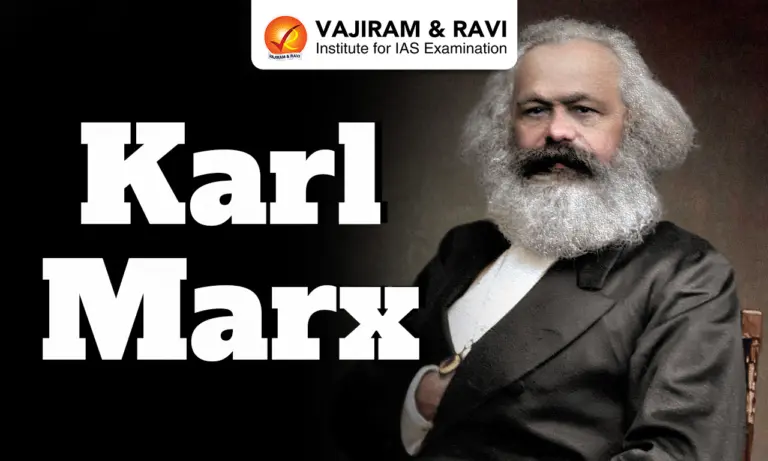
The 19th century witnessed massive social and economic transformation in Europe due to the Industrial Revolution. While industrialisation increased production and economic growth, it also created deep inequalities, exploitation of workers, poor living conditions, and concentration of wealth in the hands of industrial capitalists. In this historical context, Karl Marx emerged as one of the most influential thinkers of modern times.
About Karl Marx
Karl Marx was a German philosopher, economist, historian, political theorist, and revolutionary socialist whose ideas profoundly shaped modern political thought, labour movements, socialism, and global debates on inequality and capitalism.
His ideas, collectively known as Marxism, continue to influence discussions on economics, politics, class relations, labour rights, and social justice across the world.
Karl Marx Early Life and Background
- Karl Marx was born on 5 May 1818 in Trier in the Kingdom of Prussia (present-day Germany).
- He belonged to a middle-class Jewish family. His father Heinrich Marx, a lawyer, converted to Lutheranism for professional reasons.
- He received higher education in law and philosophy. He initially studied at the University of Bonn and later at the University of Berlin.
- During his education, he was deeply influenced by the philosophy of Georg Wilhelm Friedrich Hegel. Marx later criticised Hegel’s idealism and developed his own materialist interpretation of history.
- He collaborated closely with Friedrich Engels, who became his lifelong intellectual partner and financial supporter.
- He worked as a journalist and correspondent, most notably for the New-York Tribune (1851–1862), through which he published articles on European politics and India.
- He was expelled from Germany, France, and Belgium due to his radical political writings; eventually settled permanently in London in 1849.
- Marx also participated in international labour movements and helped establish the International Workingmen’s Association, also known as the First International, in 1864.
- He died in London in 1883.


Major Works of Karl Marx
Karl Marx produced several influential works that shaped socialist and communist thought.
| Major Work | Significance |
|
The Communist Manifesto (1848) |
Written with Friedrich Engels; outlined the principles of communism and class struggle |
|
Das Kapital (1867) |
Detailed critique of capitalism and theory of surplus value |
|
The German Ideology |
Explained historical materialism |
|
Economic and Philosophic Manuscripts |
Discussed alienation under capitalism |
|
A Contribution to the Critique of Political Economy |
Explained the relationship between economic structure and society |
Core Ideas and Contributions of Karl Marx
Karl Marx provided a systematic way to understand how societies function, how history changes, and how economic systems shape human life, especially under capitalism.
Historical Materialism
According to Marx, the economic and material conditions of society are the main forces that shape politics, law, culture, religion, and social institutions. He believed that the way people produce and distribute resources determines the nature of society.
Marx argued that human history progresses through different stages such as Primitive Communism, Slave Society, Feudalism, Capitalism, Socialism, and Communism. Each stage is defined by a particular economic system and class relationship.
He divided society into two parts:
- Base: The economic structure, including production systems and labour relations
- Superstructure: Political institutions, laws, religion, education, and culture
According to Marx, changes in the economic base eventually lead to changes in the superstructure, making economic forces the driving factor of historical change.
Dialectical Materialism
Dialectical Materialism is Karl Marx’s theory explaining how societies change and develop over time.
- According to Marx, social change does not happen peacefully or automatically. Every society contains internal conflicts and contradictions, mainly related to economic interests and class relations.
- These conflicts gradually become stronger and eventually lead to the collapse of the old system and the rise of a new one.
- For example, Marx believed that the conflict between the capitalist class and the working class within capitalism would eventually lead to the rise of socialism.
Thus, Dialectical Materialism explains that historical change occurs through conflict between opposing material forces and class interests.
Theory of Class Struggle
The Theory of Class Struggle is one of the central ideas of Karl Marx. According to Marx, human history is largely the history of conflicts between different social classes. In every society, one class controls economic resources and political power, while another class is exploited. Marx argued that different historical periods were characterised by conflict between opposing classes:
- In slave society, the conflict existed between masters and slaves.
- Under feudalism, landlords exploited peasants and serfs.
- In capitalism, the struggle exists between the bourgeoisie and the proletariat.
The bourgeoisie refers to the capitalist class that owns factories, industries, and other means of production. The proletariat refers to workers who do not own productive resources and therefore sell their labour for wages.
According to Marx, capitalists earn profits by exploiting workers and paying them less than the value they produce. Over time, this exploitation creates inequality, dissatisfaction, and conflict between the two classes. Marx believed that this class struggle would eventually lead to the overthrow of capitalism and the establishment of a socialist society.
Theory of Surplus Value
The Theory of Surplus Value is Karl Marx’s explanation of how profit is generated under capitalism.
- According to Marx, workers produce more value through their labour than the wages they receive in return. The extra value created by workers is appropriated by the capitalist as profit, which Marx called “surplus value”.
- Marx argued that labour is the real source of value in production. However, workers are paid only a portion of the value they create, while the remaining value is retained by factory owners and capitalists. In this way, capitalism is based on the exploitation of labour.
- For example, if a worker produces goods worth much more than his daily wage, the difference between the value produced and the wage paid becomes the profit of the capitalist.
- According to Marx, the continuous extraction of surplus value leads to concentration of wealth, economic inequality, and exploitation of the working class under capitalism.
Concept of Alienation
The Concept of Alienation explains how workers become disconnected from their work and their human potential under capitalism. According to Karl Marx, industrial capitalism reduces workers to mere tools of production and deprives them of creativity, satisfaction, and control over their labour.
Marx argued that workers become alienated in four major ways:
- Alienation from the product of labour because the goods produced are owned by the capitalist, not by the worker.
- Alienation from the process of work because labour becomes repetitive, mechanical, and forced rather than creative and meaningful.
- Alienation from fellow workers because competition and industrial systems weaken human cooperation and social bonds.
- Alienation from human potential because workers lose the opportunity to develop their creativity and individuality.
According to Marx, capitalism transforms labour from a source of self-development into a source of exploitation and dissatisfaction.
Karl Marx Critique of Capitalism
Karl Marx provided one of the most influential critiques of capitalism. According to Marx, capitalism contains inherent contradictions that generate instability and inequality.
- Concentration of Wealth: Capitalism concentrates wealth and resources in the hands of a small capitalist class.
- Exploitation of Labour: Workers receive wages lower than the value they produce.
- Economic Crises: Capitalism periodically faces crises due to overproduction and underconsumption.
- Unemployment and Insecurity: Capitalism creates a reserve army of labour to keep wages low.
- Inequality: The gap between rich and poor continuously widens under capitalism.
Marx believed these contradictions would ultimately lead to the collapse of capitalism.
Karl Marx’s Vision of Socialism and Communism
Karl Marx believed that capitalism would eventually collapse because of exploitation, inequality, and continuous conflict between capitalists and workers. According to him, this would lead to the establishment of socialism, which would later develop into communism.
- Marx viewed socialism as a transitional stage between capitalism and communism. In a socialist system, the working class would gain political power and the means of production such as industries, factories, and natural resources would come under collective or state ownership. Production would be organised for public welfare rather than private profit, and economic exploitation by capitalists would gradually end.
- Marx considered communism the final stage of social development. He imagined communism as a classless and stateless society in which private ownership of the means of production would disappear completely. In such a society, there would be no exploitation, inequality, or class conflict. Resources would be distributed according to people’s needs, and individuals would contribute according to their abilities.
- Marx summarised this vision through the principle: “From each according to his ability, to each according to his needs.” According to Marx, communism would create a society based on equality, cooperation, and collective welfare instead of competition and profit.
Karl Marx and India
Karl Marx’s engagement with India was primarily through his journalistic writings for the New-York Tribune between 1853 and 1858, where he analysed British colonial rule as a historically complex process that combined both destruction and transformation.
- Marx argued that British colonialism had a deeply disruptive impact on India’s traditional economy, particularly by dismantling village-based production systems and severely weakening the handloom textile industry, especially in regions like Bengal.
- At the same time, he also observed that colonial rule unintentionally introduced certain modernising elements such as railways, a unified administrative system, modern communication networks, and an English-educated Indian class, which could later play a role in social and political transformation.
Influence of Marxism on India
In terms of influence on India, Marxist ideas entered Indian political thought through multiple channels.
- Leaders like M.N. Roy played a direct role in establishing the Communist Party of India in 1920 and integrating Marxist ideology into anti-colonial politics.
- Socialist currents within the Indian National Congress during the 1930s also drew from Marxist critiques of capitalism and colonial exploitation.
- Post-independence economic planning, emphasis on public sector development, and inclusion of socialist principles in the Constitution further reflect indirect Marxist influence.
- Even thinkers like B.R. Ambedkar engaged critically with Marxist ideas while highlighting their limitations in addressing caste-based inequality.
Global Influence and Legacy of Karl Marx
Karl Marx’s ideas have had a profound and lasting impact on world history, shaping revolutions, state policies, and intellectual traditions across continents.
Revolutionary impact:
- Marxism inspired major political revolutions such as the Russian Revolution (1917) under Lenin, which led to the formation of the Soviet Union, and the Chinese Revolution (1949) under Mao Zedong.
- It also influenced several anti-colonial and liberation movements in Asia, Africa, and Latin America by providing a framework to oppose imperialism and economic exploitation.
Influence on governance:
- In the post-Second World War period, even non-socialist countries adopted welfare-oriented policies such as labour rights, social security, progressive taxation, and public welfare systems, partly in response to Marxist critiques of inequality and capitalist exploitation.
Intellectual legacy: Marx laid the foundation for modern sociology and political economy and influenced several schools of thought:
- Frankfurt School, which developed Critical Theory
- Antonio Gramsci’s concept of cultural hegemony
- Neo-Marxist analyses of global capitalism and inequality
- Contemporary economists like Thomas Piketty, who revisit capital concentration and inequality
Contemporary relevance: Marxist frameworks continue to inform debates on wealth inequality, gig economy exploitation, globalisation, and ecological crises, particularly through eco-Marxist perspectives.
While Marxism inspired movements for equality and social justice, its application in several countries led to authoritarian regimes, raising concerns about political freedom and state power.

 Last updated on Oct, 2026
→ UPSC 2027 Notification will be released on 13 January 2027 at upsconline.nic.in.
→ Asian Games 2026 are being held in Aichi-Nagoya, Japan, from 19 September to 4 October.
→ Check Nobel Prize 2026 Winners List here.
→ Download PIB PRiSM Monthly Magazine 2026 here.
→ Check UPSC Monthly Current Affairs Magazine The Recitals here.
→ Check out the latest UPSC Syllabus here.
→ Download UPSC Model Answers for Mains 2026
→ UPSC Mains Question Paper 2026 is out now for Essay & GS Paper 1, 2, 3 & 4.
→ UPSC Calendar 2027 has been released.
→ Enroll in Vajiram & Ravi’s UPSC Mains Test Series 2027 for structured answer writing practice, expert evaluation, and exam-oriented feedback.
→ Join Vajiram & Ravi’s UPSC Mentorship Program 2027 for personalized guidance, strategy planning, and one-to-one support from experienced mentors.
→ Go through the UPSC Mains Previous Year Papers to enhance your preparation.
→ UPSC has released UPSC Toppers List 2025 with the Civil Services final result on its official website.
→ Also check Best UPSC Coaching in India
Karl Marx FAQs
Q1. What are the core ideas of Karl Marx?+
Q2. What is meant by historical materialism in Karl Marx’s theory?+
Q3. What is the theory of class struggle in Karl Marx’s thought?+
Q4. What is alienation in Karl Marx’s philosophy?+
Q5. How does Karl Marx critique capitalism?+
Q6. What is Karl Marx’s concept of communism?+
Tags: karl marx