What’s in today’s article?
- Why in News?
- Key Decision of the Union Cabinet
- Fertilizer Price Dynamics
- Challenges for the Fertilizer Industry
- Government’s Strategy
- Future Outlook
Why in News?
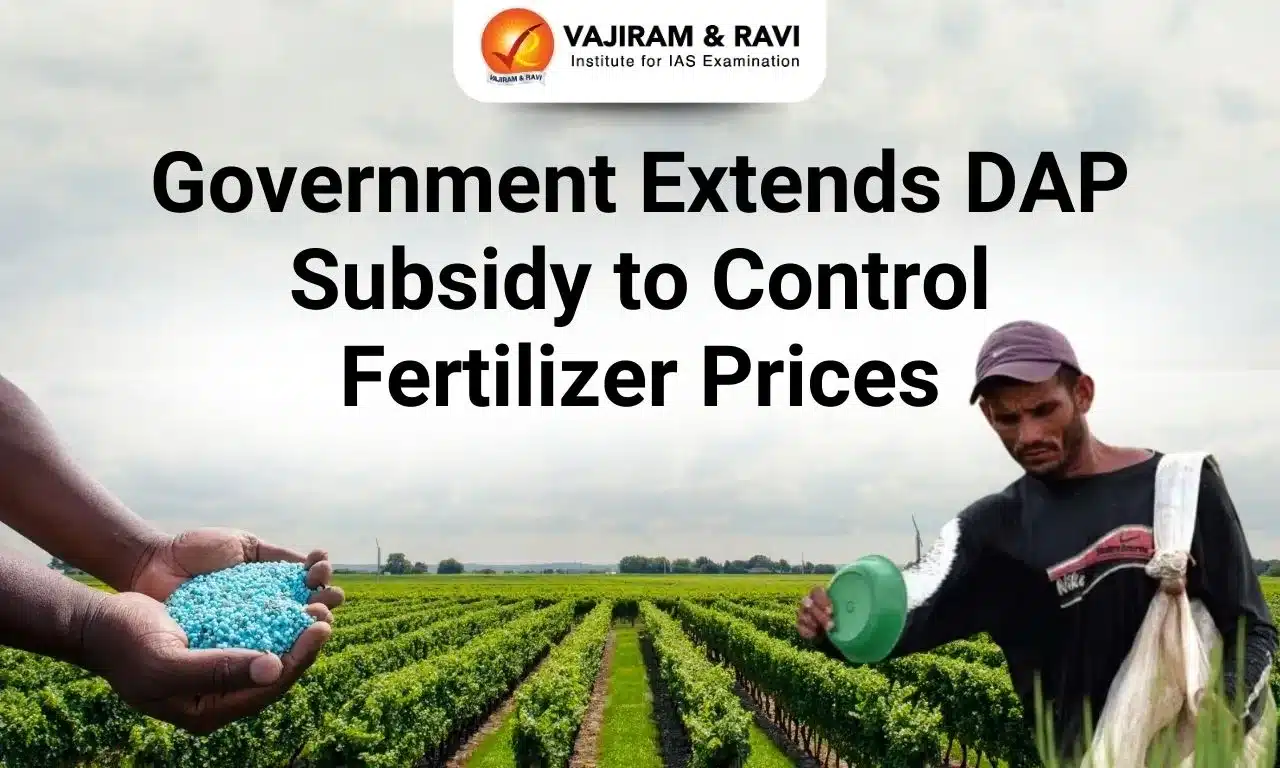
- Cabinet approves extension of One-time Special Package on Di-Ammonium Phosphate (DAP) beyond the NBS subsidy for the period from 01.01.2025 till further orders to ensure sustainable availability of DAP at affordable prices to the farmers.


Key Decision of the Union Cabinet:
- Extension of subsidy: The Centre has extended the Rs 3,500 per tonne special subsidy on di-ammonium phosphate (DAP) for one more year, effective from January 1, 2025, to December 31, 2025.
- Objective: The decision aims to stabilize farmgate prices and shield farmers from price volatility caused by the rupee’s depreciation against the US dollar.
Fertilizer Price Dynamics:
- MRP caps on fertilizers:
- The Modi government has informally frozen the maximum retail price (MRP) of non-urea fertilizers despite their decontrolled status.
- Current MRPs:
- DAP: Rs 1,350 per 50-kg bag
- Complex fertilizers: Rs 1,300 to Rs 1,600 per bag, depending on the composition.
- The government’s subsidy on DAP is Rs 21,911 per tonne, along with the Rs 3,500 special concession.
- Impact of currency depreciation:
- The rupee’s fall against the dollar has raised the cost of imported fertilizers.
- Current import costs:
- Landed price of DAP: Rs 54,160 per tonne, up from Rs 52,960 three months ago.
- Total cost after additional expenses (e.g., customs, handling, and dealer margins): Rs 65,000 per tonne.
Challenges for the Fertilizer Industry:
- Viability concerns:
- Fertilizer companies face unviable import economics unless:
- The government increases subsidies.
- Companies are allowed to revise MRPs upward.
- Even with the extended subsidy, companies estimate a shortfall of Rs 1,500 per tonne due to currency depreciation.
- Fertilizer companies face unviable import economics unless:
- Stock levels:
- Current stocks of DAP (9.2 lakh tonnes) and complex fertilizers (23.7 lakh tonnes) are below last year’s levels.
- Insufficient imports may lead to supply challenges for the next kharif season (June-July 2025).
Government’s Strategy:
- Compensation for imports:
- On September 20, 2024, the government approved compensation for DAP imports above a benchmark landed price of $559.71 per tonne.
- However, these calculations were based on an exchange rate of Rs 83.23 per dollar, which has since fallen below Rs 85.7.
- Fiscal implications:
- The extended subsidy will cost the government an additional Rs 6,475 crore.
- Any MRP hike is expected to have minimal political implications, given that major agriculture states are not going to polls soon and the current DAP consumption season is over.
Future Outlook:
- Immediate priority: Ensuring adequate fertilizer availability for the kharif season by securing imports of both finished fertilizers and raw materials.
- The government’s ability to balance fiscal constraints, industry viability, and farmer affordability will be critical in the coming months.
Q.1. What is nutrient based subsidy (NBS)?
NBS is a government policy that provides subsidies for fertilizers based on their nutrient content. The policy was introduced in 2010 to improve agricultural productivity, ensure food security, and balance fertilizer use.
Q.2. What is Di-Ammonium Phosphate (DAP)?
DAP is a fertilizer that is made from a reaction of phosphoric acid and ammonia and is a primary source of nitrogen and phosphorus for plants. It is the most widely used phosphorus fertilizer in the world.
Source: IE

 Last updated on Sep, 2026
→ UPSC 2027 Notification will be released on 13 January 2027 at upsconline.nic.in.
→ Asian Games 2026 are being held in Aichi-Nagoya, Japan, from 19 September to 4 October.
→ Check out the latest UPSC Syllabus here.
→ Download UPSC Model Answers for Mains 2026
→ UPSC Mains Question Paper 2026 is out now for Essay & GS Paper 1, 2, 3 & 4.
→ UPSC Calendar 2027 has been released.
→ Enroll in Vajiram & Ravi’s UPSC Mains Test Series 2027 for structured answer writing practice, expert evaluation, and exam-oriented feedback.
→ Join Vajiram & Ravi’s UPSC Mentorship Program 2027 for personalized guidance, strategy planning, and one-to-one support from experienced mentors.
→ Go through the UPSC Mains Previous Year Papers to enhance your preparation.
→ UPSC has released UPSC Toppers List 2025 with the Civil Services final result on its official website.
→ Also check Best UPSC Coaching in India