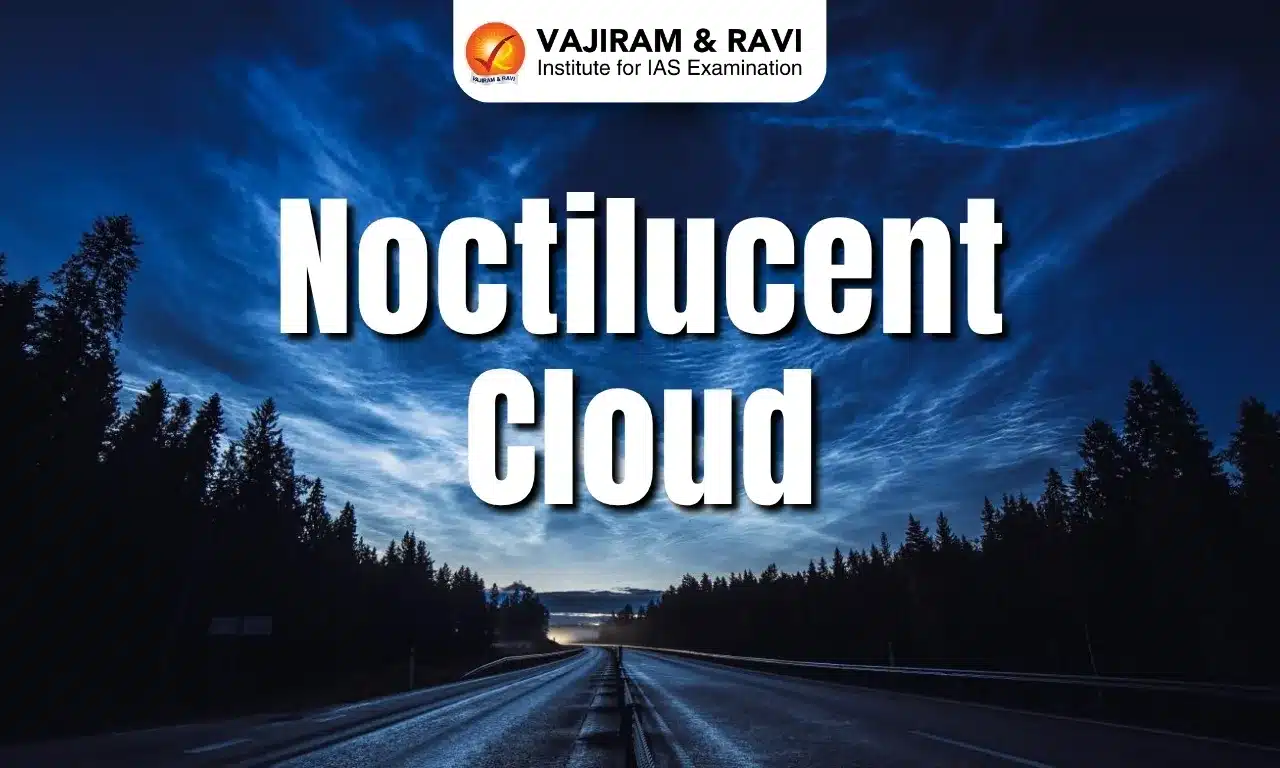
Noctilucent Clouds Latest News
Rare noctilucent clouds that form in summer high up in the Earth’s atmosphere have been recently seen from parts of Scotland.
About Noctilucent Clouds
- They are thin, wispy clouds that glow with a blue or silvery hue at night when illuminated by sunlight from below the horizon.
- Horizon refers to the apparent line that separates the Earth from the sky—specifically, the point below which the Sun appears to set.
- The name ‘noctilucent’ is derived from the Latin words “nocto” and “lucent” which translates to “night” and “shining” respectively.
- They are sometimes referred to as polar mesospheric clouds.
- Most of our planet’s clouds form in the Earth’s troposphere. Noctilucent clouds are located in the third layer of Earth’s atmosphere, the mesosphere, making them Earth’s highest clouds.
- They only appear during the summer months, and only at latitudes between about 45 and 80 degrees north or south of the equator.
- In the Northern Hemisphere, they can appear from the end of May to the beginning of August, with sightings more likely during June and July.
- In the Southern Hemisphere, noctilucent cloud sightings are much rarer, but they can be visible from the end of November to the beginning of February, with sightings most likely during December and January.
- In these months and at the right latitudes, the Sun only just sets below the horizon at nighttime.
- That means these very high clouds can still be lit by bright sunlight from below, even though the rest of the surface is in darkness – making the clouds appear to glow.
- The Sun sets increasingly less below the horizon the further north you go, which means northern latitudes will experience noctilucent clouds for longer during the night.


How are Noctilucent Clouds Formed?
- They are formed of ice crystals; in the summer the mesosphere becomes cold enough to allow ice to form on suspended dust particles floating in the atmosphere.
- The dust particles may originate from micrometeorites falling to Earth from space, or the dust left over from volcanic eruptions.
- Humans have also accidentally seeded our own noctilucent clouds through the exhausts of rockets propelled into space.
The ice crystals that form reflect the sunlight when the Sun hits them from below, causing the clouds’ characteristic shimmer.
Source: BBC

 Last updated on August, 2026
→ UPSC Mains Question Paper 2026 is out now for Essay & GS Paper 1, 2, 3 & 4.
→ UPSC Mains GS Paper 1 2026 is out now.
→ UPSC Mains GS Paper 2 2026 is out now.
→ UPSC Mains GS Paper 3 2026 is out now.
→ UPSC Mains GS Paper 4 2026 is out now.
→ UPSC Mains Indian Language Paper & English Compulsory Paper are out now.
→ Check out the latest UPSC Syllabus 2026 here.
→ UPSC Mains Admit Card 2026 is now out.
→ Enroll in Vajiram & Ravi’s UPSC Mains Test Series 2027 for structured answer writing practice, expert evaluation, and exam-oriented feedback.
→ Join Vajiram & Ravi’s UPSC Mentorship Program 2027 for personalized guidance, strategy planning, and one-to-one support from experienced mentors.
→ Go through the UPSC Mains Previous Year Papers to enhance your preparation.
→ Download UPSC Mains Essay Paper 2025, UPSC Mains GS Paper-I 2025, UPSC Mains GS Paper-II 2025, UPSC Mains GS Paper-III 2025, UPSC Mains GS Paper-IV 2025, UPSC Mains English (Compulsory) Paper 2025, UPSC Mains Hindi (Qualifying) Paper 2025 here.
→ UPSC has released UPSC Toppers List 2025 with the Civil Services final result on its official website.
→ UPSC Calendar 2027 has been released.
→ Also check Best UPSC Coaching in India
Noctilucent Clouds FAQs
Q1. n which layer of the Earth's atmosphere do noctilucent clouds form?+
Q2. What causes noctilucent clouds to glow at night?+
Q3. During which months are noctilucent clouds typically visible in the Northern Hemisphere?+
Q4. What is the range of latitudes where noctilucent clouds are typically observed?+
Tags: noctilucent clouds prelims pointers upsc current affairs upsc prelims current affairs