India’s Herbicide Market Latest News
- Crop protection chemicals, commonly referred to as pesticides, are substances applied to crops to safeguard them from damage caused by pests.
- These pests may harm crops directly by feeding on them or indirectly by spreading diseases.
- For instance, the white-backed plant hopper attacks rice crops both by feeding on them and by transmitting the Fiji virus, which leads to stunted plant growth—a problem currently affecting paddy farmers in Punjab and Haryana.
- While insecticides target such harmful insects, crop protection chemicals also include fungicides for fungal diseases like blast in rice and rust in wheat, and herbicides to control weeds that compete with crops for nutrients.
- This article explores how rising labour shortages and evolving farming practices are driving a rapid shift in India’s pesticide market, especially towards herbicides, amid multinational dominance and Indian innovation.
Herbicides: The Fastest-Growing Segment in India’s Crop Protection Market
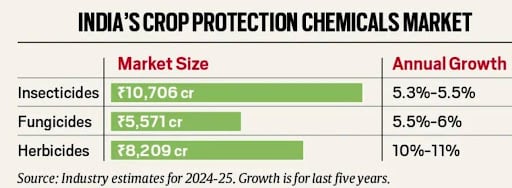
- India’s organised crop protection chemicals market, valued at approximately ₹24,500 crore, is witnessing rapid growth in the herbicide segment.
- While insecticides lead the market at ₹10,700 crore, herbicides follow closely at ₹8,200 crore, growing at an annual rate of over 10%, the fastest among all segments.
- This space is largely dominated by multinational giants, many of which are backed by Chinese state-owned Sinochem Holdings. However, Indian companies are also making inroads.


Labour Shortage Fuels Surge in Herbicide Use
- Weeds indirectly harm crops by competing for essential resources like water, nutrients, and sunlight, and sometimes even hosting pests and pathogens.
- Traditionally, farmers controlled weeds through manual weeding or tools like khurpi, and in recent years, power weeders.
- However, manual weeding is labour-intensive and time-consuming—requiring 8–10 hours per acre—and needs to be repeated throughout the crop cycle.
- Though power weeders reduce this to 2–3 hours, they are not effective for all weed types, especially those with deep roots or growing in dense crop areas.
- Meanwhile, agricultural labour shortages have worsened, and wages have risen significantly—from ₹326.2 in 2019 to ₹447.6 in 2024.
- With fewer rural workers willing to engage in strenuous fieldwork, farmers increasingly rely on herbicides.
- Herbicides now function as labour-saving tools, much like tractors, addressing the twin challenges of time and workforce scarcity in Indian agriculture.
Shift Towards Preventive Herbicide Use in Indian Agriculture
- Traditionally, farmers applied insecticides, fungicides, and herbicides only when pest or weed infestations visibly crossed economic threshold levels—when anticipated crop losses justified the cost of treatment.
- However, the herbicide market is evolving with a growing shift towards preventive strategies.
- Farmers are increasingly using pre-emergent herbicides—sprayed around or just after sowing—to prevent weed growth altogether and maintain clean fields from the outset.
- Others opt for early post-emergent herbicides to target weeds during the crop’s sensitive early stages.
- This proactive approach is gaining momentum, especially amid acute farm labour shortages.
- In the ₹1,500-crore paddy herbicide market, pre-emergent products make up about ₹550 crore, and roughly 20% of the ₹1,000-crore wheat herbicide market.
- These sub-segments are now the main drivers of growth in India’s crop protection space, reflecting a broader shift from reactive to preventive weed management.
Multinational Monopoly and Indian Push in Herbicide Market
- While India has a diverse base of public and private players in seeds and fertilisers, its crop protection chemicals industry remains dominated by multinational corporations, raising concerns of monopoly.
- Despite this, Indian firms are gradually making inroads. Crystal Crop Protection Ltd (CCPL), for example, is developing innovative products through international collaborations.
- In partnership with multinational corporations, CCPL introduced a new paddy herbicide called Sikosa, which combines two active ingredients—Bensulfuron-methyl and Pretilachlor—in a patented oil-dispersion formulation.
- This formulation allows efficient application within 0–3 days after transplanting, offering broad-spectrum weed control at a cost-effective price of ₹850–₹900 per acre—far cheaper than manual weeding.
- While such developments show promise, India still lacks a dominant global player like China’s Sinochem Holdings Corporation, reflecting the long road ahead for Indian companies in breaking the multinational stronghold.
Source: IE

 Last updated on Oct, 2026
→ UPSC 2027 Notification will be released on 13 January 2027 at upsconline.nic.in.
→ Asian Games 2026 are being held in Aichi-Nagoya, Japan, from 19 September to 4 October.
→ Check Nobel Prize 2026 Winners List here.
→ Download PIB PRiSM Monthly Magazine 2026 here.
→ Check UPSC Monthly Current Affairs Magazine The Recitals here.
→ Check out the latest UPSC Syllabus here.
→ Download UPSC Model Answers for Mains 2026
→ UPSC Mains Question Paper 2026 is out now for Essay & GS Paper 1, 2, 3 & 4.
→ UPSC Calendar 2027 has been released.
→ Enroll in Vajiram & Ravi’s UPSC Mains Test Series 2027 for structured answer writing practice, expert evaluation, and exam-oriented feedback.
→ Join Vajiram & Ravi’s UPSC Mentorship Program 2027 for personalized guidance, strategy planning, and one-to-one support from experienced mentors.
→ Go through the UPSC Mains Previous Year Papers to enhance your preparation.
→ UPSC has released UPSC Toppers List 2025 with the Civil Services final result on its official website.
→ Also check Best UPSC Coaching in India
India’s Herbicide Market FAQs
Q1. What is driving herbicide use in India?+
Q2. Which segment of pesticides is growing fastest?+
Q3. Why are pre-emergent herbicides gaining popularity?+
Q4. Who dominates India’s herbicide market?+
Q5. How are Indian firms innovating in this space?+
Tags: India’s herbicide market mains articles upsc current affairs upsc mains current affairs