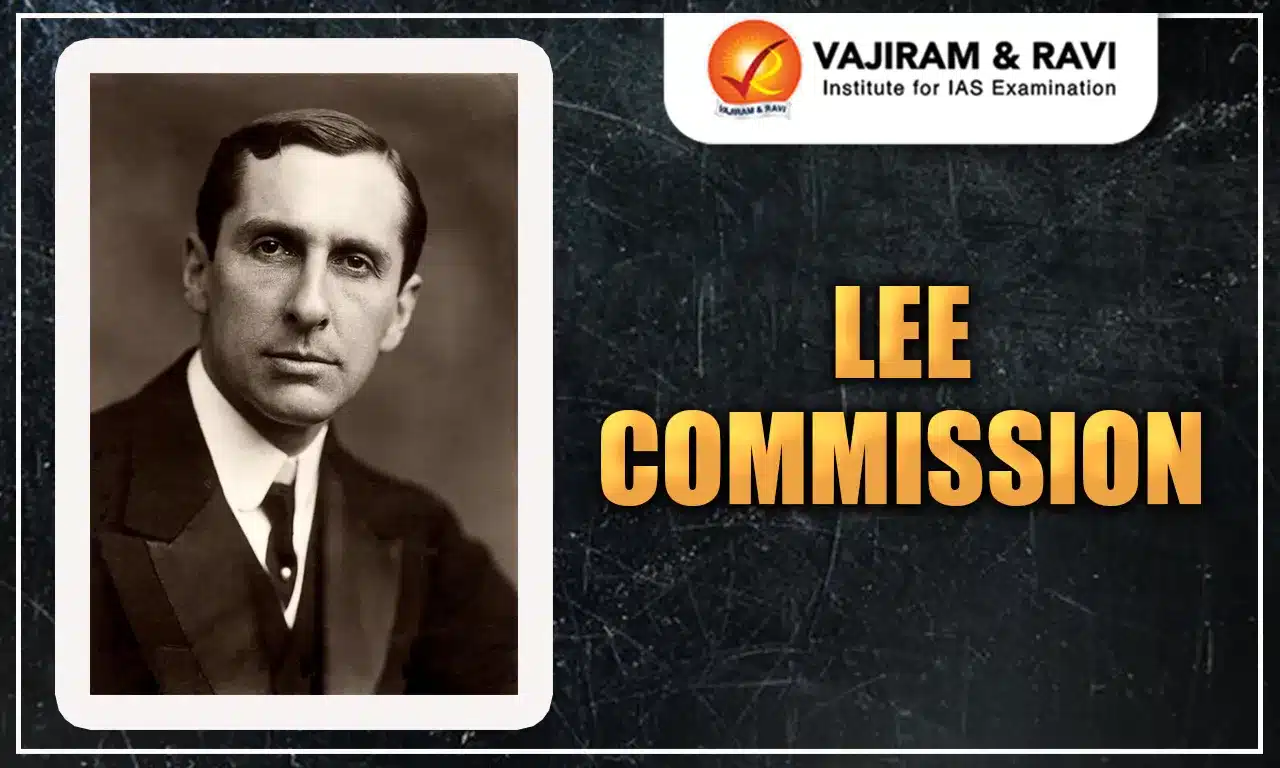
The Lee Commission was established in 1923 by Lord Lee with an equal proportion of Indians and British members with the agenda of evaluating the racial composition of superior civil services in India. The Commission submitted its report in 1924. It examined the earlier recommendations of the Islington Commission and evaluated the structure of the All-India Services and Central Services in 1912. It didn’t focus on Provincial Services, since those were already under the control of provincial governments.
Lee Commission History
- During 1923, against the growing political tension for independence and slow pace in civil services, the British government appointed a Royal Commission on the Superior Civil Services in India which was led by Lord Lee which was known as the Lee Commission.
- The Lee Commission was composed of equal proportions of the Indian and the British Members with the main task of examining the racial composition and recruitment structure of the civil services in India.
- There were two main groups including All India Services and the Central Services. Provincial Services were left as they were managed by allocated provincial governments.
- The Lee Commission also considered the Islington Commission Report 1912, which made a suggestion that 25% of superior civil service posts should be provided to the Indians, some of which were directly recruited, some were recruited through promotion and the exams must be held in India.
- Though the Montagu-Chelmsford Reforms, 1919 which influenced greater Indian participation in the Indian Governance had moved further. They also proposed that 1/3rd of the higher service recruitments will go to the Indian, effectively considering the recommendations.
- In response to these context, the Lee Commission recommended a new structure which includes:
- 20% of superior posts should be filled by promotion from Provincial Services
- The remaining 80% should be split between British and Indian officers recruited directly (though the actual ratio within this 80% leaned heavily toward British candidates)
- Despite the growing demand of Indianisation, the pace of the changes which were expected remained very slow, especially in elite services like Indian Civil Service (ICS).
- The Indian Statutory Commission (Simon Commission) in 1930 became the next major step in taking up the issues of the civil service reforms, following up with the dissatisfaction from the Lee Commission’s recommendations.
Lee Commission Features
- The Lee Commission was established by the British Government in 1923 to examine the composition of Higher Civil Services of India especially to maintain the balance between the Indians and British Officers.
- The Commission was headed by Lord Lee from Fareham; he ensured the equal representation of both British and Indian members.
- In the Lee Commission Report in 1924, they recommended the future recruitment to higher civil services where the ratio should be 40% British, 40% directly recruited Indians, and 20% promoted from provincial services.
- Since the commission only focused on the recruitment of the top-tier recruitment for higher services, they also referred to the Royal Commission on the Superior Civil Services in India.
- One of the most significant recommendations was the establishment of a Public Service Commission which is considered as essential to ensure the fair and efficient administration.
- The commission also described this idea as a “cardinal feature” of its report and important to the future structure of the services.
- By the time of Independence of India in 1947, over half of the roughly 1000 members of the civil services were Indian, from which various held the senior and the vital position to the future of the services.


Lee Commission Recommendations
- The Lee Commission classified the services into three major categories which included All India Services: Common to both central and provincial governments (e.g., ICS, Indian Police). Central Services: Under the control of the central government (e.g., Railways, Posts, Foreign Affairs). Provincial Services: Controlled by respective provincial governments (e.g., Education, Health).
- The Lee Commission has introduced the Recruitment Authority that was the Secretary of State that manages the recruitment for key All India Services including Indian Civil Service (ICS), Indian Police Service, Indian Forest Service, Indian Medical Service, Indian Service of Engineers.
- Provincial governments should take charge of recruitment for services operating in transferred fields like Education, Civil Medical Service, Agriculture, Veterinary Services.
- The Lee Commission suggested that within 15 years, direct recruitment to the ICS was to achieve a 50:50 ratio between British and Indian officers.
- Recommended immediate establishment of a Public Service Commission, as discussed in the Government of India Act, 1919. This body would advise on recruitment and service matters and help make the system more impartial.
- Officers already in All India Services would retain their rights and status. Provincial governments were to get recruitment powers only for new vacancies in services under their control.
- Central services were to handle core national functions including Relations with Indian States, Foreign Affairs, State Railways, Posts & Telegraphs, Customs and Revenue, Audit and Accounts, Scientific and Technical Services.

 Last updated on Sep, 2026
→ UPSC 2027 Notification will be released on 13 January 2027 at upsconline.nic.in.
→ Asian Games 2026 are being held in Aichi-Nagoya, Japan, from 19 September to 4 October.
→ Check out the latest UPSC Syllabus here.
→ Download UPSC Model Answers for Mains 2026
→ UPSC Mains Question Paper 2026 is out now for Essay & GS Paper 1, 2, 3 & 4.
→ UPSC Calendar 2027 has been released.
→ Enroll in Vajiram & Ravi’s UPSC Mains Test Series 2027 for structured answer writing practice, expert evaluation, and exam-oriented feedback.
→ Join Vajiram & Ravi’s UPSC Mentorship Program 2027 for personalized guidance, strategy planning, and one-to-one support from experienced mentors.
→ Go through the UPSC Mains Previous Year Papers to enhance your preparation.
→ UPSC has released UPSC Toppers List 2025 with the Civil Services final result on its official website.
→ Also check Best UPSC Coaching in India
Lee Commission FAQs
Q1. What was the Lee Commission?+
Q2. Who headed the Lee Commission?+
Q3. Why was the Lee Commission established?+
Q4. When was the Lee Commission appointed?+
Q5. What was the main recommendation of the Lee Commission?+
Tags: lee commission