Ethanol Blending Latest News
- India has achieved 20% Ethanol blending in petrol five years ahead of schedule, raising debates on its economic, environmental, and EV transition impacts.
Introduction
- India has achieved its ambitious target of blending 20% ethanol with petrol (E20) five years ahead of schedule, marking a major milestone in its clean energy transition.
- Ethanol blending, part of the National Policy on Biofuels, has grown from just 1.5% in 2014 to 20% in 2025, driven by strong government incentives.
- While hailed as a step toward energy security, reduced oil imports, and farmer welfare, it has also sparked debates over its impact on vehicle performance, groundwater sustainability, and India’s long-term transition to electric mobility.


Ethanol Blending and Vehicle Owners
- From April 2023, vehicles in India have carried E20 compatibility stickers. However, acceptance among consumers has been limited.
- A LocalCircles survey covering 36,000 respondents found that two in three petrol vehicle owners opposed the E20 mandate, citing reduced mileage and higher maintenance costs.
- Automakers such as Hero MotoCorp have acknowledged the need for new materials (rubbers, elastomers, plastics) to make engines E20-compatible.
- The Union government admits to a “marginal drop” in fuel efficiency but argues that improved engine tuning will offset losses.
- Despite these assurances, NITI Aayog has recommended tax incentives on E10 and E20 fuels to compensate consumers for efficiency loss.
Economic and Fiscal Impacts
- One of the key justifications for ethanol blending has been its role in reducing India’s oil import bill:
- Since 2014-15, ethanol substitution has saved Rs. 1.40 lakh crore in foreign exchange.
- However, benefits to consumers have been limited. While oil PSUs (IOC, BPCL) saw a 255% rise in dividend payouts since 2022-23 due to falling crude prices, petrol prices fell only by 2%, raising questions on whether gains are being equitably shared.
Impact on Agriculture and Environment
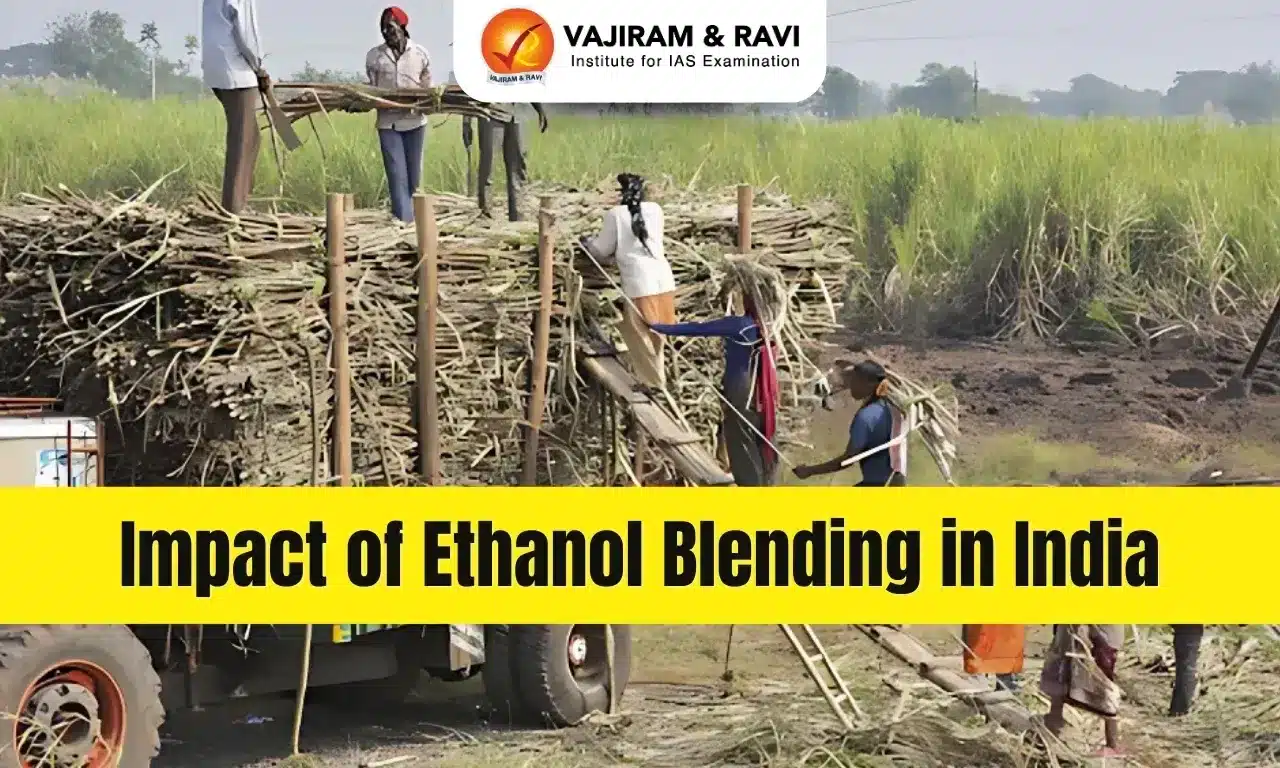
- Ethanol blending has opened a steady revenue stream for farmers, especially sugarcane growers:
- Ethanol production grew from 40 crore litres in FY14 to nearly 670 crore litres in FY24, with about 9% of sugar output diverted to fuel.
- The Centre says it has paid Rs. 1.20 lakh crore to farmers since FY15.
- However, concerns persist about the environmental cost:
- Sugarcane cultivation requires 60-70 tonnes of water per tonne of crop, leading to excessive groundwater extraction, especially in drought-prone Maharashtra.
- Nearly 30% of India’s land is already degraded, and water-intensive cropping patterns worsen desertification risks.
- The government is now diversifying ethanol sources:
- Food Corporation of India allocated 5.2 million tonnes of rice for ethanol in 2024-25.
- 34% of corn output was diverted, forcing a surge in corn imports (9.7 lakh tonnes in 2024-25).
- Despite diversification, sugarcane acreage remains stable at ~57 lakh hectares, driven by assured Fair and Remunerative Pricing (FRP).
Global Trade and U.S. Concerns
- India’s booming ethanol sector has attracted international scrutiny.
- The U.S. has pushed India to relax ethanol import restrictions, calling current policies a “trade barrier.”
- The Indian Sugar Mills Association warns that import liberalisation could undermine domestic capacity building and hurt farmers.
Ethanol Blending and the EV Transition
- While ethanol blending has reduced carbon dioxide emissions by 700 lakh tonnes, experts argue that a faster shift to electric vehicles (EVs) would deliver greater climate gains.
- India lags global peers, with EVs making up only 7.6% of vehicle sales in 2024. To meet its 2030 target of 30% EV sales, growth must accelerate by over 22% in the next five years.
- EV adoption is constrained by rare earth element (REE) shortages, as India relies heavily on Chinese supplies for components like magnets and batteries.
- Carmakers such as Maruti Suzuki have cut production targets for EVs due to supply chain disruptions.
- The government is engaged in diplomatic talks with Beijing to ensure REE supply stability, highlighting the intersection between energy security and geopolitics.
Future Outlook
- While the Petroleum Ministry has indicated plans to pursue blending beyond 20%, the Union government clarified in March 2025 that no formal decision has been taken. Policymakers face a delicate balance between:
- Supporting farmers and energy independence through ethanol.
- Addressing the environmental costs of water-intensive sugarcane.
- Accelerating the shift to EVs for deeper decarbonisation.
- India’s ethanol success is undeniable, but the challenge lies in ensuring that its gains are not offset by ecological and consumer costs.
Source : TH

 Last updated on Sep, 2026
→ UPSC 2027 Notification will be released on 13 January 2027 at upsconline.nic.in.
→ Asian Games 2026 are being held in Aichi-Nagoya, Japan, from 19 September to 4 October.
→ Check out the latest UPSC Syllabus here.
→ Download UPSC Model Answers for Mains 2026
→ UPSC Mains Question Paper 2026 is out now for Essay & GS Paper 1, 2, 3 & 4.
→ UPSC Calendar 2027 has been released.
→ Enroll in Vajiram & Ravi’s UPSC Mains Test Series 2027 for structured answer writing practice, expert evaluation, and exam-oriented feedback.
→ Join Vajiram & Ravi’s UPSC Mentorship Program 2027 for personalized guidance, strategy planning, and one-to-one support from experienced mentors.
→ Go through the UPSC Mains Previous Year Papers to enhance your preparation.
→ UPSC has released UPSC Toppers List 2025 with the Civil Services final result on its official website.
→ Also check Best UPSC Coaching in India
Ethanol Blending FAQs
Q1. What is India’s current ethanol blending level in petrol?+
Q2. How has ethanol blending benefited the Indian economy?+
Q3. What environmental concerns are linked to ethanol blending?+
Q4. How are Indian consumers reacting to E20 petrol?+
Q5. Will ethanol blending affect India’s EV transition?+
Tags: ethanol blending mains articles upsc current affairs upsc mains current affairs