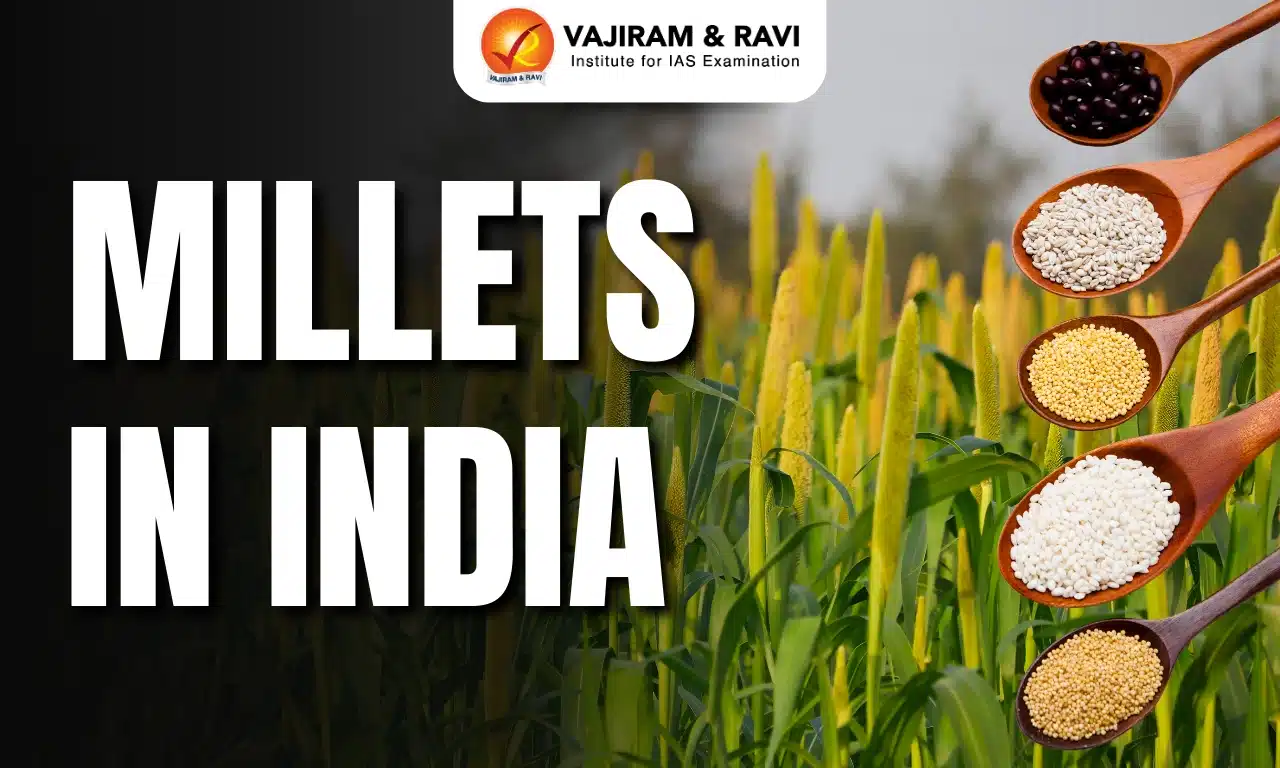
Millets in India are small-grained, hardy cereals that grow well in warm climates and are especially suited to regions with poor soil fertility and low rainfall. Known for their resilience, these crops require minimal external inputs, making them essential for dry-land farming systems in India. Beyond their adaptability, millets are highly valued for their nutritional richness, offering a sustainable alternative to staple grains like rice and wheat.
This article discusses the major Types of Millets cultivated in India, such as Jowar (Sorghum), Bajra (Pearl Millet), Ragi (Finger Millet) and Barley. It examines their growth requirements, patterns of production and distribution across the country, highlighting their significance in food security and agricultural sustainability.
Millets in India
Millets are short-duration cereals, typically maturing within 3-4 months and belong to the grass family. These small-grained crops thrive in warm climates and are highly resilient, making them suitable for cultivation in less fertile soils and drought-prone regions. With minimal or no requirement for purchased inputs, Millets form the backbone of dry-land agriculture.
Nutritionally, millets are rich in fibre, protein and essential minerals, while being non-acid-forming and easy to digest. Their nutraceutical properties contribute to better health outcomes, particularly in preventing lifestyle-related diseases. Owing to their affordability and resilience, millets play a crucial role in ensuring food and nutritional security, especially for economically weaker sections of society.
Major Types of Millets in India
Millets in India are known for their short growing season, resilience to drought and high nutritional value; they are often called “nutri-cereals” (Shree Anna). Millets not only provide food security to millions in arid and semi-arid regions but also offer health benefits like better digestion, improved bone strength and diabetes management. Below is a table outlining the major Types of Millets in India, their nutritional highlights and regions of production.
| Major Types of Millets in India | ||
|
Millet |
Nutritional Highlights |
Major Producing States in India |
|
Pearl Millet (Bajra) |
Rich in iron, fibre, protein; highly energy-giving |
Rajasthan, Maharashtra, Gujarat, Haryana, Uttar Pradesh |
|
Finger Millet (Ragi) |
High calcium, amino acids; supports bone health, diabetes management |
Karnataka, Tamil Nadu, Uttarakhand, Andhra Pradesh, Maharashtra |
|
Sorghum (Jowar) |
Gluten-free, rich in antioxidants, protein, fibre |
Maharashtra, Karnataka, Telangana, Madhya Pradesh |
|
Foxtail Millet (Kangni/Rala) |
High fibre, iron, magnesium; aids in digestion, controls blood sugar |
Andhra Pradesh, Karnataka, Tamil Nadu, Telangana |
|
Little Millet (Kutki) |
Easily digestible, rich in B-vitamins and iron |
Madhya Pradesh, Chhattisgarh, Tamil Nadu, Odisha |
|
Barnyard Millet (Sanwa) |
Rich in fibre, calcium, phosphorus; light on stomach, fasting food |
Uttarakhand, Madhya Pradesh, Uttar Pradesh, Tamil Nadu |
|
Kodo Millet (Kodo) |
High protein, fibre, minerals; useful for weight and diabetes management |
Madhya Pradesh, Chhattisgarh, Tamil Nadu, Karnataka |
|
Proso Millet (Cheena) |
Quick-growing, rich in protein, essential fatty acids |
Madhya Pradesh, Uttar Pradesh, Bihar, Andhra Pradesh |


Jowar (Sorghum)
Jowar is a highly nutritious millet, rich in protein, fibre, thiamine, riboflavin, folic acid and carotene. Unlike other cereals, the proteins in sorghum are less digestible after cooking, which in some cases can be beneficial for people requiring slower digestion, such as diabetics. Because of its nutrient profile, Jowar is considered an important food grain for maintaining energy and overall health.
Conditions for Growth
- Jowar is primarily a rainfed crop suited to dry farming regions. It is cultivated both as a Kharif crop (during the monsoon) and as a Rabi crop (during the winter).
- The crop does not thrive in areas receiving more than 100 cm of rainfall. Ideal soils for Jowar cultivation are clayey deep regur (black cotton soils) and alluvial soils.
- It can also be grown on gentle slopes up to an altitude of about 1,200 meters, making it a versatile crop in semi-arid regions.
Production and Distribution
India is one of the leading producers of Jowar. Maharashtra contributes about 38% of the country’s total production, followed by Karnataka with 20%. Other important states cultivating Jowar include Tamil Nadu, Rajasthan, Andhra Pradesh and Uttar Pradesh.
Bajra (Bull Rush Millet)
Bajra is the second most important Millet in India and has been cultivated since prehistoric times in Africa and the Indian subcontinent. It is valued for its ability to grow under harsh conditions and is a staple in semi-arid regions. Bajra is rich in iron, fibre, protein and essential amino acids, making it a vital food grain for combating malnutrition. Apart from human consumption, it also serves as an important fodder crop in drought-prone areas.
Conditions for Growth
- Bajra is primarily a rainfed Kharif crop, suited to dry and warm climates.
- It grows well in regions with an annual rainfall of 40-50 cm, with an upper tolerance limit of around 100 cm.
- The crop thrives in poor, light sandy soils as well as in black and red soils. Bajra is often sown either as a pure crop or as a mixed crop along with cotton, jowar and ragi.
- Its resilience to drought, low soil fertility, high temperatures and even saline or low pH soils makes it highly adaptable.
Production and Distribution
India is one of the world’s leading producers of Bajra. The major producing states are:
- Rajasthan (largest producer, contributing about 45.22% of India’s total output)
- Uttar Pradesh (2nd)
- Haryana (3rd)
- Gujarat (4th)
These states dominate Bajra cultivation due to their arid to semi-arid conditions, where other cereals struggle to grow.
Ragi (Finger Millet)
Ragi, or finger millet, is one of the most nutrient-rich cereals cultivated in India. It is especially known as the richest natural source of calcium (300-350 mg per 100 grams), making it highly beneficial for bone health and preventing malnutrition. Apart from calcium, it also contains iron, dietary fibre and essential amino acids. Its slow-digesting starch helps in controlling diabetes and it is widely used in preparing traditional food items such as ragi mudde, dosa, porridge and malted drinks.
Conditions for Growth
- Ragi is a rainfed Kharif crop, sown between May and August and harvested between September and January.
- It thrives in warm climates and requires 50-100 cm of rainfall, making it highly suited to semi-arid and drier regions.
- The crop can be cultivated in a range of soils, including red soils, light black soils, sandy soils and well-drained alluvial loams.
- It is particularly well adapted to areas where conditions are neither too wet nor too dry and it avoids waterlogging.
Production and Distribution
Ragi is widely cultivated across Southern and Central India. The major producing states include:
- Karnataka (largest producer, particularly in its drier regions)
- Maharashtra
- Uttarakhand
- Tamil Nadu
- Andhra Pradesh
- Jharkhand
- Odisha
- Chhattisgarh
- Gujarat
Barley
Barley is one of the world’s oldest cultivated grains, domesticated nearly 10,000 years ago and grown extensively across Eurasia. In India, it holds importance as both a food and industrial crop.
Barley is used as animal fodder, in the preparation of health foods and as a raw material in breweries for making beer and whisky. Its high fibre content also makes it beneficial for digestion and overall health and barley-based products are increasingly included in dietary supplements and wellness foods.
Conditions for Growth
- Barley is largely a rabi crop in India, cultivated in the cooler seasons. It grows best in temperate climates, as it does not tolerate high heat or humidity.
- The crop requires 75-100 cm of rainfall and thrives in the Great Plains and valleys of the western Himalayas, where winters are suitable for its growth.
- Barley can also be cultivated at altitudes of up to 1,300 meters, particularly in states such as Uttarakhand.
Production and Distribution
Barley production in India has seen a gradual decline over time, much like other traditional cereals. However, it remains an important crop in several states. The leading barley-producing regions are:
- Uttar Pradesh
- Rajasthan
- Punjab
- Madhya Pradesh
- Haryana
- Bihar
- Himachal Pradesh
- West Bengal
- Jammu and Kashmir
Millets in India Map
Millets are cultivated across diverse regions of India, with each type concentrated in specific states depending on climate and soil conditions. Maharashtra and Karnataka dominate in jowar production, Rajasthan leads in bajra, while Karnataka and Tamil Nadu are major ragi growers. A Millets in India Map highlights these regional patterns, showcasing how different states contribute to the overall millet production.
Millets in India Production
- Millet Production in India: India produced around 18.59 million tonnes of millets in 2024-25, maintaining its position as the world’s largest millet producer. Rajasthan, Maharashtra and Karnataka were the leading producing states.
- Major Millet-Producing States: In 2024-25, Rajasthan (29.86%), Maharashtra (13.62%), Karnataka (12.91%), Uttar Pradesh (12.67%) and Gujarat (7.25%) were among the major millet-producing states. Other important producers included Haryana, Madhya Pradesh, Tamil Nadu Andhra Pradesh and Telangana.
- Crop-wise Production: Bajra accounted for the largest share of millet production, followed by jowar, ragi and small millets.
- India’s Millet Exports: In 2024-25, India exported 89,164.96 tonnes of millets, valued at around US$37 million.
- Export Growth: During 2025-26, millet exports increased to 138.69 thousand MT, valued at ₹543.40 crore (US$61.57 million).
- Major Export Destinations: India’s major millet export markets in 2025-26 included the UAE (22.4%), Saudi Arabia (12.7%), Nepal (7.8%), USA (6.7%) and Morocco (3.8%).
- State-Level Promotion: States such as Andhra Pradesh, Chhattisgarh, Haryana, Odisha and Nagaland have promoted millet cultivation, processing and consumption through various initiatives, including FPOs, price support, processing units and nutrition programmes.
- Millet Value Chain: The mainstreaming approach covers the entire value chain, including production, storage and transport, processing, packaging and branding, distribution and consumption.
- Processing and Distribution: Support is being provided for better storage, post-harvest handling, processing facilities, branding and market linkages to reduce losses and help farmers and FPOs receive better returns.
- Promoting Consumption: Awareness campaigns, millet-based products, Millet Experience Centres, cafés and government canteens are being used to increase the everyday consumption of millets.
- Export and Market Linkages: FPOs and farmer groups are being encouraged to connect with buyers and explore domestic as well as international markets, strengthening the overall millet value chain.
Millets in India Major Government Schemes
- National Food Security Mission (NFSM) – Nutri-Cereals: Supports millet cultivation through improved seeds, demonstrations, modern farming practices, training and plant protection measures.
- Pradhan Mantri Kisan SAMPADA Yojana (PMKSY): Provides financial support for food-processing infrastructure, including millet processing, storage and preservation, helping reduce post-harvest losses and promote value addition.
- Production Linked Incentive Scheme for Millet-Based Products (PLISMBP): With an ₹800 crore outlay, it promotes the production, value addition and sale of millet-based products in domestic and export markets.
- PM Formalisation of Micro Food Processing Enterprises (PMFME): Supports micro food-processing units involved in millet products through financial, technical and branding assistance. Millet products are identified as One District One Product (ODOP) in 21 districts.
- Pradhan Mantri Rashtriya Krishi Vikas Yojana (PM-RKVY): Encourages crop diversification, including the promotion of millets as an alternative to conventional crops.
- APEDA Millet Export Promotion Initiatives: Supports the export and global promotion of Indian millets, including market development and opportunities for agri-food entrepreneurs.
Millets in India Benefits
- Nutrient-Dense – Millets are packed with essential vitamins, minerals, protein and dietary fibre, making them an excellent choice for balanced nutrition and overall health.
- Drought-Resilient – These crops thrive in arid and semi-arid regions, requiring far less water than rice or wheat, which makes them vital for sustainable farming and climate-resilient agriculture.
- Low Glycemic Index – Millets release sugar slowly into the bloodstream, helping regulate blood sugar levels. This makes them particularly beneficial for people with diabetes or those managing weight.
- Culinary Versatility – From traditional porridges and rotis to modern snacks and health foods, millets can be adapted into a wide range of dishes, enriching diets with both taste and nutrition.
- High Dietary Fibre: Their relatively high fibre content can support digestive health and contribute to better dietary quality.
- Rich in Micronutrients: Millets provide important minerals such as iron, calcium and zinc, along with B-group vitamins, helping address micronutrient deficiencies.
- Gluten-Free: Most millets are naturally gluten-free, making them suitable for people who need to avoid gluten, including those with coeliac disease.
- Supports Crop Diversification: Their ability to grow on marginal land and under harsh climatic conditions makes millets useful for diversifying farming systems and strengthening food security.
| Also Check Other Posts | |
| Soils of India | Forests in India |
| Dams in India | Major Ports in India |
| Coastal States of India | Natural Vegetation of India |

 Last updated on Sep, 2026
→ UPSC 2027 Notification will be released on 13 January 2027 at upsconline.nic.in.
→ Check out the latest UPSC Syllabus here.
→ Download UPSC Model Answers for Mains 2026
→ UPSC Mains Question Paper 2026 is out now for Essay & GS Paper 1, 2, 3 & 4.
→ UPSC Calendar 2027 has been released.
→ Enroll in Vajiram & Ravi’s UPSC Mains Test Series 2027 for structured answer writing practice, expert evaluation, and exam-oriented feedback.
→ Join Vajiram & Ravi’s UPSC Mentorship Program 2027 for personalized guidance, strategy planning, and one-to-one support from experienced mentors.
→ Go through the UPSC Mains Previous Year Papers to enhance your preparation.
→ UPSC has released UPSC Toppers List 2025 with the Civil Services final result on its official website.
→ Also check Best UPSC Coaching in India
Millets in India FAQs
Q1. Which millet is grown most in India?+
Q2. Which is the king of millets?+
Q3. Which is the best millet to eat in India?+
Q4. What are the 7 types of millets?+
Q5. Which crop is Queen of Millets?+
Tags: millets in india