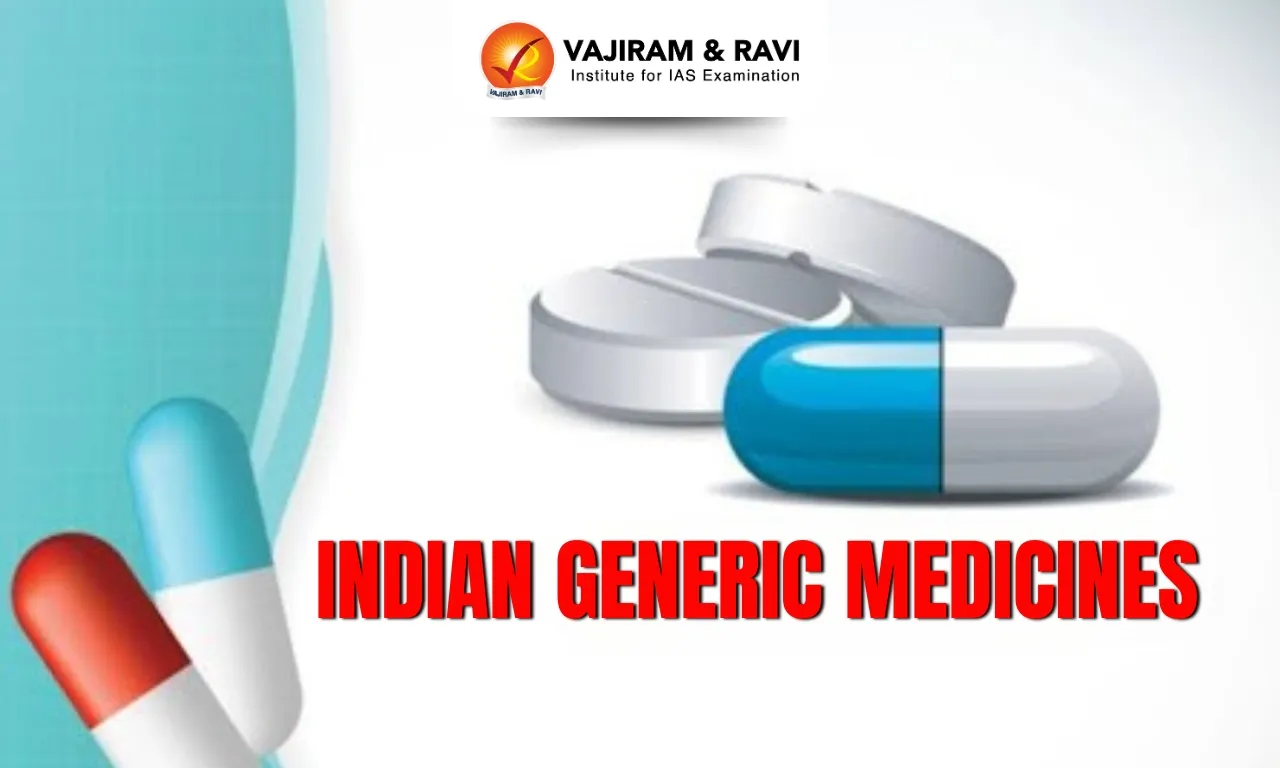
Indian Generic Medicines Latest News
- The Indian pharmaceutical sector, heavily reliant on the U.S. — which accounts for over 31% of its exports and sources nearly half of its generics from India — faces serious concerns over potential U.S. sector-specific duties.
- With the global generic market projected to reach $614 billion by 2030, ongoing trade negotiations with Washington are crucial for the industry’s future.
- Policymakers worry that U.S. tariff threats could undermine India’s role as a key global supplier of affordable medicines, raising broader questions of public interest and long-term viability.
India’s Contribution to Affordable Healthcare
- India supplies about 20% of all generic drugs and is known as the “pharmacy of the world.”
- It produces affordable versions of brand name medicines, which are widely prescribed around the world.
- Indian generics already dominate U.S. prescriptions, accounting for over 90% in areas like diabetes, anxiety, depression, and cancer.
- They saved the U.S. healthcare system $219 billion in 2022 alone, and nearly $1.3 trillion between 2013 and 2022 — underscoring India’s indispensable role in global healthcare affordability.


U.S. Tariff Threats and Indian Pharma’s Stakes
- The U.S., India’s largest pharmaceutical export market, sources nearly half of its generics from India, making tariff threats a major concern for policymakers.
- With the global generic market projected to reach $614 billion by 2030, the outcome of U.S.–India trade talks is critical for the industry’s future and global access to affordable medicines.
- Commentators suggest India should use its pharmaceutical strength in bilateral trade negotiations, positioning Indian generics as a global public good.
- To do so, India must recalibrate its trade and investment strategy while mobilising public opinion in the U.S. and beyond.
Key U.S. Concerns in Negotiations
- The Trump administration’s main concerns are high drug prices in the U.S. and India’s intellectual property (IP) regime.
- It is pushing international reference pricing (IRP) to cut drug prices, while also seeking stronger IPR protections that extend monopolies for Big Pharma.
- This would raise drug costs and delay generic entry into global markets.
- The U.S. also demands extended patent exclusivity and stricter data protection beyond TRIPS requirements, using FTAs as leverage.
- So far, India has resisted such norms and must continue safeguarding TRIPS flexibilities, including compulsory licensing provisions.
- To safeguard exports, India is prepared to make concessions, including supplying generics at 20–25% of branded prices for three years after patent expiry, followed by further 10–15% reductions over seven years.
Need for a Strategic Shift in Trade Negotiations
- India must move beyond a transactional approach in its Bilateral Trade Agreement (BTA) talks with the U.S.
- The Indian Pharmaceutical Alliance (IPA) had proposed reducing import tariffs on U.S. pharma products to zero, but this fell flat as U.S. concerns lie elsewhere.
- Despite earlier exemptions, President Trump imposed levies of 26% plus penalties of 25% on Indian pharma imports, signalling that financial incentives alone cannot resolve issues.
India’s Negotiating Capital
- India has long upheld its patent laws against foreign pressure and now holds negotiating capital to make a strategic move.
- By highlighting the global public good created by Indian generics, India can strengthen its bargaining power.
- Offering joint ventures in the pharma sector not just to the Global South but also to the U.S. and EU could recalibrate the trade dynamic in India’s favour.
Diversification of Markets
- India must diversify pharma trade and investment beyond the U.S., tapping into growing markets in West Asia, Central Asia, Africa, South America, China, Russia, and ASEAN.
- Overseas investments with social impact can build stronger global alliances and reduce dependence on U.S. markets.
Focus on Technology Transfer and R&D
- India should link price reductions on generics supplied to the U.S. with demands for technology transfer, voluntary licensing, and collaborative R&D.
- The India–U.S. TRUST (Transforming the Relationship Utilizing Strategic Technology) initiative should be directed toward biotechnology, pharma manufacturing, and innovation partnerships.
Conclusion: Championing Public Health as a Global Good
- India must resist unreasonable U.S. demands while promoting generics as a global public good.
- By pursuing joint ventures worldwide, especially with the Global South, India can expand its role as a key supplier of affordable essential medicines.
- This strategic move would protect public health, secure domestic industry interests, and position Indian pharma as a global leader.

 Last updated on Oct, 2026
→ UPSC 2027 Notification will be released on 13 January 2027 at upsconline.nic.in.
→ Asian Games 2026 are being held in Aichi-Nagoya, Japan, from 19 September to 4 October.
→ Check Nobel Prize 2026 Winners List here.
→ Download PIB PRiSM Monthly Magazine 2026 here.
→ Check UPSC Monthly Current Affairs Magazine The Recitals here.
→ Check out the latest UPSC Syllabus here.
→ Download UPSC Model Answers for Mains 2026
→ UPSC Mains Question Paper 2026 is out now for Essay & GS Paper 1, 2, 3 & 4.
→ UPSC Calendar 2027 has been released.
→ Enroll in Vajiram & Ravi’s UPSC Mains Test Series 2027 for structured answer writing practice, expert evaluation, and exam-oriented feedback.
→ Join Vajiram & Ravi’s UPSC Mentorship Program 2027 for personalized guidance, strategy planning, and one-to-one support from experienced mentors.
→ Go through the UPSC Mains Previous Year Papers to enhance your preparation.
→ UPSC has released UPSC Toppers List 2025 with the Civil Services final result on its official website.
→ Also check Best UPSC Coaching in India
Indian Generic Medicines FAQs
Q1. Why are Indian generics important globally?+
Q2. What threat does the U.S. pose to Indian pharma?+
Q3. How is India preparing to safeguard its pharma exports?+
Q4. What strategic shift is needed in India–U.S. trade talks?+
Q5. How can India strengthen its pharma sector globally?+
Tags: Indian generic medicines mains articles upsc current affairs upsc mains current affairs