Indus Waters Treaty Latest News
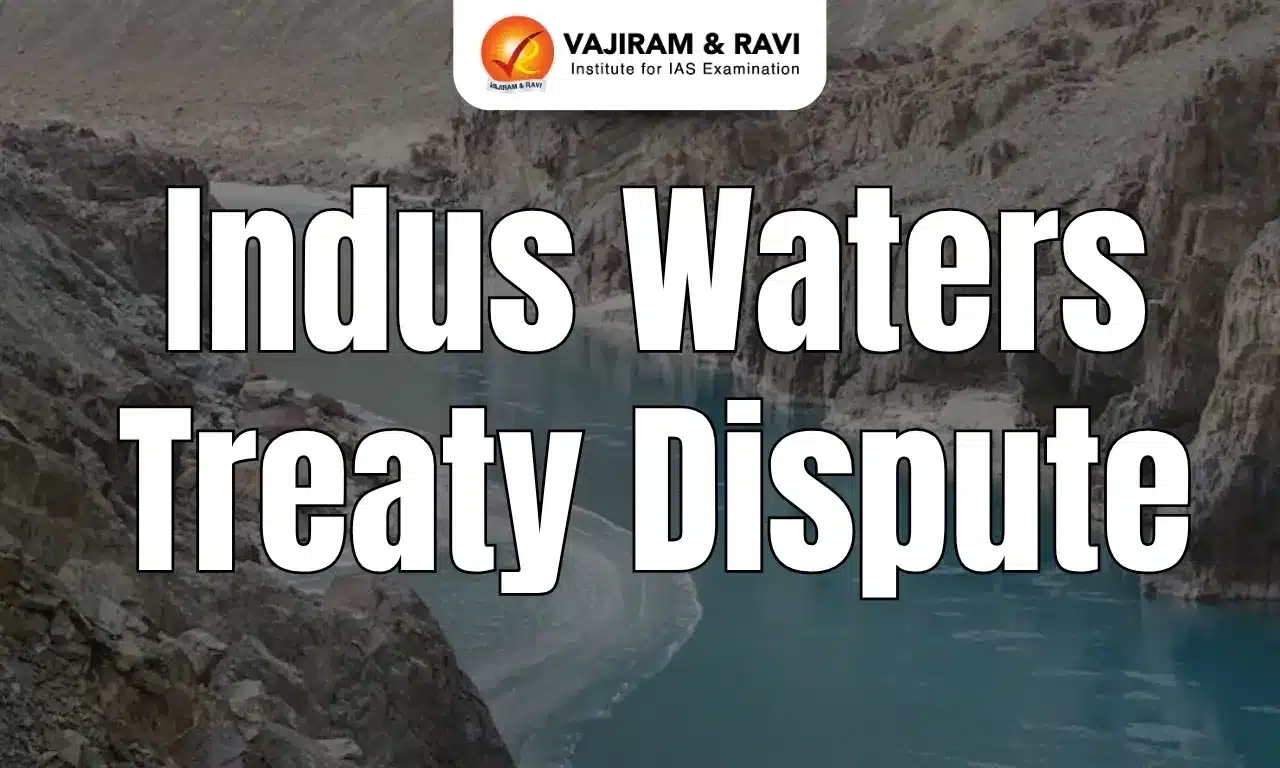
- India, after calling for a review and renegotiation of the Indus Waters Treaty (IWT), suspended the 65-year-old agreement following the April Pahalgam terror attack.
- Water sharing is now poised to become as contentious as terrorism and Kashmir in bilateral ties. Much debate on the issue has been emotional rather than fact-based.
Divergent Perspectives on the Indus Waters Treaty
- The Indus Waters Treaty (IWT) gave Pakistan 80% of the Indus system’s waters, a decision that has sparked criticism in India.
- As per some experts, this allocation was not based on volume but on geography, terrain, and natural flow.
- For India, the then PM Nehru saw the Treaty as a magnanimous step toward peaceful coexistence, even calling it a “purchased peace.”
- However, critics, including External Affairs Minister S. Jaishankar, view it as appeasement.
- Pakistan, meanwhile, recognized the leverage of an upper riparian state but has never celebrated the 80:20 distribution.
- Its leaders avoided claiming victory, knowing it could weaken their narrative of victimhood.
- Over time, both nations have remained dissatisfied with the Treaty, albeit for different reasons.


Pakistan’s Insecurity Over Indus Waters
- While the Indus Waters Treaty (IWT) gave India rights over the eastern rivers and limited use of the western rivers, Pakistan has consistently used the Treaty’s dispute mechanisms to delay Indian projects in J&K.
- This reflects not a need for more water, but Pakistan’s deep insecurity about India’s control over river flows.
- Its fear is that India could disrupt these flows, on which Pakistan is heavily dependent.
- Experts argue that this insecurity ties directly to Pakistan’s Kashmir agenda, where control of rivers is central.
- Indeed, soon after the Treaty’s signing, General Ayub Khan openly linked Kashmir’s annexation to Pakistan’s water security concerns.
Why the Indus Waters Treaty Endured
- The Indus Waters Treaty (IWT) has withstood four wars, terrorism, and decades of hostility, often hailed as a model of cross-border water governance.
- Its survival is credited largely to India, which, as the upper riparian, bears the main responsibility — ensuring minimum flows and sharing timely data with Pakistan.
- This upstream role directly impacts Pakistan, while Pakistan’s actions have no effect upstream.
- Analysts note that had Pakistan been the upper riparian, the Treaty might not have endured.
- Even as the lower riparian, Pakistan has exploited Treaty provisions to stall India’s legitimate projects in J&K.
The Future of the Indus Waters Treaty
- Pakistan recognises it already enjoys the most favourable terms under the Indus Waters Treaty (IWT) and will resist any renegotiation.
- Fearing bilateral renegotiation with India, Pakistani experts suggest involving China and Afghanistan in the Indus Waters Treaty talks.
- About 8% of the Indus basin is in China and 6% in Afghanistan.
- India, however, insists that revisions must remain bilateral, excluding third parties like the World Bank.
- Freed from strict adherence to Treaty provisions, India now prioritises completing water projects in J&K, aiming to fully utilise its rights over western rivers without disrupting flows.
- While India may still share some flow and weather data, the suspension of Permanent Indus Commissioner meetings reduces structured exchanges.
- By leveraging its upper riparian advantage, India signals it is ready to pressure Pakistan into rethinking its stance on cross-border terrorism and water disputes.
Source: IE

 Last updated on Oct, 2026
→ UPSC 2027 Notification will be released on 13 January 2027 at upsconline.nic.in.
→ Asian Games 2026 are being held in Aichi-Nagoya, Japan, from 19 September to 4 October.
→ Check Nobel Prize 2026 Winners List here.
→ Download PIB PRiSM Monthly Magazine 2026 here.
→ Check UPSC Monthly Current Affairs Magazine The Recitals here.
→ Check out the latest UPSC Syllabus here.
→ Download UPSC Model Answers for Mains 2026
→ UPSC Mains Question Paper 2026 is out now for Essay & GS Paper 1, 2, 3 & 4.
→ UPSC Calendar 2027 has been released.
→ Enroll in Vajiram & Ravi’s UPSC Mains Test Series 2027 for structured answer writing practice, expert evaluation, and exam-oriented feedback.
→ Join Vajiram & Ravi’s UPSC Mentorship Program 2027 for personalized guidance, strategy planning, and one-to-one support from experienced mentors.
→ Go through the UPSC Mains Previous Year Papers to enhance your preparation.
→ UPSC has released UPSC Toppers List 2025 with the Civil Services final result on its official website.
→ Also check Best UPSC Coaching in India
Indus Waters Treaty FAQs
Q1. What is the Indus Waters Treaty (IWT+
Q2. Why has the IWT faced criticism in India?+
Q3. Why does Pakistan feel insecure despite favorable terms?+
Q4. Why has the IWT endured decades of hostility?+
Q5. What is the future of the IWT?+
Tags: indus waters treaty mains articles upsc current affairs upsc mains current affairs