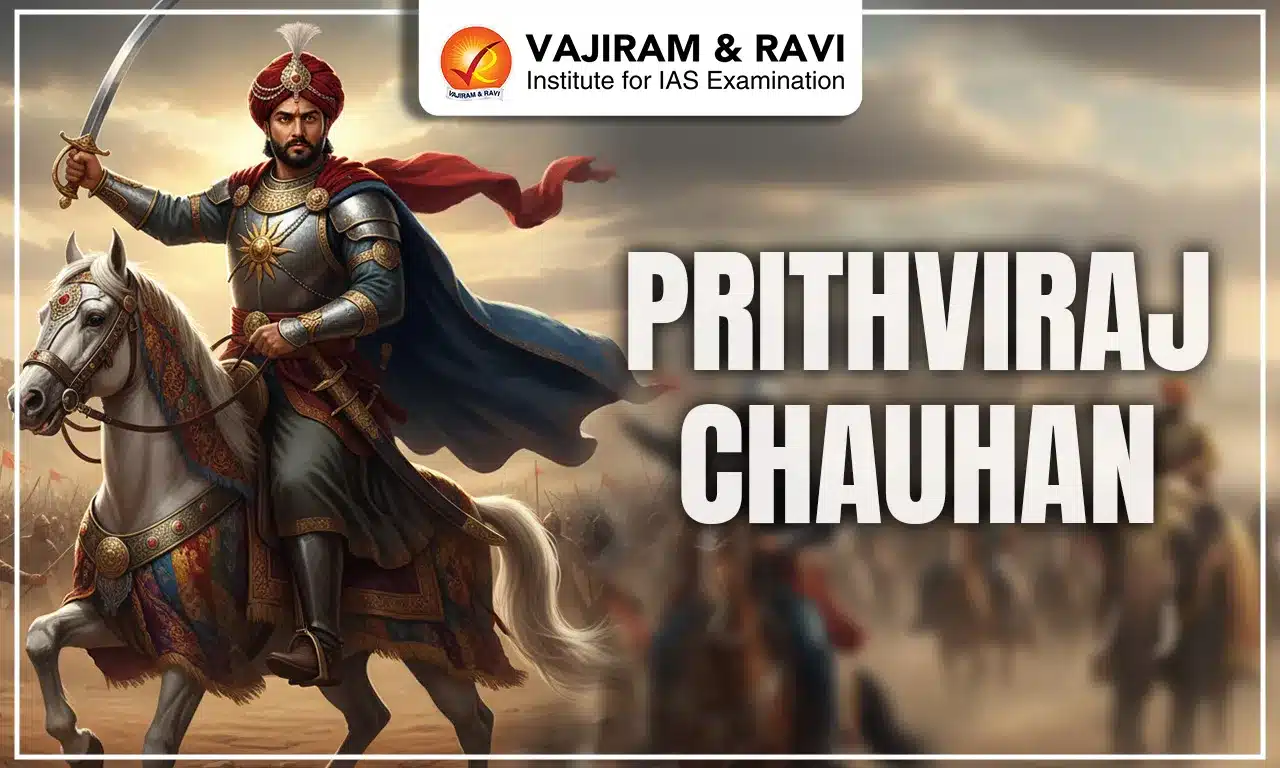
Prithviraj Chauhan, one of the most prominent rulers of medieval India, reigned from 1178 to 1192 CE. He is remembered as a heroic figure in Rajput history for his courage, military prowess, and chivalry. His most notable adversary was Muhammad of Ghor, with whom he fought a series of decisive battles. The First Battle of Tarain in 1191 CE marked a major victory for Prithviraj, showcasing his strength and leadership. However, in the Second Battle of Tarain in 1192 CE, he was defeated, captured, and taken prisoner. Despite this tragic end, his bravery, pride, and spirit turned him into a legendary symbol of resistance in Indian history. Prithviraj Chauhan Jayanti is observed each year on May 16th to commemorate his contributions and valor.
Prithviraj Chauhan Biography
Prithviraj Chauhan was born on 16th May 1168 CE in Ajmer, Rajasthan. He was the son of Someshvara Chauhan and belonged to the Chauhan or Chahamana dynasty, which emerged after the decline of the Pratihara Empire.
- Following the death of his father, he ascended the throne around 1177-1178 CE at a young age. Despite his age, he soon established himself as a capable ruler and military commander.
- His capital was Ajmer, though Delhi also became an important centre of his rule. His kingdom stretched from Thanesar in the north to parts of Mewar in the south, covering regions of present day Rajasthan, Delhi, and Haryana.
- From childhood, Prithviraj received education in warfare, archery, horsemanship, poetry, and music. Historical traditions describe him as an exceptional archer and a fearless cavalry commander.
- He strengthened the Chauhan kingdom by defeating several neighbouring rulers and smaller Rajput states. His campaigns increased his political influence across northern India during the late twelfth century.
- According to literary traditions, especially the Prithviraj Raso, his wife was Samyukta (Sanyogita), daughter of Jayachandra of Kannauj (Gahadavala Dynasty). Their story became one of the most famous narratives in medieval Indian literature.
- Historical records about his son remain limited and debated among historians. Some later traditions mention Govindaraja in connection with the Chauhan lineage after Prithviraj’s fall.
- Prithviraj Chauhan is remembered as the last great Hindu ruler of Delhi before the establishment of Muslim rule in northern India. His courage, tragic fall, and legendary tales have secured him a lasting place in Indian history as a symbol of bravery and resistance.
Prithviraj Chauhan History
Prithviraj Chauhan, also known as Rai Pithora, was a prominent king of the Chauhan (Chahamana) Dynasty who ruled Sapadalaksha with his capital at Ajmer in present-day Rajasthan. He ascended the throne in 1177 CE as a minor, inheriting a kingdom stretching from Thanesar in the north to Jahazpur (Mewar) in the south. Prithviraj sought to expand his territory through military campaigns, most notably defeating the Chandelas.
- Early in his reign, he faced a challenge from his cousin Nagarjuna, who claimed the throne. The rebellion was crushed, strengthening Prithviraj’s authority over the kingdom.
- Before 1182 CE, he defeated the Bhadanakas, who had long threatened Chauhan territories around Delhi. Their defeat removed a significant regional challenge.
- Prithviraj defeated Parmardin Deva Chandela of Jejakabhukti, including regions around Mahoba and Khajuraho. This victory enhanced his prestige but increased hostility from neighbouring powers.
- He launched campaigns against the Chalukyas of Gujarat. Although he demonstrated military ambition, he faced setbacks that limited his western expansion.
- Political competition with Jayachandra of Kannauj became one of the major rivalries of the period. Literary traditions connect this conflict with the story of Samyukta.
- In 1191 CE, during the first Battle of Tarain, Prithviraj led a Rajput coalition against Muhammad of Ghor near Tarain in present day Haryana. The Ghurid ruler was injured and forced to retreat after a decisive defeat.
- In 1192 CE during the second Battle of Tarain, Muhammad of Ghor returned with a larger and strategically stronger force. The Rajput army was defeated, and Prithviraj was captured, marking a major turning point in Indian history.


Prithviraj Chauhan Battles and Conflicts
Military campaigns defined Prithviraj Chauhan’s reign and shaped the political future of northern India during the twelfth century.
- Campaign Against Nagarjuna: The suppression of Nagarjuna’s rebellion secured internal stability and allowed Prithviraj to focus on territorial expansion and external military campaigns.
- War Against Bhadanakas: His victory over the Bhadanakas eliminated a long-standing threat around Delhi and strengthened Chauhan control over strategic northern territories.
- Chandela Campaign of 1182 CE: Defeating Parmardin Deva Chandela increased Prithviraj’s influence in central India and demonstrated the military strength of the Chauhan kingdom.
- Conflict with Chalukyas: Military engagements with the Chalukyas of Gujarat revealed the competitive nature of regional politics and highlighted the limits of Chauhan expansion toward western India.
- Battle of Tarain: The battles were fought between Prithviraj Chauhan and Muhammad Ghori in two phases:
- First Battle of Tarain (12 March 1191): Fought near present day Taraori, around 110 kilometres north of Delhi, this battle ended in a major Rajput victory. Muhammad of Ghor suffered defeat and retreated towards Afghanistan.
- Second Battle of Tarain (17 November 1192): Muhammad of Ghor returned with Persians, Afghans, and Turks supported by mounted archers and heavy cavalry. Strategic mobility and Rajput disunity contributed to Prithviraj’s defeat.
- Historical Consequences: The wars between Prithviraj Chauhan and Muhammad of Ghor represented a watershed moment. They accelerated the decline of major Rajput dominance in northern India and facilitated subsequent Ghurid expansion.
Prithviraj Chauhan Sources of History
Knowledge about Prithviraj Chauhan comes from literary works, court chronicles, and later historical writings of different periods.
- Prithviraja Vijaya: Written by Jayanaka, a Kashmiri poet associated with Prithviraj’s court around 1191 CE, this Sanskrit mahakavya is considered the earliest and most valuable contemporary source.
- Prithviraj Raso: Traditionally attributed to Chand Bardai and compiled in later centuries, this famous epic combines historical events with folklore, heroic narratives, and the popular story of Samyukta.
- Ghurid Records: Persian chronicles related to Muhammad of Ghor provide important information about the Battles of Tarain, military campaigns, and the political situation of northern India.
- Inscriptions and Epigraphy: Stone inscriptions issued by the Chauhans and neighbouring dynasties help historians reconstruct territorial boundaries, royal titles, and administrative developments during his reign.
- British Historical Works: James Mill’s The History of British India (1817) and James Tod’s Annals and Antiquities of Rajasthan (1829) popularised the image of Prithviraj as the last great Hindu ruler before Muslim political dominance.
- Folk Traditions: Ballads, poems, regional legends, and oral traditions preserved memories of his bravery, transforming him into a heroic cultural figure beyond documented history.
Prithviraj Chauhan Death
After the Second Battle of Tarain in 1192 CE, Prithviraj attempted to retreat but was captured shortly after the battlefield by the victorious Ghurid forces. Most historical sources state that Muhammad of Ghor ordered his execution after the battle. His death ended Chauhan resistance at the highest political level.
The Prithviraj Raso presents a different narrative, claiming that he was taken to Ghazni, blinded, and later killed Muhammad of Ghor through archery before dying himself. Historians generally regard this as a literary legend. The death of Prithviraj Chauhan weakened organised resistance in northern India and contributed to the rise of new political structures under Ghurid authority.

 Last updated on Oct, 2026
→ UPSC 2027 Notification will be released on 13 January 2027 at upsconline.nic.in.
→ Check Nobel Prize 2026 Winners List here.
→ Download PIB PRiSM Monthly Magazine 2026 here.
→ Check UPSC Monthly Current Affairs Magazine The Recitals here.
→ Check out the latest UPSC Syllabus here.
→ Download UPSC Model Answers for Mains 2026
→ UPSC Mains Question Paper 2026 is out now for Essay & GS Paper 1, 2, 3 & 4.
→ UPSC Calendar 2027 has been released.
→ Enroll in Vajiram & Ravi’s UPSC Mains Test Series 2027 for structured answer writing practice, expert evaluation, and exam-oriented feedback.
→ Join Vajiram & Ravi’s UPSC Mentorship Program 2027 for personalized guidance, strategy planning, and one-to-one support from experienced mentors.
→ Go through the UPSC Mains Previous Year Papers to enhance your preparation.
→ UPSC has released UPSC Toppers List 2025 with the Civil Services final result on its official website.
→ Also check Best UPSC Coaching in India
Prithviraj Chauhan FAQs
Q1. What was the cause of death of Prithviraj Chauhan?+
Q2. Who defeated Prithviraj Chauhan 17 times?+
Q3. Why is Prithviraj Chauhan so famous?+
Q4. Why did Prithviraj lose to Ghori?+
Q5. Did Prithviraj Chauhan marry his cousin?+
Tags: history medieval history prithviraj chauhan