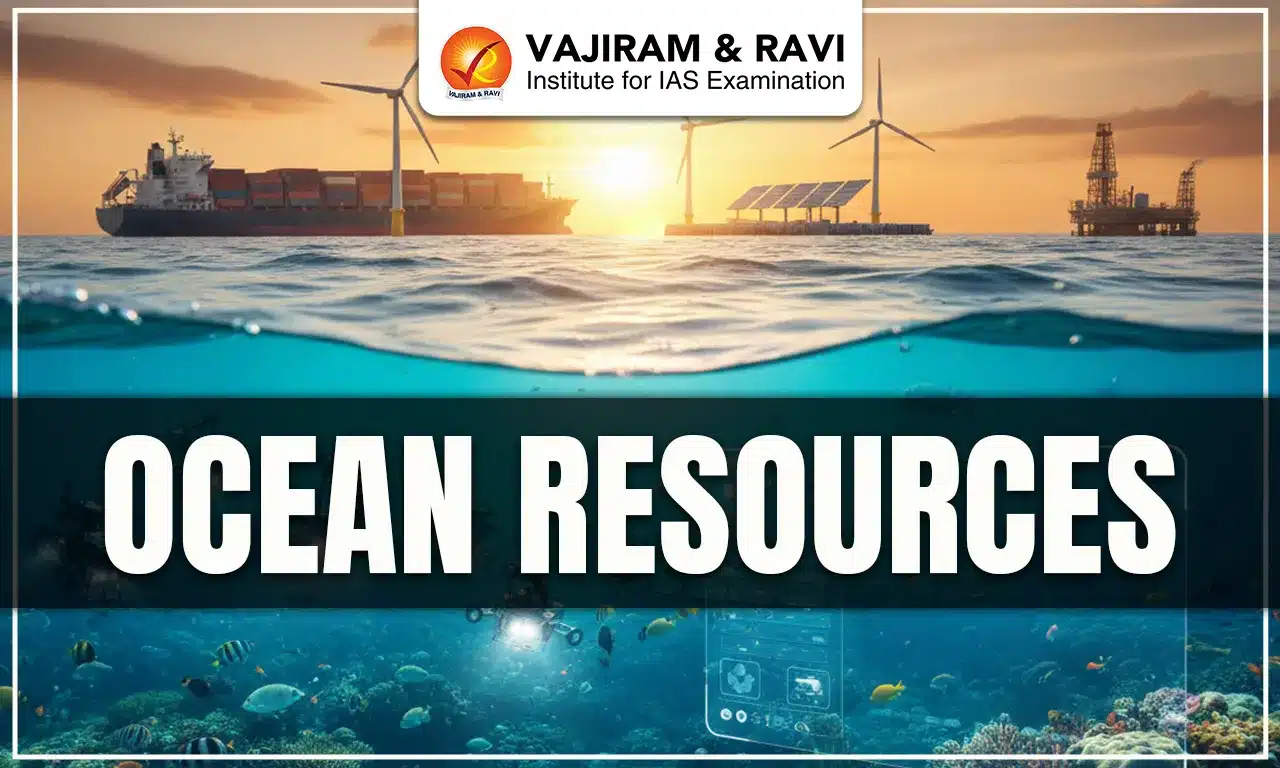
Marine resources are the wealth we derive from the oceans, which cover about 70.8% of Earth’s surface and form the planet’s most dominant feature. Oceans are deeply tied to the origin and evolution of life, carrying an ancient history that shaped the world as we know it. Of the four major oceans, the Pacific, Atlantic, Indian, and Arctic, the Pacific stands out as the largest and deepest, named by Ferdinand Magellan in 1520.
Oceans are among the most valuable natural resources on Earth, sustaining billions of people by offering food, livelihoods, and raw materials. Their economic importance is immense, providing fish, fuel, energy sources, medicines, minerals, and even building materials. Offshore drilling extracts crude oil, while mining yields salt, sand, gravel, and metals such as manganese, copper, nickel, iron, and cobalt from the seabed.
Beyond tangible resources, oceans play a crucial role in regulating the planet’s climate. They absorb massive amounts of carbon dioxide, produce much of the world’s oxygen, and influence weather patterns across continents, making them not only an economic asset but also a lifeline for environmental stability.
Ocean Resources Types
The seas and oceans hold a wide variety of resources, both living and non-living, that come from two main sources. First, rivers bring along minerals, organic matter, and other materials as they flow across the land and eventually empty into the sea. These deposits enrich marine waters with essential elements, plants, and animals. Second, marine plants, especially those found in shallow waters, also contribute significantly by producing resources that sustain aquatic life.
Marine resources are generally classified into two categories:
- Biotic Resources – living resources such as fish, seaweeds, and other marine organisms.
- Abiotic Resources – non-living resources like minerals, salts, and fossil fuels extracted from the ocean floor.
Oceanic Biotic Resources
Biotic resources are the living organisms found in marine waters. These include phytoplankton, zooplankton, algae, fish, crustaceans, mollusks, corals, reptiles, and even mammals. Together, they form the foundation of marine ecosystems and support food chains that extend from microscopic organisms to large predators like whales.
Plankton in Oceans
Plankton refers to a wide variety of tiny organisms that drift in water and cannot swim against currents. Each individual organism is called a plankter. While most plankton live in aquatic environments, some airborne forms, known as aeroplankton, float in the atmosphere.
Plankton are essential to the marine food chain. They include bacteria, archaea, algae, and protozoa, all of which float in saltwater or brackish estuarine waters. Countless marine animals, from bivalves to fish and whales, depend on plankton as their primary source of food.
Algae in Oceans
Algae are primarily aquatic, photosynthetic organisms with a nucleus, but unlike higher plants, they lack roots, stems, leaves, and specialized reproductive organs. Marine algae are extremely useful to humans.
- Brown algae produce algin, used as a stabilizer in paints, to strengthen ceramics, and as a thickener in jams.
- Red algae provide agar and carrageenan. Agar is crucial for bacterial culture in laboratories and is also used in desserts and pharmaceuticals. Carrageenan serves as a stabilizer in ice creams and as an emulsifier in cosmetics and medicines.
- Sea lettuce is consumed as a flavoring in soups and salads.
- Kelp can be cultivated for the production of methane gas, which can be converted into energy.
Zooplankton in Oceans
Zooplankton are tiny organisms floating in the water column. They are divided into:
- Primary consumers that feed on algae.
- Secondary consumers that feed on other zooplankton.
Together, these groups form the zooplankton community, which includes crustaceans, rotifers, insect larvae, and aquatic mites. Zooplankton are vital links in the aquatic food web. They transfer energy from microscopic algae (the producers) to larger predators like invertebrates and fish. Any change in aquatic habitats directly affects zooplankton populations, making them reliable indicators of environmental disturbances.
Nekton Community in Oceans
Nekton are actively swimming organisms capable of moving against currents. Fish are the most important members of this group.
- Demersal fish live near or on the seabed.
- Reef fish are associated with coral ecosystems.
- Pelagic fish occupy open waters away from both the shore and the seabed.
The pelagic environment, covering about 1,370 million cubic kilometers, is the largest aquatic habitat on Earth and supports nearly 11% of all known fish species.
Benthos Community in Oceans
Benthos are organisms that live on, in, or near the seabed. They play a key role in recycling nutrients and supporting marine food chains.
Types of Benthos:
- Epifauna live on the surface of the ocean floor, attaching themselves to rocks, shells, or hard surfaces. Examples include oysters, sponges, sea stars, and barnacles.
- Infauna burrow into sediments and include worms, clams, and other species that build their own communities.
Importance of Benthos:
- They connect producers like phytoplankton to higher levels in the food chain.
- Filter feeders such as clams and oysters consume plankton and organic particles.
- Economically important species such as crabs, striped bass, and croakers depend on benthic organisms for food.
- Bacteria and decomposers living at the seabed recycle waste, dead plants, and animals, maintaining ecological balance.


Fishing Ocean Resources
Fishing is not limited to catching fish alone. It also includes the capture of other aquatic animals such as mollusks, crustaceans, and echinoderms like starfish and sea urchins. Depending on the type of water body, fishing can be broadly classified into inland fishing and marine fishing.
| Fishing Ocean Resources | |
|
Inland Fishing |
Marine Fishing |
|
Practised in freshwater sources such as rivers, ponds, canals, and reservoirs. |
Carried out in seas and oceans where saltwater dominates. |
|
Fish are often raised in controlled environments like tanks or ponds for human consumption. |
Large-scale fishing is done using mechanized boats, synthetic nets, and advanced techniques. |
|
Primarily part of commercial freshwater fishing for local markets. |
Catches from marine fisheries are often exported to international markets. |
|
Common species include Rohu, Grass Carp, Catla, and Mrigal. |
Marine species include catfish, sardines, tuna, mackerel, mollusks, and crustaceans. |
Fishing Grounds in Temperate Ocean Regions
Temperate regions across the globe have some of the most productive fishing grounds. Several geographical, biological, and climatic factors make these areas favorable for large-scale fishing.
- Plankton Availability: Plankton, the microscopic organisms that drift in seawater, form the base of the marine food chain. They are of two types, phytoplankton (plant-like) and zooplankton (animal-like). Zooplankton feed on phytoplankton, and in turn, fish feed on zooplankton. The abundance of plankton in temperate waters makes these regions ideal breeding and feeding zones for fish.
- Continental Shelves: Temperate regions often have wide continental shelves, providing shallow waters where fish tend to concentrate. These areas are also home to coral reefs and submerged banks, which serve as breeding and nursery grounds for smaller fish species. Famous examples include the Grand Banks of Newfoundland, Georges Bank, and Dogger Bank in the North Sea.
- Carbon Fixation Rate: The rate of carbon fixation in oceanic waters directly affects plankton growth, and consequently, fish populations. Marine scientists note that a rate below 0.3 g-calorie per cubic meter per day is ideal for sustaining healthy fish stocks. Upwelling systems in temperate zones, like the Benguela Current near Africa and the Canary Current near Europe, provide just the right conditions.
- Indented Coastlines: Coastlines with natural indentations, bays, or fjords offer excellent shelter for fishing activities. They make it easier to construct ports and protect fishing vessels from storms. Norway and Sweden, with their fjord coastlines, are prime examples of this advantage.
- Fish Variety and Quality: Temperate seas are rich in edible fish species, unlike some tropical waters where certain species are toxic. This makes fishing more commercially viable in temperate zones.
- Favorable Climate: Fish spoil quickly, making preservation a major concern. Cool temperate climates act as a natural preservative, allowing catches to last longer. In contrast, tropical regions face greater challenges in storing and transporting fish. This is one reason why the per capita fish catch in temperate areas is higher than in tropical ones.
- Suitable Topography: Flat and accessible coastal plains in temperate zones provide better conditions for establishing ports, fishing settlements, and related industries. Rugged or inaccessible coastlines, on the other hand, hinder fishing activities.
- Role of Forests: Forests near coastal regions indirectly support fishing. They supply timber for boats and jetties, regulate sea temperatures, and enrich waters with organic material through weathering. This creates favorable conditions for fish communities to thrive.
Reasons for Backwardness in Commercial Fishing in Tropical Regions
Despite abundant marine waters, fishing in tropical regions faces several challenges that limit its growth. These factors are both natural and socio-economic.
- Plankton Deficiency: Tropical seas are characterized by high water temperatures, which are not conducive to plankton growth. Since plankton forms the base of the marine food chain, its scarcity leads to lower fish populations and reduced fishery productivity.
- High Temperature: The extreme heat in tropical regions makes it difficult to preserve fish after capture. Without proper refrigeration or processing facilities, the perishable nature of fish becomes a major obstacle for fishers.
- Species Diversity: Tropical waters are home to a wide variety of fish species, but many are inedible or even toxic. A significant portion of the catch often goes unused, increasing the overall cost of fish production and reducing efficiency.
- Absence of Shallow Continental Shelves: Shallow shelves and banks act as breeding and nursery grounds for fish. Tropical seas tend to be deep and lack such structures, limiting fish abundance in easily accessible areas.
- Lack of Indented Coastlines: Coastlines with natural inlets, bays, or fjords are ideal for constructing fishing harbors. Tropical coasts often lack these features, making fishing operations and port development difficult.
- Transportation Challenges: Rapid transport of perishable fish is essential for a thriving fishing industry. In tropical areas, poor infrastructure and inaccessible terrain hamper timely transportation, limiting market reach and profitability.
- Unsanitary Conditions: Tropical regions are prone to epidemics and diseases, which can directly affect fishermen’s health and reduce labor availability for fishing activities.
- Underdeveloped Economy: The fishing sector in many tropical countries suffers from low investment, limited technology, and lack of modern equipment. The industry is often unorganized, restricting large-scale or efficient operations.
- Low Investment Capacity: Many fishermen in tropical regions remain economically disadvantaged. Low income prevents them from investing in better boats, nets, or storage facilities, creating a cycle of low output and minimal profit.
Major Fishing Grounds of the World
The world’s most productive fishing regions are distributed across both temperate and tropical oceans. These areas are rich in nutrients and support high fish populations, making them key contributors to global fisheries.
- North-East Pacific Region: This region stretches from the Aleutian Islands in the north to the Philippines in the south. It also includes the eastern coastal waters of Russia, China, South Korea, Japan, and the Philippines. China, Japan, and South Korea are major contributors, accounting for approximately 13%, 8%, and 3% of the global fish catch, respectively.
- North-East Atlantic Region: Extending along the European coasts from Portugal to Iceland, this region is dominated by Norway, Great Britain, and Denmark. The North Sea is a particularly significant area due to its rich fish stocks and well-developed fishing infrastructure.
- North-West Atlantic Region: This area covers the continental shelves along New England in the USA and parts of Canada, including New Brunswick, Nova Scotia, and Newfoundland. The Grand Banks are a key fishing ground here. Productivity is high due to the convergence of the cold Labrador Current with the warm Gulf Stream near Newfoundland, creating nutrient-rich waters.
- South-East Pacific Region: Stretching along the western coasts of South America, particularly Chile and Peru, this region benefits from upwelling of cold, nutrient-rich waters that support dense fish populations. Peru is especially famous for its fisheries. However, during strong El Niño events, fish populations decline sharply, causing major losses.
- West-Central Pacific Region: This region extends from the Philippines to the eastern coasts of Australia. The warm, nutrient-rich waters here support a diverse and abundant marine life, making it an important fishing zone in the Pacific.
Ocean Energy Resources
Marine energy, also called ocean energy or marine and hydrokinetic energy, is the power derived from the movement and properties of ocean water. It includes energy from waves, tides, salinity differences, and temperature gradients.
The kinetic energy generated by the continuous movement of ocean waters represents a vast and largely untapped source of power. This energy can be harnessed to produce electricity, which in turn can supply homes, industries, and transportation systems.
Oceans store enormous amounts of energy and are often located near densely populated coastal regions, making them highly suitable for energy extraction. Marine energy has the potential to become a significant renewable energy source, complementing solar, wind, and hydroelectric power globally.
While wave and tidal energy have already been explored under conventional energy resources, another promising method is Ocean Thermal Energy Conversion (OTEC), which utilizes the temperature differences between surface and deep ocean waters to generate power.
Ocean Thermal Energy Conversion (OTEC)
Ocean Thermal Energy Conversion (OTEC) is the process of generating electricity by exploiting the temperature difference between the surface and deeper layers of the ocean. Because it relies on the sun to warm the ocean’s surface, OTEC plants are sometimes referred to as Solar Sea Power plants.
In tropical regions, surface waters are significantly warmer than the deep waters below. This temperature gradient drives the generation of electricity and can also be used for desalinating seawater.
OTEC is a renewable and environmentally friendly energy source with virtually unlimited supply. Despite its potential, widespread adoption has been limited due to the high cost of technology required to harness it. The world’s largest OTEC plant is operated by Makai Ocean Engineering in Kailua-Kona, Hawaii, USA.

 Last updated on Oct, 2026
→ UPSC 2027 Notification will be released on 13 January 2027 at upsconline.nic.in.
→ Check Nobel Prize 2026 Winners List here.
→ Download PIB PRiSM Monthly Magazine 2026 here.
→ Check UPSC Monthly Current Affairs Magazine The Recitals here.
→ Check out the latest UPSC Syllabus here.
→ Download UPSC Model Answers for Mains 2026
→ UPSC Mains Question Paper 2026 is out now for Essay & GS Paper 1, 2, 3 & 4.
→ UPSC Calendar 2027 has been released.
→ Enroll in Vajiram & Ravi’s UPSC Mains Test Series 2027 for structured answer writing practice, expert evaluation, and exam-oriented feedback.
→ Join Vajiram & Ravi’s UPSC Mentorship Program 2027 for personalized guidance, strategy planning, and one-to-one support from experienced mentors.
→ Go through the UPSC Mains Previous Year Papers to enhance your preparation.
→ UPSC has released UPSC Toppers List 2025 with the Civil Services final result on its official website.
→ Also check Best UPSC Coaching in India
Ocean Resources FAQs
Q1. What are the ocean resources in India?+
Q2. Why is the ocean an important resource?+
Q3. What are the resources of the ocean Class 11?+
Q4. What is the importance of ocean resources for the future?+
Q5. What are the main types of ocean resources?+
Tags: ocean resources