


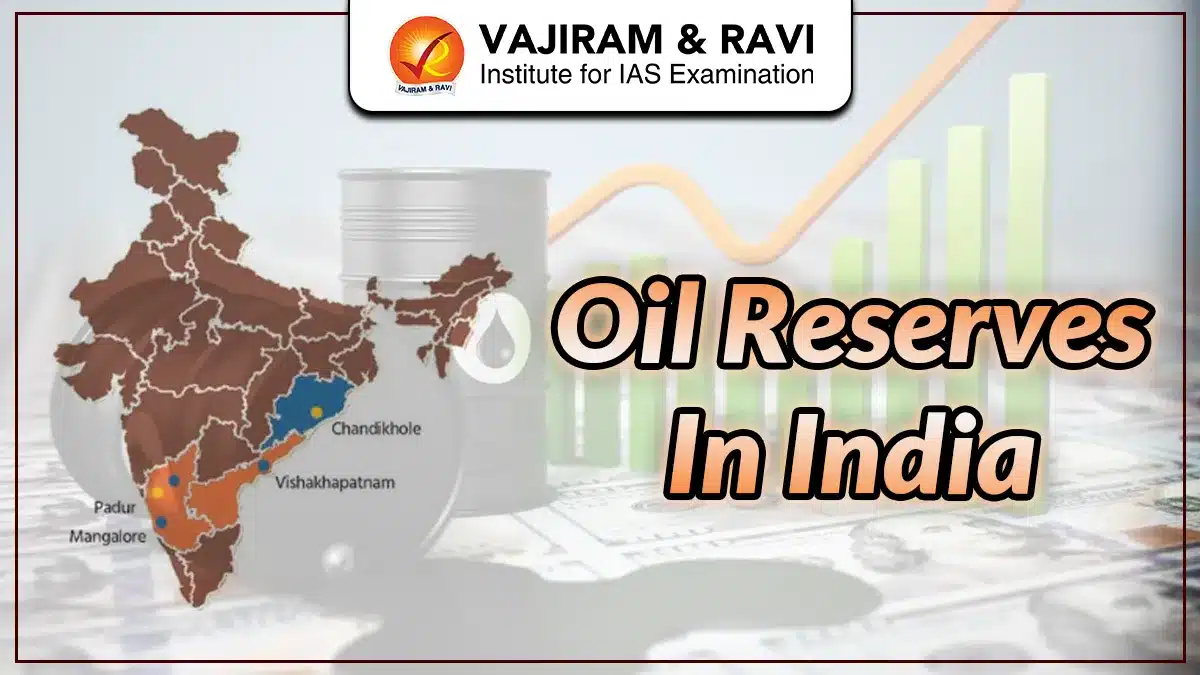
Oil Reserves in India 2026 play a crucial role in ensuring the country’s energy security, economic stability, and industrial growth. Petroleum oil is the backbone of transportation, manufacturing, power generation, and defence sectors. Despite being one of the largest consumers of crude oil in the world, India has limited domestic oil reserves, making it heavily dependent on imports.
Oil Reserves in India 2026
India has moderate proven oil reserves compared to global standards. These reserves are unevenly distributed and largely confined to specific geological regions. The country’s sedimentary basins cover nearly 3.36 million square kilometres, but only a portion has been explored so far. Domestic crude oil production meets only 15-18% of India’s total demand, while the rest is fulfilled through imports from West Asia, Russia, and Africa. This makes the development of Oil Reserves in India a strategic priority.
Also Read: Coal Mines In India
What is Mineral Oil?
Petroleum, also known as mineral oil, is a complex mixture of hydrocarbons along with small amounts of other organic compounds. It is formed over millions of years from decomposed organic matter under high pressure and temperature in sedimentary rocks. The constituents of the Mineral Oil include:
- Hydrocarbons (90–95%) – Mainly compounds of hydrogen and carbon, forming alkanes, cycloalkanes, and aromatic hydrocarbons.
- Organic compounds (5–10%) – Contain oxygen, nitrogen, sulphur, and other elements.
- Trace organo-metallic compounds – Include metals like vanadium and nickel present in very small amounts.
- Minor impurities – Influence refining processes and environmental emissions when combusted.
Formation of Petroleum and Mineral Oil
Petroleum or mineral oil is formed over millions of years through geological and biochemical processes in sedimentary rocks. Its formation requires specific conditions of organic matter accumulation, burial, pressure, and temperature.
- Origin: Derived from the remains of microscopic plants and animals deposited in sediments millions of years ago.
- Sedimentary Rock Requirement: Only occurs in porous and permeable sedimentary rocks capable of storing oil.
- Porosity: Rocks must have tiny pores or gaps to accommodate sufficient quantities of oil.
- Permeability: Pores must be interconnected to allow oil and gas to flow when wells are drilled.
- Impervious Cap Rock: Porous rocks must be capped by impermeable layers to prevent oil from escaping.
Accumulation in Traps: Oil generally accumulates in anticlines, fault traps, and other geological traps. - Favourable Geological Period: Most petroleum in India formed during the Tertiary period when conditions for organic deposition were ideal.
- Transformation Process: Buried organic matter undergoes heat and pressure, converting it into hydrocarbons over millions of years.


Oil Reserves in India Distribution 2026
The Distribution of Petroleum and Mineral Oil in India 2026 is closely linked to sedimentary basins formed over millions of years. These basins contain organic matter that, under heat and pressure, transformed into hydrocarbons.
1. Assam (Brahmaputra Valley)
Assam is the oldest oil-producing region in India and holds a historic position in the country’s petroleum industry. Oil-bearing strata extend for nearly 320 km along the Brahmaputra Valley in Upper Assam. The oil occurs in Tertiary sedimentary rocks associated with anticlines and fault traps.
- Oldest oil-producing state in India
- Major oilfields: Digboi, Naharkatiya, Moran-Hugrijan
- Digboi is the oldest oilfield in India
- Oil is refined mainly at Digboi, Guwahati, Bongaigaon, and Barauni
- Oilfields are relatively inaccessible and far from major consumption centres
2. Gujarat (Cambay Basin)
Gujarat is one of the most important on-shore oil-producing regions in western India. The oilfields are mainly located in the Cambay (Khambhat) Basin, which contains thick sedimentary deposits rich in hydrocarbons.
- Major oilfields: Ankleshwar, Kalol, Mehsana, Nawgam, Kosamba, Kathana, Barkol, Sanand
- Ankleshwar is the most productive oilfield of the state
- Oil is transported to refineries at Trombay and Koyali
- Well-developed pipeline network supports production and refining
3. Rajasthan (Barmer–Sanchor Basin)
Rajasthan has emerged as India’s largest on-shore oil-producing state due to major discoveries in the Barmer region. The basin contains significant reserves trapped in sandstone formations.
- One of the largest inland oil discoveries in India
- Major oilfields: Mangala, Saraswati, Rajeshwari
- Contributes significantly to India’s domestic crude oil output
- Modern extraction technology used for enhanced oil recovery
4. Mumbai High (Western Offshore Region)
Mumbai High is the largest and most productive oil-producing region in India. It is an off-shore oilfield located in the Arabian Sea, about 160 km west of Mumbai. Discovered in 1974, it lies in Miocene-age rock strata.
- Largest contributor to India’s crude oil production
- Located in the western off-shore basin
- Supported by advanced offshore drilling platforms like Sagar Samrat
- Includes nearby fields such as Bassein
5. Krishna–Godavari Basin (Eastern Offshore Region)
The Krishna–Godavari (KG) Basin along the eastern coast is an important emerging oil and gas-producing region. It holds substantial hydrocarbon potential in both on-shore and off-shore areas.
- Located off the coast of Andhra Pradesh
- Important off-shore oilfield: Rava
- Significant reserves of both oil and natural gas
- Considered one of India’s most promising future energy regions
6. Cauvery Basin (Tamil Nadu and Offshore Areas)
The Cauvery Basin is another important oil-producing region located in Tamil Nadu and adjoining offshore areas. The basin has both on-shore and off-shore oilfields.
- Important oilfields: Narimanam, Kovilappal
- Oil found in Tertiary sedimentary formations
- Moderate but steady contribution to domestic production
Also Read: Silver Production in India
Unexplored Oil Reserves in India 2026
As of 2026, India has 75-90% Unexplored Oil Reserves. However the government of India has been prioritizing the domestic exploration of reserves since years with primary focus in Andaman, Mahanadi Basin and Kerala-konkan basin. Some previously explored proven reserves are expected to produce more potential including Krishna-Godavari (KG) Basin.
Oil Reserves in India Map
An Oil Reserves in India Map highlights the concentration of petroleum resources along the western coast and north-eastern region. Offshore areas dominate India’s oil production, while onshore reserves are relatively scattered.
Oil Reserves in India vs Global Oil Reserves
India’s oil reserves are very limited compared to global oil-rich nations, even though India is among the top crude oil consumers worldwide. While India holds less than 1% of global proven oil reserves, countries in the Middle East and Russia dominate global reserves, making India highly dependent on imports.
| Indian Oil Reserves vs Global Oil Reserves | |
| Oil Reserves in India | Global Oil Reserves |
|
Less than 1% share of proven oil reserves |
Over 50% reserves concentrated in the Middle East |
|
Domestic production meets only a small part of demand |
Many countries have surplus production |
|
Heavy import dependence (over 80%) |
Major exporters of crude oil |
|
Oilfields mainly in Mumbai High, Assam, Gujarat, Rajasthan |
Large reserves in Saudi Arabia, Venezuela, Russia, Iran |
|
Low reserve-to-production ratio |
High reserve-to-production ratio |
|
Vulnerable to global price and supply shocks |
Greater energy and strategic stability |
Oil Reserves in India Government Initiatives 2026
Government Initiatives for Oil Reserves in India and Oil Exploration are aimed at boosting domestic crude oil production, reducing import dependence, and encouraging private and foreign investment. These reforms focus on policy simplification, flexible licensing, and faster monetisation of oil and gas resources.
- Hydrocarbon Exploration and Licensing Policy (HELP): Introduced a single licence for all hydrocarbons, replaced profit-sharing with a revenue-sharing model, and provided pricing and marketing freedom to explorers.
- Open Acreage Licensing Policy (OALP): Allows companies to choose exploration blocks of interest through continuous bidding rounds, promoting exploration of unexplored and frontier areas.
- New Exploration Licensing Policy (NELP): Earlier framework that opened the sector to private and foreign players, later replaced due to regulatory rigidity and delays.
- Discovered Small Field Policy (DSF): Aimed at monetising small and marginal oilfields quickly by encouraging participation of smaller operators.
- National Data Repository (NDR): Provides easy access to geological and geophysical data, improving transparency and informed investment decisions.
Oil Reserves in India Challenges
Environmental and ecological concerns related to oil exploration arise due to the intensive drilling, extraction, and transportation activities involved in the petroleum sector. These activities often take place in ecologically sensitive areas such as coastal regions, forests, wetlands, and offshore zones, posing serious risks to the environment.
- Oil spills and leakages that contaminate marine and coastal ecosystems, affecting fisheries and coral reefs
- Air pollution caused by gas flaring, drilling operations, and emissions of greenhouse gases
- Water pollution due to contamination of surface and groundwater from drilling muds and chemical waste
- Land degradation and deforestation during on-shore exploration and pipeline construction
- Loss of biodiversity and disturbance to wildlife habitats, especially in sensitive regions
- Climate change impacts due to increased carbon emissions from fossil fuel extraction and use
Also Read: Manganese Ore Distribution in India
Domestic Oil Production in India Challenges
Challenges in Enhancing Domestic Oil Production have been discussed below:
- Limited proven reserves: India holds less than 1% of global proven crude oil reserves, which restricts large-scale expansion of domestic output.
- High import dependence: Domestic production meets only 15–18% of India’s crude oil demand, making the country heavily reliant on imports.
- Declining production from mature fields: Major fields such as Mumbai High and Assam have crossed peak production, leading to falling output despite enhanced recovery efforts.
- High cost of offshore and deep-water exploration: Deep-sea drilling involves advanced technology and high capital investment, increasing financial risk for operators.
- Technological constraints: Limited access to advanced technologies for enhanced oil recovery (EOR) and exploration of ultra-deep and unconventional resources.
- Low exploration coverage: Out of India’s 26 sedimentary basins, several frontier and deep-water basins remain underexplored.
- Long gestation period: Oil exploration projects take 10-15 years from exploration to commercial production, delaying output gains.
- Regulatory and environmental hurdles: Multiple clearances and strict environmental norms often slow project execution.
Way Forward:
- Accelerate exploration in unexplored and frontier basins, especially deep-water and offshore regions
- Adopt advanced technologies such as enhanced oil recovery (EOR), seismic imaging, and digital oilfields
- Improve recovery from mature fields through secondary and tertiary recovery techniques
- Simplify regulatory and clearance processes to reduce project delays
- Encourage private and foreign investment by ensuring policy stability and risk-sharing mechanisms
- Expand Strategic Petroleum Reserves (SPR) to cushion against global supply disruptions
- Strengthen overseas oil asset acquisitions to secure long-term crude supplies
- Promote energy efficiency and conservation to moderate demand growth
- Accelerate transition to renewable and alternative energy sources to reduce long-term oil dependence
| Also Read | |
| Critical Minerals | Coal Mines in India |
| Mineral Resources in India | Mining Sector in India |
| Natural Resources | Gold Reserves in India |
| Silver Production in India | Semiconductor Industry in India |

 Last updated on Oct, 2026
→ UPSC 2027 Notification will be released on 13 January 2027 at upsconline.nic.in.
→ Check Nobel Prize 2026 Winners List here.
→ Download PIB PRiSM Monthly Magazine 2026 here.
→ Check UPSC Monthly Current Affairs Magazine The Recitals here.
→ Check out the latest UPSC Syllabus here.
→ Download UPSC Model Answers for Mains 2026
→ UPSC Mains Question Paper 2026 is out now for Essay & GS Paper 1, 2, 3 & 4.
→ UPSC Calendar 2027 has been released.
→ Enroll in Vajiram & Ravi’s UPSC Mains Test Series 2027 for structured answer writing practice, expert evaluation, and exam-oriented feedback.
→ Join Vajiram & Ravi’s UPSC Mentorship Program 2027 for personalized guidance, strategy planning, and one-to-one support from experienced mentors.
→ Go through the UPSC Mains Previous Year Papers to enhance your preparation.
→ UPSC has released UPSC Toppers List 2025 with the Civil Services final result on its official website.
→ Also check Best UPSC Coaching in India
Oil Reserves in India 2026 FAQs
Q1. Where are Oil Reserves mainly found in India 2026?+
Q2. Which is the largest Oil Producing Region in India?+
Q3. Which state is the largest On-Shore Oil Producer in India 2026?+
Q4. Why does India import most of its crude oil?+
Q5. How many sedimentary basins does India have 2026?+
Tags: economy geography oil reserves in india resources in india








