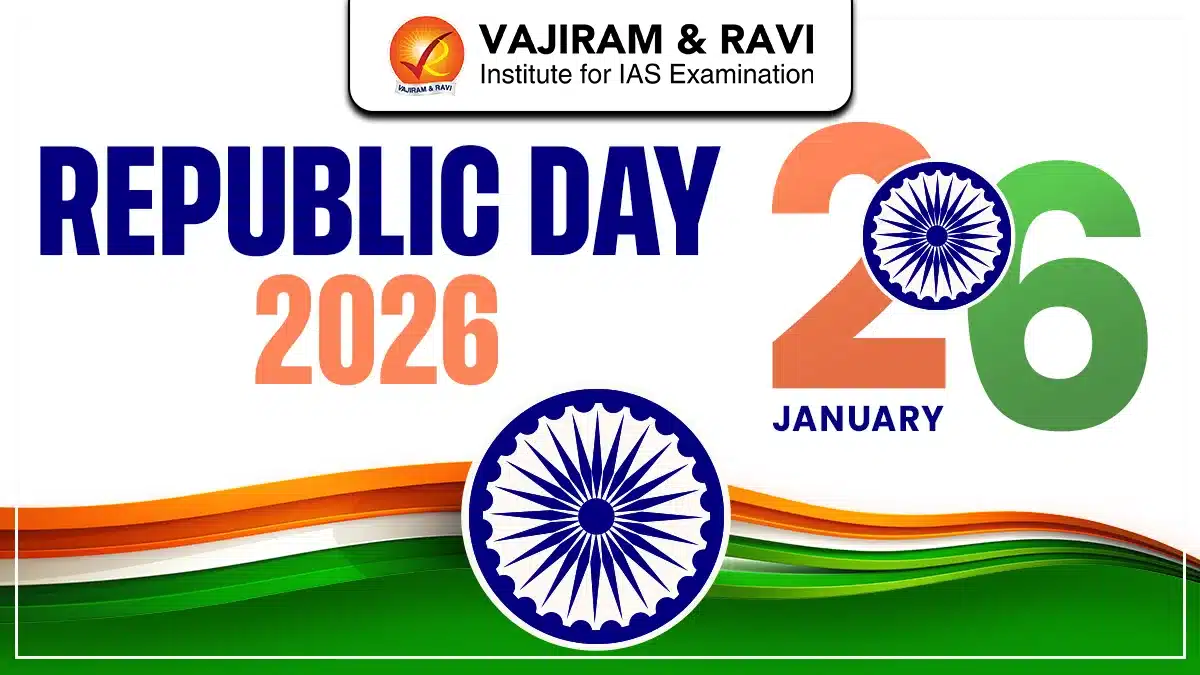
India celebrates Republic Day every year on 26 January to mark the historic day when the Constitution of India came into force in 1950, transforming the nation into a sovereign democratic republic. Republic Day 2026 will mark the 77th anniversary of the Republic of India and holds immense constitutional, political, and cultural importance for citizens
Republic Day 2026
Republic Day 2026 will be celebrated across the country with patriotism, discipline, and national pride. The main celebration takes place at Kartavya Path, New Delhi, featuring a grand parade that showcases India’s military strength, cultural diversity, technological achievements, and federal unity.
Schools, colleges, government institutions, and Indian missions abroad also observe the day by hoisting the national flag, singing the national anthem, and organizing cultural programs.
Why is Republic Day 2026 celebrated?
Republic Day 2026 is celebrated to commemorate the adoption and implementation of the Indian Constitution on 26 January 1950. Although India attained independence on 15 August 1947, it did not have a permanent constitution until 1950.
The date 26 January was deliberately chosen to honor the Purna Swaraj Declaration of 1929 at Lahore Session on December 19, 1929, when the Indian National Congress proclaimed complete independence from British rule. Republic Day symbolizes:
- Supremacy of the Constitution
- Rule of law
- Democratic governance
- Equality, liberty, and justice for all citizens


Republic Day 2026 Chief Guests
The Chief Guests for India’s 77th Republic Day celebrations on 26 January 2026 will be the top leadership of the European Union, namely Ursula von der Leyen, President of the European Commission, and António Costa, President of the European Council. Their presence reflects a significant deepening of India–EU strategic and diplomatic relations. The EU leaders will be on an official visit to India from 25 to 27 January 2026, during which they will also co-chair the 16th India–EU Summit, underscoring growing cooperation in areas such as trade, technology, security, and global governance.
Other leaders across various countries will also be invited to participate in India’s Republic Day 2026 celebration.
Beating Retreat Ceremony 2026
Republic Day 2026 Theme
The Republic Day 2026 theme continues to echo India’s long-term national vision of “Viksit Bharat” (Developed India) and “Bharat – Loktantra ki Matruka” (India – The Mother of Democracy). These themes underscore India’s commitment to achieving comprehensive development by 2047 while reaffirming its deep-rooted democratic traditions that date back to ancient times.
The spirit of these themes is vividly showcased through tableaux presented by States, Union Territories, and central Ministries, highlighting governance reforms, cultural heritage, technological progress, and inclusive growth.
Republic Day History
- Lahore Session of the INC (1929): The Indian National Congress, at its historic Lahore Session on 19 December 1929 under the leadership of Jawaharlal Nehru, formally adopted the resolution of Purna Swaraj (Complete Independence), rejecting dominion status under British rule.
- Proclamation of Complete Independence: The Purna Swaraj resolution declared that British rule in India was illegitimate and affirmed the Indian people’s inalienable right to self-governance and sovereignty.
- Observance of Independence Day Before 1947: Between 1930 and 1947, 26 January was observed as Independence Day by freedom fighters across India, with public meetings, oath-taking ceremonies, and hoisting of the tricolour.
- Formation of the Constituent Assembly (1946): The Constituent Assembly of India was constituted in December 1946 to draft a permanent constitution for independent India, representing diverse regions, communities, and political ideologies.
- Adoption of the Constitution (1949): After nearly 2 years, 11 months, and 18 days of deliberations, the Constitution of India was adopted on 26 November 1949, establishing the :framework of governance and fundamental values.
- Choice of 26 January as Republic Day: The date 26 January 1950 was chosen for the enforcement of the Constitution to honor the historic Purna Swaraj resolution of 1930, linking constitutional governance with the freedom struggle.
- India Becomes a Republic (1950): On 26 January 1950, the Constitution came into force, India officially became a Sovereign Democratic Republic, and Dr. Rajendra Prasad was sworn in as the first President of India.
- First Republic Day Celebration: The first Republic Day parade was held at Rajpath (now Kartavya Path), New Delhi, symbolizing the transfer of power from colonial rule to the people of India through constitutional democracy.
- Evolution of Republic Day Celebrations: Over the decades, Republic Day celebrations have evolved to showcase India’s military strength, cultural diversity, technological progress, and federal unity, making it a powerful symbol of national integration.
- Constitutional and Democratic Legacy: Republic Day serves as an annual reminder of the supremacy of the Constitution, the rule of law, and the commitment to justice, liberty, equality, and fraternity enshrined in the Preamble.
Role of the Constitution in Strengthening Indian Democracy
- The Constitution of India establishes India as a Sovereign, Socialist, Secular, Democratic Republic, ensuring that ultimate authority rests with the people, which is the foundation of democratic governance.
- It provides Universal Adult Franchise, granting voting rights to all citizens above 18 years of age, enabling political equality and mass participation regardless of caste, gender, religion, or economic status.
- The Constitution guarantees Fundamental Rights (Articles 12–35), including equality before law, freedom of speech and expression, and protection against discrimination, empowering citizens to actively participate in democracy.
- It enshrines the Rule of Law, ensuring that all individuals and institutions, including the government, are subject to the Constitution, thereby preventing arbitrary exercise of power.
- An independent judiciary with powers of judicial review safeguards the Constitution, protects citizens’ rights, and acts as a check on the legislature and executive.
- The principle of separation of powers among the Legislature, Executive, and Judiciary creates a system of checks and balances, strengthening accountability and preventing concentration of power.
- The federal structure divides powers between the Union and the States through the Seventh Schedule, allowing democratic governance at multiple levels while maintaining national unity.
- The Directive Principles of State Policy (Part IV) guide the state to achieve social and economic justice, helping transform political democracy into a welfare-oriented democracy.
- Constitutional bodies such as the Election Commission, Comptroller and Auditor General (CAG), Finance Commission, and UPSC ensure free elections, financial transparency, and administrative neutrality.
- The 73rd and 74th Constitutional Amendments (1992) strengthened grassroots democracy by empowering Panchayats and Municipalities, bringing governance closer to the people.
- Provisions for reservation and affirmative action for SCs, STs, OBCs, women, and minorities promote inclusive representation and social justice in democratic institutions.
Republic Day Awards and Civil Honours
Republic Day Awards and Civil Honours recognize individuals for exceptional service and achievements in fields such as public service, arts, science, social work, sports, and national security, reflecting the nation’s gratitude and constitutional values.
Civilian Awards (Highest Honours):
- Bharat Ratna – India’s highest civilian award for exceptional service in art, literature, science, or public service; a maximum of three awards per year
- Padma Vibhushan – Conferred for exceptional and distinguished service
- Padma Bhushan – Awarded for distinguished service of a high order
- Padma Shri – Given for distinguished service in any field
Gallantry and Service Awards (Police and Forces):
- President’s Police Medal (PPM) – For distinguished service
- Police Medal (PM) for Gallantry – For acts of exceptional bravery
- Police Medal (PM) for Meritorious Service – For sustained dedication and service
- Fire Services, Home Guards, and Correctional Services Awards – For bravery and distinguished service
Other Important Awards:
- Jeevan Raksha Padak – For acts of courage and life-saving by civilians
- Pradhan Mantri Rashtriya Bal Puraskar – For children showing exceptional achievement and bravery
Republic Day 2026 Significance
Republic Day 2026 marks the celebration of India’s constitutional governance and reaffirms the ideals of sovereignty, democracy, and rule of law as the nation progresses through the Amrit Kaal towards a developed India by 2047.
- Celebrates the enforcement of the Indian Constitution (26 January 1950)
- Reinforces democratic values and constitutional morality
- Highlights unity in diversity and national integration
- Showcases India’s defence strength and cultural heritage
- Inspires citizens to uphold fundamental rights and duties

 Last updated on Oct, 2026
→ UPSC 2027 Notification will be released on 13 January 2027 at upsconline.nic.in.
→ Check Nobel Prize 2026 Winners List here.
→ Download PIB PRiSM Monthly Magazine 2026 here.
→ Check UPSC Monthly Current Affairs Magazine The Recitals here.
→ Check out the latest UPSC Syllabus here.
→ Download UPSC Model Answers for Mains 2026
→ UPSC Mains Question Paper 2026 is out now for Essay & GS Paper 1, 2, 3 & 4.
→ UPSC Calendar 2027 has been released.
→ Enroll in Vajiram & Ravi’s UPSC Mains Test Series 2027 for structured answer writing practice, expert evaluation, and exam-oriented feedback.
→ Join Vajiram & Ravi’s UPSC Mentorship Program 2027 for personalized guidance, strategy planning, and one-to-one support from experienced mentors.
→ Go through the UPSC Mains Previous Year Papers to enhance your preparation.
→ UPSC has released UPSC Toppers List 2025 with the Civil Services final result on its official website.
→ Also check Best UPSC Coaching in India
Republic Day 2026 FAQs
Q1. When is Republic Day 2026 celebrated?+
Q2. Why is 26 January important in Indian history?+
Q3. Who drafted the Indian Constitution?+
Q4. What is the significance of the Republic Day parade?+
Q5. Which awards are announced on Republic Day?+
Tags: republic day 2026