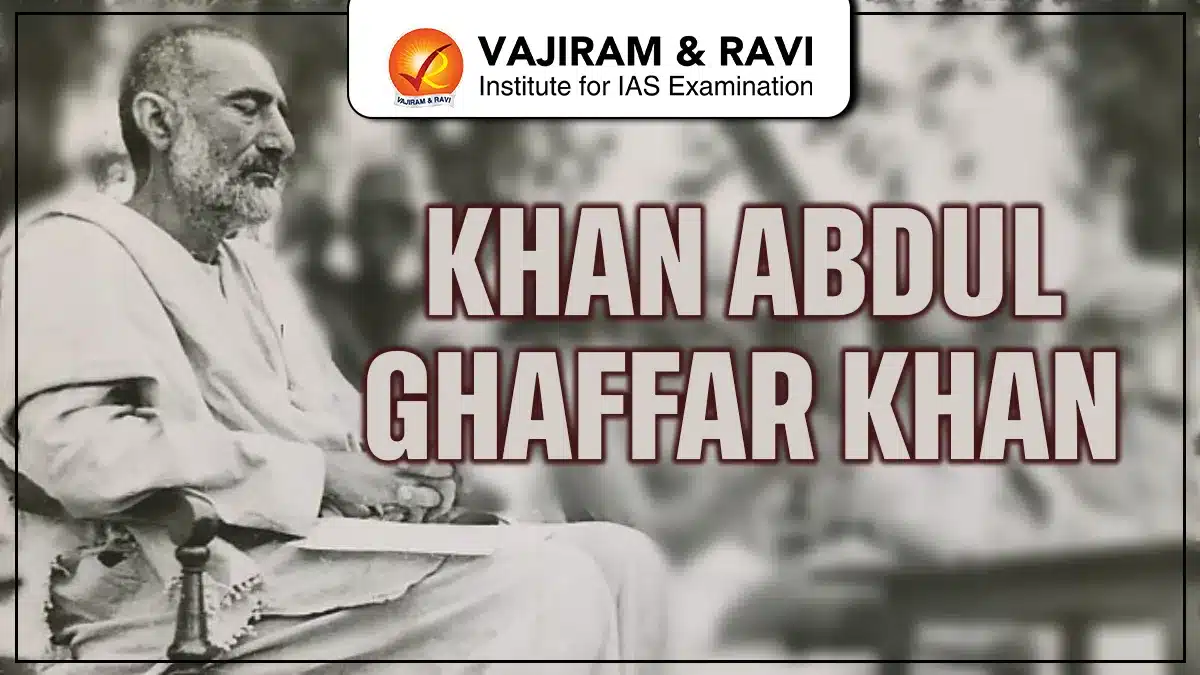
Khan Abdul Ghaffar Khan, popularly known as Frontier Gandhi or Badshah Khan, was one of the most remarkable leaders of India’s freedom movement. A close associate of Mahatma Gandhi, he dedicated his life to non-violence, social reform, and the upliftment of the Pashtun community. His unwavering commitment to peace and justice made him a unique figure in the history of India’s independence struggle. This article provides a detailed overview of Khan Abdul Ghaffar Khan’s life, ideology, contributions, and legacy.
Khan Abdul Ghaffar Khan’s Early Life
Khan Abdul Ghaffar Khan was born on 6 February 1890 in Utmanzai village of the North-West Frontier Province (now in Pakistan). He belonged to a well-off Pashtun family and received modern as well as traditional education. From an early age, he was deeply concerned about social backwardness, illiteracy, and injustice among his people.
- His father, Khan Bahadur Behram Khan, was a respected tribal leader who emphasized discipline and social responsibility.
- Ghaffar Khan received early education in missionary schools, where he was exposed to modern ideas, rational thinking, and social reform.
- He was deeply disturbed by the backwardness, illiteracy, and internal divisions among the Pashtun community.
- Despite being offered a position in the British Indian Army, he refused, as he opposed colonial rule and racial discrimination.
- From a young age, he believed that education and moral reform were the only means to uplift society.
- His early experiences shaped his lifelong commitment to peaceful resistance, social service, and nation-building.
- These formative years laid the foundation for his later association with Mahatma Gandhi and the freedom movement.
Role in India’s Freedom Struggle
Khan Abdul Ghaffar Khan played a significant role in India’s freedom struggle by mobilizing the Pashtun population against British rule through non-violent means. He was inspired by Mahatma Gandhi, and he joined the Indian National Congress and became a prominent leader in the North-West Frontier Province.
- Actively participated in the Non-Cooperation Movement (1920–22), spreading nationalist ideas among Pashtuns.
- Became a close associate of Mahatma Gandhi and adopted the philosophy of non-violence and civil disobedience.
- Played a crucial role in organizing mass movements in the North-West Frontier Province, a region traditionally known for armed resistance.
- Led protests against British policies and unjust laws, facing repeated arrests and imprisonment.
- Actively participated in the Civil Disobedience Movement (1930) and supported the Salt Satyagraha.
- Opposed repressive British actions, including the brutal firing on peaceful protesters at Qissa Khwani Bazaar (1930).
- Took part in the Quit India Movement (1942), openly demanding an end to British rule.
- Worked consistently to promote Hindu-Muslim unity and national integration during the freedom struggle.


Khudai Khidmatgar Movement (Red Shirts)
The Khudai Khidmatgar Movement was launched by Khan Abdul Ghaffar Khan in 1929 to organize the Pashtun community against British rule through non-violent means. Its members, known as the Red Shirts, took an oath of peace, discipline, and service to humanity. The movement aimed at social reform, promotion of education, and eradication of social evils among Pashtuns. It played a major role during the Civil Disobedience Movement, especially in the North-West Frontier Province. Despite severe British repression, including the Qissa Khwani Bazaar massacre (1930), the movement remained firmly committed to Gandhian non-violence.
Philosophy of Non-Violence and Gandhian Influence
Khan Abdul Ghaffar Khan strongly believed in non-violence as a moral and political force and adopted it as the core principle of his struggle against British rule.
- He accepted Ahimsa (non-violence) as the most powerful weapon against injustice and oppression.
- Strongly influenced by Gandhian principles of truth, self-discipline, and civil disobedience.
- Believed that Islam preached patience, tolerance, and peace, making non-violence compatible with faith.
- Applied Gandhian methods in the North-West Frontier Province, a region known for armed resistance.
- Emphasized moral strength over physical force in political struggles.
- Encouraged his followers to remain peaceful even during severe British repression.
- Earned the title “Frontier Gandhi” for his unwavering commitment to non-violence.
Opposition to Partition and Political Stand
Khan Abdul Ghaffar Khan strongly opposed the Partition of India in 1947, believing it would divide communities and weaken national unity. He supported a united, secular India and felt that the interests of the Pashtun people were ignored during the partition process.
- He firmly opposed the creation of Pakistan, as he believed it was imposed without the consent of the Pashtun population.
- He criticized the Congress leadership for accepting Partition despite earlier promises of unity.
- Advocated for autonomy and democratic rights for Pashtuns within a united India.
- After Partition, he faced political repression and imprisonment in Pakistan for his views.
- Continued to follow non-violence and constitutional methods despite persecution.
Khan Abdul Ghaffar Khan Contributions After Independence
After India’s independence, Khan Abdul Ghaffar Khan continued his lifelong mission of promoting peace, democracy, and social justice. Despite facing political suppression in Pakistan, he remained committed to non-violence and worked for the rights and welfare of the Pashtun people.
- Opposed authoritarian rule in Pakistan and demanded democratic rights and provincial autonomy for Pashtuns.
- Founded and supported movements aimed at social reform, education, and political awareness.
- Spent nearly 15 years in imprisonment or house arrest due to his political beliefs.
- Continued to advocate peaceful coexistence between India and Pakistan.
- Remained loyal to Gandhian principles even while facing political isolation and hardship.
- Recognized internationally as a symbol of peaceful resistance and moral courage.
- Awarded the Bharat Ratna in 1987, becoming the first non-Indian recipient of India’s highest civilian honor.

 Last updated on Sep, 2026
→ UPSC 2027 Notification will be released on 13 January 2027 at upsconline.nic.in.
→ Check out the latest UPSC Syllabus here.
→ Download UPSC Model Answers for Mains 2026
→ UPSC Mains Question Paper 2026 is out now for Essay & GS Paper 1, 2, 3 & 4.
→ UPSC Calendar 2027 has been released.
→ Enroll in Vajiram & Ravi’s UPSC Mains Test Series 2027 for structured answer writing practice, expert evaluation, and exam-oriented feedback.
→ Join Vajiram & Ravi’s UPSC Mentorship Program 2027 for personalized guidance, strategy planning, and one-to-one support from experienced mentors.
→ Go through the UPSC Mains Previous Year Papers to enhance your preparation.
→ UPSC has released UPSC Toppers List 2025 with the Civil Services final result on its official website.
→ Also check Best UPSC Coaching in India
Khan Abdul Ghaffar Khan FAQs
Q1. Who was Khan Abdul Ghaffar Khan?+
Q2. Why was he called Frontier Gandhi?+
Q3. What was the Khudai Khidmatgar Movement?+
Q4. Did Khan Abdul Ghaffar Khan oppose Partition?+
Q5. When was he awarded the Bharat Ratna?+
Tags: khan abdul ghaffar khan