Tailings Latest News
The central government recently announced the country’s first tailings policy, setting guidelines for exploration of critical minerals from primary as well as the secondary sources like mine dumps and tailings of existing mines.
About Tailings
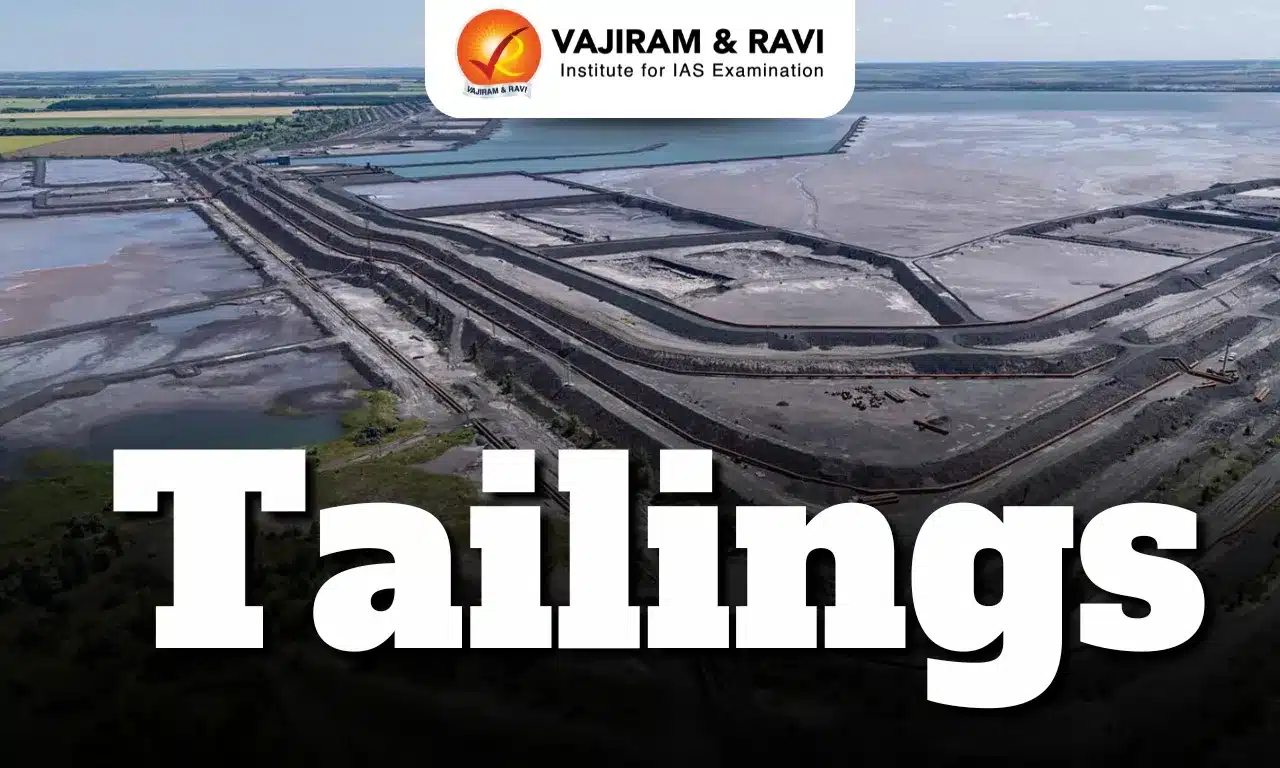
- Tailings are the leftover materials from the processing of mined ore.
- They consist of finely ground rock, unrecoverable or uneconomic metals, chemicals, organic matter, and effluent from the extraction process.
- They usually take the form of a liquid slurry made of fine mineral particles, created as mined ore is crushed, ground, and processed.
- Effective tailings management is integral to the safe and sustainable production of metals and minerals.
- Tailings can be stored in a variety of ways; which way depends on numerous factors, for instance, the local topography, how much rainfall an area gets, whether there is regular or irregular seismic activity recorded, the type of mineral being mined, and how close the mine is to populated areas.
- There is no one-size-fits-all solution; each tailings facility (also commonly known as a tailings storage facility) is unique.
- Dams, embankments, and other types of surface impoundments are by far the most common storage methods used today.


India’s First Tailings Policy for Critical Minerals
- It sets guidelines for exploration of critical minerals from primary as well as secondary sources like mine dumps and tailings of existing mines.
- The new policy is developed on the idea that a few commodities currently mined in India as primary ore may have scope for recovery of companion metals or elements from the tailings, anode slimes, pot linings, and slags.
- For example, a copper mine may have Selenium, Tellurium, Molybdenum, Cobalt, Rhenium, Gold, and Silver as companion elements.
- Similarly, Zinc is found along with Germanium, Silver, Cadmium, and Indium.
- Critical minerals, including lithium, cobalt, nickel, rare earth elements (REE), etc., are vital for solar panels, wind turbines, batteries and are essential for India’s economic growth.
Source: BS

 Last updated on Sep, 2026
→ UPSC 2027 Notification will be released on 13 January 2027 at upsconline.nic.in.
→ Asian Games 2026 are being held in Aichi-Nagoya, Japan, from 19 September to 4 October.
→ Check out the latest UPSC Syllabus here.
→ Download UPSC Model Answers for Mains 2026
→ UPSC Mains Question Paper 2026 is out now for Essay & GS Paper 1, 2, 3 & 4.
→ UPSC Calendar 2027 has been released.
→ Enroll in Vajiram & Ravi’s UPSC Mains Test Series 2027 for structured answer writing practice, expert evaluation, and exam-oriented feedback.
→ Join Vajiram & Ravi’s UPSC Mentorship Program 2027 for personalized guidance, strategy planning, and one-to-one support from experienced mentors.
→ Go through the UPSC Mains Previous Year Papers to enhance your preparation.
→ UPSC has released UPSC Toppers List 2025 with the Civil Services final result on its official website.
→ Also check Best UPSC Coaching in India
Tailings FAQs
Q1. What are tailings?+
Q2. What do tailings mainly consist of?+
Q3. In what physical form are tailings usually found?+
Q4. What is a tailings storage facility (TSF)?+
Q5. What are the most commonly used methods for storing tailings today?+
Tags: prelims pointers upsc current affairs upsc prelims current affairs