


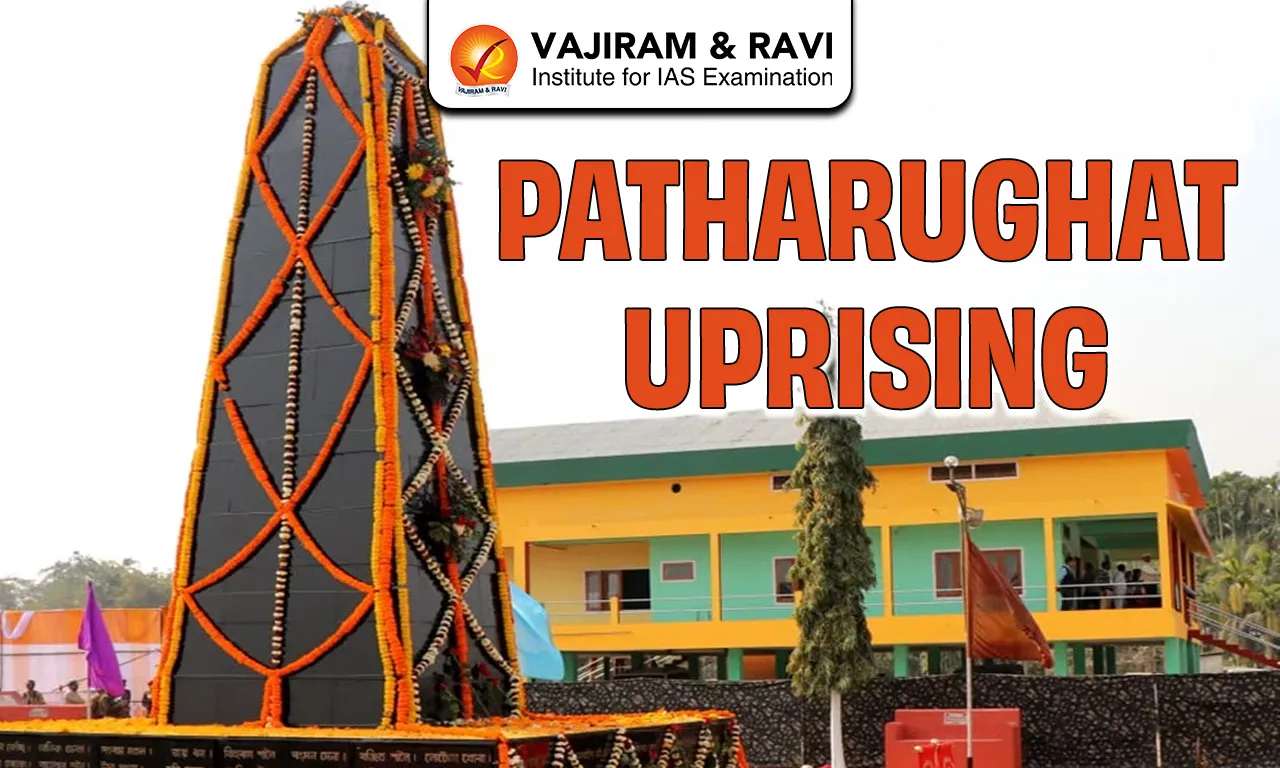
The Patharughat Uprising was a major peasant resistance against British colonial rule that took place on 28 January 1894 in Patharighat, earlier known as Patharughat, in Darrang district of Assam. It is located on the north bank of the Brahmaputra River, about 35 km northeast of the Baruah Souk area of north Guwahati. The site was a symbol of agrarian protest in colonial India. The incident, often called Patharughatar Ran or Patharughat Massacre, resulted in a brutal police firing on unarmed peasants. The day is remembered annually as Krishak Swahid Divas in honour of the farmer martyrs on January 28th.
Patharughat Uprising Causes
The Patharughat Uprising emerged from agrarian distress caused by steep colonial taxation and rigid revenue policies. The immediate causes of massacre are:
- British Annexation of Assam (1826): After annexing Assam in 1826, colonial authorities began systematic land surveys to maximize revenue collection from agrarian regions.
- Introduction of Cash Land Revenue: Traditional payment in kind or service was replaced with compulsory cash payments, disrupting the rural barter based agrarian economy.
- Revenue Enhancement in 1893: In 1893, agricultural land tax was increased by nearly 70% to 80%, sharply burdening subsistence farmers.
- Impact on Agrarian Economy: Repeated revenue revisions between 1826 and 1893 weakened peasant households and reduced their capacity to sustain farming.
- Emergence of Raij Mels: Farmers organised peaceful public conventions called Raij Mels to discuss grievances and present collective petitions. These assemblies reflected organised mass participation without violent intent or secret planning.
- Colonial Suspicion: British officials labelled Raij Mels as potential “breeding grounds for sedition” despite their non violent character.
- Administrative Repression: Police forces frequently dispersed such gatherings with force to discourage collective mobilisation.
- Immediate Trigger at Patharughat: On 28 January 1894, officials refused to address farmers’ complaints regarding revenue enhancement, escalating tensions.
Also Read: Civil Uprisings Before 1857
Patharughat Massacre
The protest at Patharughat turned violent when colonial police used force against peaceful protesters.
- Date of Incident: The firing occurred on 28 January 1894 at Patharughat village in Darrang district.
- Protesters: The peasants present were unarmed and had gathered solely to protest enhanced land revenue demands.
- Firing on the protestors was done by the British police, killing several peasants.
- Official Casualty Figures: The Darrang District Gazette of 1905, edited by BC Allen, recorded 15 deaths and 37 injuries.
- Unofficial Estimates: Eyewitness accounts and local sources suggest nearly 140 peasants lost their lives in the firing.


Patharughat Uprising British Response
Colonial authorities treated the Patharughat Uprising as a law and order threat rather than a revenue grievance.
- Officials interpreted peaceful assemblies as anti government conspiracies requiring immediate suppression.
- Police units regularly attended Raij Mels to intimidate participants and prevent collective resolutions.
- On the day of the incident, officers declined to consider petitions regarding excessive taxation.
- Authorities first ordered a lathi charge to disperse the crowd assembled for grievance redressal.
- When agitation intensified, the Indian Imperial Police opened direct fire on the gathered farmers.
- Authorities defended the firing as necessary to maintain order and discourage rebellion.
- Increased monitoring of rural gatherings followed to prevent recurrence of mass mobilisation.
Also Read: Peasant Movements in India
Patharughat Uprising Outcomes
The Patharughat Uprising Massacre left a deep social and political impact within Assam’s collective memory.
- Immediate Fear Among Peasants: The violent suppression discouraged large scale gatherings temporarily across the district.
- Moral Shock to Society: News of the firing spread rapidly, creating anger among rural communities.
- Agrarian Awareness: Farmers became conscious of exploitative revenue mechanisms imposed by colonial administration.
- Place in Freedom Movement: The uprising is considered one of the earliest organised mass protests before structured national leadership emerged.
- Precursor to Civil Disobedience: Its peaceful method anticipated later non violent mass movements in India.
- Limited Archival Coverage: Despite British record keeping, the episode remains underrepresented in mainstream history.
- Cultural Transmission: Folk memory preserved the narrative even when formal documentation was minimal.
- Comparison in Regional Memory: For Assamese society, it is often ranked second only to the 1671 Battle of Saraighat.
- Annual Commemoration: 28 January is observed every year as Krishak Swahid Divas to honour farmer martyrs.
- Recognition of Agrarian Identity: The uprising strengthened regional pride and identity linked to land and cultivation.
Also Read: Revolt of 1857
Patharughat Uprising Leaders
The Patharughat Uprising involved identifiable British officials who ordered the firing and local Indian organisers who mobilised peasants through Raij Mels in Darrang district.
- J.D. Anderson: Deputy Commissioner of Darrang district who authorised police firing on 28 January 1894 against unarmed protesting peasants.
- J.R. Barrington (Berington): Superintendent of Police and officiating commandant of military police who directly commanded the armed force during firing.
- Mr. Remington: Sub Divisional Officer present during confrontation, representing executive authority at the protest site.
- Local Raij Mel Organisers: Village level Assamese peasant representatives who convened peaceful conventions to oppose revenue hike.
- Narottam Das: Eyewitness poet who later composed Doli Puran, preserving names and memory of martyrs in Assamese literary tradition.
- Peasant Martyrs: Over 140 according to unofficial estimates, representing collective rural resistance rather than individual prominence.
- British Military Police Unit: Armed colonial force executing Anderson’s orders under Barrington’s operational command at the protest ground.
Patharughat Uprising Memorial
The Patharughat Uprising Site today stands as a place of remembrance and historical reflection.
- A martyrs column was erected at the firing site on 28 January 2001.
- State authorities and local residents gather every year on 28 January for homage.
- Since 2000, the Army has paid respects in military style to honour fallen peasants.
- The commemoration is formally observed as Krishak Swahid Divas.
- The memorial stands in Patharighat town, nearly 60 km northeast of Guwahati.
- An Integrated Training and Skill Development Centre for farmers was inaugurated near the site in 2021.
- The centre aims to teach modern agricultural techniques and technology to local cultivators.
- The site is often referred to as Assam’s Jallianwala Bagh due to the scale of peasant sacrifice.

 Last updated on Oct, 2026
→ UPSC 2027 Notification will be released on 13 January 2027 at upsconline.nic.in.
→ Check Nobel Prize 2026 Winners List here.
→ Download PIB PRiSM Monthly Magazine 2026 here.
→ Check UPSC Monthly Current Affairs Magazine The Recitals here.
→ Check out the latest UPSC Syllabus here.
→ Download UPSC Model Answers for Mains 2026
→ UPSC Mains Question Paper 2026 is out now for Essay & GS Paper 1, 2, 3 & 4.
→ UPSC Calendar 2027 has been released.
→ Enroll in Vajiram & Ravi’s UPSC Mains Test Series 2027 for structured answer writing practice, expert evaluation, and exam-oriented feedback.
→ Join Vajiram & Ravi’s UPSC Mentorship Program 2027 for personalized guidance, strategy planning, and one-to-one support from experienced mentors.
→ Go through the UPSC Mains Previous Year Papers to enhance your preparation.
→ UPSC has released UPSC Toppers List 2025 with the Civil Services final result on its official website.
→ Also check Best UPSC Coaching in India
Patharughat Uprising FAQs
Q1. When did the Patharughat Uprising take place?+
Q2. What was the main cause of the Patharughat Uprising?+
Q3. How many people were killed in the Patharughat Firing?+
Q4. Who ordered the firing at Patharughat?+
Q5. Why is 28 January observed as Krishak Swahid Divas?+
Tags: modern indian history patharughat uprising











