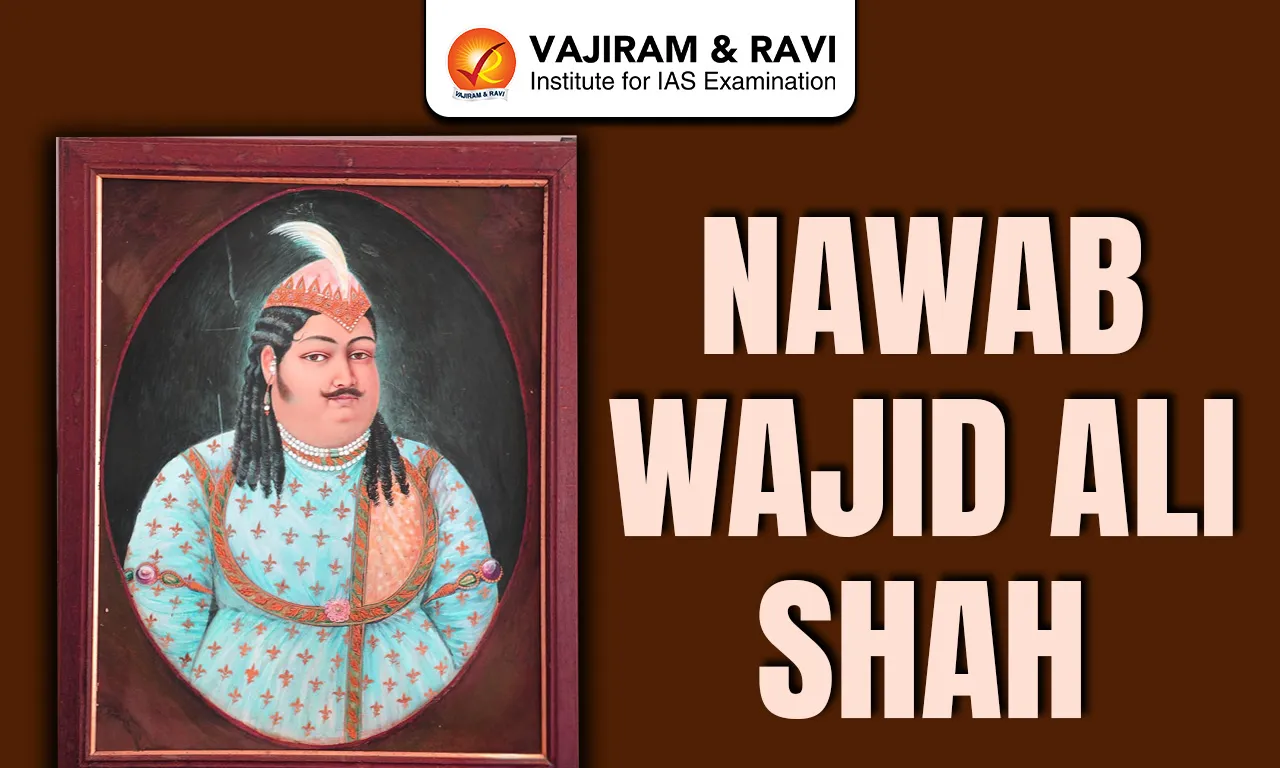
Mirza Wajid Ali Shah, also known as Nawab Wajid Ali Shah, was the eleventh and last ruler of Awadh (Oudh). He governed from 13 February 1847 to 11 February 1856. He inherited a politically fragile yet culturally vibrant kingdom. Though removed by the British East India Company, he emerged as one of the most remarkable cultural monarchs of nineteenth century India. His reign reflects the intersection of colonial expansion, regional politics, and extraordinary artistic brilliance that transformed Lucknow into a celebrated cultural capital.
Nawab Wajid Ali Shah Biography
Nawab Wajid Ali Shah was born on 30 July 1822 in a royal family of Oudh. He was the son of Nawab Amjad Ali Shah and later became the final sovereign of Awadh. He ascended the throne on 13 February 1847 and ruled for nine years. He is known for his compassionate temperament and administrative interest. He combined governance with artistic dedication. After the British annexed Awadh on 11 February 1856, he moved to Metiabruz near Kolkata, where he recreated the refined cultural environment of Lucknow and continued his literary and musical pursuits until his death on 1 September 1887.
Nawab Wajid Ali Shah of Awadh
Nawab Wajid Ali Shah ruled Awadh during intense colonial pressure and strategic British expansion in North India. The major features of his reign are:
- He succeeded Nawab Amjad Ali Shah and became the eleventh ruler of Awadh, assuming authority at a time when British political control had already deepened through earlier treaties.
- Under a prior treaty signed in 1801, large territories of Awadh were ceded, and the kingdom bore the heavy expense of maintaining the Bengal Army, weakening its financial independence.
- After accession, he actively supervised justice delivery, introduced reforms, and reorganised the armed forces to strengthen internal administration.
- General William Sleeman, the British Resident at Lucknow, submitted a report alleging maladministration and lawlessness, which later became the official ground for annexation.
- On 11 February 1856, just before the ninth anniversary of his coronation, the East India Company annexed Awadh under the expansionist policy of Governor-General Lord Dalhousie.
- The removal of Wajid Ali Shah and the takeover of Awadh generated deep resentment among soldiers and elites, becoming one of the major triggers of the Revolt of 1857.
- His second wife, Begum Hazrat Mahal, assumed leadership in Lucknow during 1857 and acted as regent of Awadh in open resistance against British authority.
- After annexation of awadh, he travelled via Kanpur to Calcutta by steamer and arrived at Bichali Ghat near Metiabruz on 13 May 1856 with a large entourage of musicians, attendants, and court members.
- During the uprising of 1857, British authorities detained him at Fort William fearing he might inspire rebel sepoys, while one of his sons was symbolically placed on the Awadh throne.
- However the claims of exile has been denied through a recent translation of biography by the Great-Grandson of Nawab. He claimed that nawab left the city for signing a petition in London but due to restrictions, his journey was adjourned and had to stay in Calcutta.
- Settled at Garden Reach in Metiabruz, he lived on a pension and established a miniature version of Lucknow known as Matiya Burj, preserving courtly traditions despite political loss.


Nawab Wajid Ali Shah Contributions
Nawab Wajid Ali Shah reshaped nineteenth century North Indian culture through music, dance, literature, and architecture. Few of his major contributions are listed below:
- Pen Names and Literary Identity: He wrote under pen names such as “Akhtar” and “Qaisar,” composing Urdu and Persian poetry.
- Poetic Collection: His celebrated work Sawat-ul-Qalub contains 44,562 couplets.
- Writing: In Huzn-i-Akhtar, he described personal suffering and political humiliation after British intervention, offering insight into royal displacement. Another composition Ishqnamah was written in Urdu verse and explores themes of love and emotional sensitivity.
- Patron of Mirza Ghalib: The renowned poet Mirza Ghalib received his patronage, reflecting the Nawab’s encouragement of high literary culture in Lucknow.
- Musical Training: He received instruction from eminent ustads Basit Khan, Pyar Khan, and Jafar Khan, who were direct descendants of Mian Tansen, linking him to classical musical lineage.
- Adoption of ‘Akhtarpiya’: Under the name Akhtarpiya, he composed ghazals and thumris, and his collections Diwan-i-Akhtar and Husn-i-Akhtar preserve these works.
- Thumri: He enriched the light classical form thumri, and popular belief credits him with shaping its refined emotional style.
- Raginis: During his reign, simpler raginis such as tilak, pilu, sendura, khammach, bhairvi, and jhanjhauti became widely appreciated, replacing the dominance of complex dhrupad styles.
- Madanul Moosiqui: Much information about music in Nawabi Lucknow is preserved in the text Madanul Moosiqui, highlighting the structured musical culture of his court.
- Revival of Kathak: Originally performed in temples, Kathak flourished under his patronage and was formally established as the official court dance of Awadh.
- Creation of Rahas: He introduced Rahas, a choreographed dance-drama blending acting, music, and expressive storytelling with changing settings.
- Religious Raas: He also promoted Raas, a devotional performance beginning with dhrupad singing and rooted in spiritual themes.
- Lucknow Gharana: His encouragement led to the emergence of the Lucknow Gharana of Kathak, known for elegance, graceful movements, and emphasis on abhinaya or expressive gestures.
- Hindustani Theatre: Grand spectacles such as Jogia Jashan integrated poetry, music, and dance, laying foundations for modern Hindustani theatre traditions.
- Architecture: Soon after accession, he initiated construction of the Qaiser Bagh palace complex between 1848 and 1850, reflecting royal grandeur and artistic taste.
- Paintings: Awadh-style watercolour paintings flourished in his period, alongside miniature traditions and Mughal-influenced illustrated manuscripts.
- Culinary: Introduced saffron potatoes in Kolkata biryani, promoted dum-pukht cooking, aromatic flavours, eggs addition, and created melt-in-mouth Galawati kebab.
- Unique Dressing Style: Popularised the Angarkha in muslin, chikankari, brocade and velvet, styled with overlapping side-tied panels and distinctive exposed opening.
- Ganga-Jamuni tehzeeb: He showed deep respect for Hindu culture and devotional traditions, blending cultural elements and strengthening Awadh’s composite heritage.

 Last updated on Sep, 2026
→ UPSC 2027 Notification will be released on 13 January 2027 at upsconline.nic.in.
→ Check out the latest UPSC Syllabus here.
→ Download UPSC Model Answers for Mains 2026
→ UPSC Mains Question Paper 2026 is out now for Essay & GS Paper 1, 2, 3 & 4.
→ UPSC Calendar 2027 has been released.
→ Enroll in Vajiram & Ravi’s UPSC Mains Test Series 2027 for structured answer writing practice, expert evaluation, and exam-oriented feedback.
→ Join Vajiram & Ravi’s UPSC Mentorship Program 2027 for personalized guidance, strategy planning, and one-to-one support from experienced mentors.
→ Go through the UPSC Mains Previous Year Papers to enhance your preparation.
→ UPSC has released UPSC Toppers List 2025 with the Civil Services final result on its official website.
→ Also check Best UPSC Coaching in India
Nawab Wajid Ali Shah FAQs
Q1. Who was Nawab Wajid Ali Shah?+
Q2. Why was Awadh annexed in 1856?+
Q3. What was Wajid Ali Shah’s contribution to Kathak?+
Q4. Which literary works were written by Wajid Ali Shah?+
Q5. Where did Wajid Ali Shah spend his later years?+
Tags: modern indian history nawab wajid ali shah