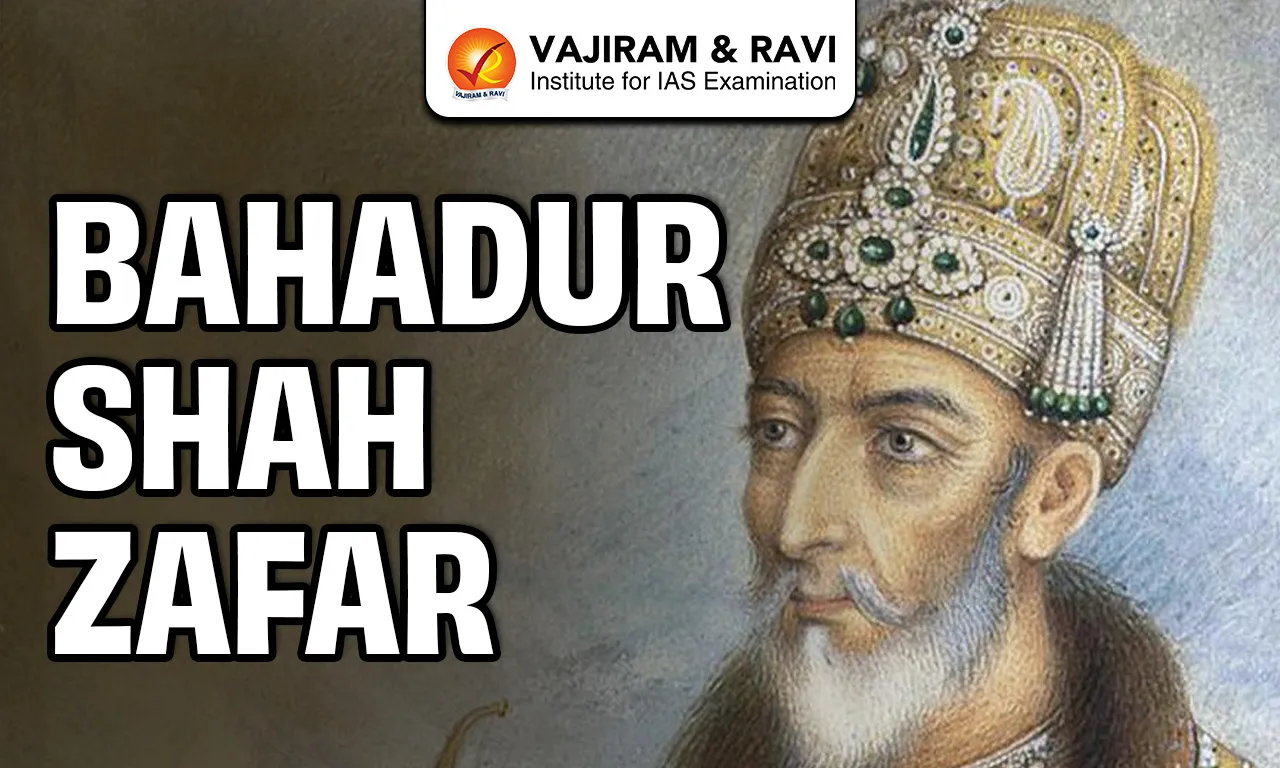
Bahadur Shah Zafar, also known as Abu Zafar Siraj-ud-din Muhammad and Bahadur Shah II, was the twentieth and final Mughal emperor of India. He ruled from 1837 until 1857, when the uprising against the East India Company ended his authority. His rule was mostly limited to the Walled City of Delhi yet in 1857 he was proclaimed Emperor of India by rebel forces. A noted Urdu poet writing under the title “Zafar,” he witnessed exile to Rangoon (present day Yangon) in December 1857, bringing the nearly 500 year old Timurid dynasty to the end.
Bahadur Shah Zafar Biography
Bahadur Shah Zafar was born on 24 October 1775 in Delhi to Akbar II. He was not the preferred heir as another prince, Mirza Jahangir, had earlier been projected for succession. However, after Jahangir attacked Archibald Seton, the British Resident at the Red Fort, and was exiled by the Company, Zafar’s path to the throne became clear. He succeeded his father in 1837 at the age of 62. By then, Mughal authority had shrunk to Delhi and nearby Palam. The East India Company paid him a pension and controlled revenue collection and military presence in the city. His consort was Zeenat Mahal. He passed away while being in exile at Rangoon in November 1862.
Bahadur Shah Zafar in Revolt of 1857
In 1857, rebel sepoys declared Bahadur Shah Zafar as the Emperor of India despite his limited authority and advanced age.
- On 12 May 1857, sepoy regiments reached the Mughal court and attended his first formal audience in years. They insisted on his leadership, arguing that without his symbolic authority, their campaign against the Company would fail.
- Initially, he expressed inability to support them due to lack of resources. However, under pressure, he allowed his name and seal to legitimize their cause, transforming a military revolt into a broader political challenge.
- On 16 May 1857, fifty-two European prisoners were executed under a peepul tree near the palace despite his objections. Though not proven to have ordered it, he was later treated as morally responsible.
- Delhi’s governance during the uprising became disorganized. The emperor appointed his eldest son, Mirza Mughal, as commander. Yet sepoys rejected centralized command, and city administration functioned in a disorderly manner.
- As British forces closed in during September 1857, he sought refuge at Humayun’s Tomb. Major William Hodson captured him on 20 September. Shortly after, Hodson executed his sons Mirza Mughal and Mirza Khizr Sultan, and grandson Mirza Abu Bakht near the Delhi Gate.
- In April 1858, he faced a 21-day trial with 19 hearings, 21 witnesses, and over 100 Persian and Urdu documents translated into English. Charges included aiding mutiny, waging war, assuming sovereignty, and involvement in killings.
- At 82, he argued that sepoys forced decisions upon him and even used his seal without consent. Though spared execution, he was exiled on 7 October 1858 to Rangoon (Yangon) in Burma under British escort.
- He arrived in Burma (Myanmar) at the age of 83 and lived under strict supervision. His health declined, and by November 1862 he suffered paralysis in the throat region. He died on 7 November 1862 and was buried near the Shwedagon Pagoda.
Also Read: Mughal Empire


Bahadur Shah Zafar Contributions
Despite political weakness, Bahadur Shah Zafar left enduring literary, cultural, and spiritual legacies as highlighted below:
- Urdu Poetry and Ghazals: He composed numerous Urdu ghazals reflecting exile, faith, and loss. Though some manuscripts were destroyed in 1857, surviving works were compiled into the Kulliyyat-i-Zafar, preserving his poetic voice.
- Patronage of Scholars: His court hosted distinguished literary figures such as Mirza Ghalib, Daagh Dehlvi, Momin Khan Momin, and Mohammad Ibrahim Zauq, who also mentored him. This made Delhi a major center of Urdu culture.
- Sufi Identity: Regarded as a Sufi Pir, he accepted disciples and was described by Delhi Urdu Akhbaar as a leading saint of his time. Before accession, he reportedly lived like a modest scholar rather than a royal prince.
- Religious Harmony: In his verses, he expressed that Hinduism and Islam shared a common spiritual essence. His court celebrated festivals like Holi, Diwali, and Rakhi alongside Islamic observances, reflecting composite Mughal culture.
- Belief in Spiritual Practices: He trusted ta’aviz, charms, and spiritual remedies. During illness, he consulted Sufi pirs and even distributed cows, elephants, and horses to religious institutions and the poor as acts of devotion.
- Symbol of Resistance: After defeat, he recited lines- “गाजियों में बू रहेगी जब तलक ईमान की, तख्त-ए- लंदन तक चलेगी तेग हिन्दुस्तान की।”. These words elevated him as a moral symbol of resistance.
- End of Timurid Dynasty: His exile formally ended the Timurid Dynasty founded by Timur and followed by Babur as the Mughal Dynasty. With his removal, governance of India shifted fully under British Crown authority.
- Exile: Initially buried in an unmarked grave in Yangon, his resting place later became the Bahadur Shah Zafar Dargah after restoration in 1991, symbolizing remembrance beyond imperial power.

 Last updated on Sep, 2026
→ UPSC Mains Question Paper 2026 is out now for Essay & GS Paper 1, 2, 3 & 4.
→ UPSC Mains GS Paper 1 2026 is out now.
→ UPSC Mains GS Paper 2 2026 is out now.
→ UPSC Mains GS Paper 3 2026 is out now.
→ UPSC Mains GS Paper 4 2026 is out now.
→ UPSC Mains Indian Language Paper & English Compulsory Paper are out now.
→ Check out the latest UPSC Syllabus 2026 here.
→ UPSC Mains Admit Card 2026 is now out.
→ Enroll in Vajiram & Ravi’s UPSC Mains Test Series 2027 for structured answer writing practice, expert evaluation, and exam-oriented feedback.
→ Join Vajiram & Ravi’s UPSC Mentorship Program 2027 for personalized guidance, strategy planning, and one-to-one support from experienced mentors.
→ Go through the UPSC Mains Previous Year Papers to enhance your preparation.
→ Download UPSC Mains Essay Paper 2025, UPSC Mains GS Paper-I 2025, UPSC Mains GS Paper-II 2025, UPSC Mains GS Paper-III 2025, UPSC Mains GS Paper-IV 2025, UPSC Mains English (Compulsory) Paper 2025, UPSC Mains Hindi (Qualifying) Paper 2025 here.
→ UPSC has released UPSC Toppers List 2025 with the Civil Services final result on its official website.
→ UPSC Calendar 2027 has been released.
→ Also check Best UPSC Coaching in India
Bahadur Shah Zafar FAQs
Q1. Who was Bahadur Shah Zafar?+
Q2. What was the role of Bahadur Shah Zafar in the Revolt of 1857?+
Q3. What were the main charges against Bahadur Shah Zafar?+
Q4. Where was Bahadur Shah Zafar exiled?+
Q5. Who were some famous poets in Bahadur Shah Zafar’s court?+
Tags: bahadur shah zafar