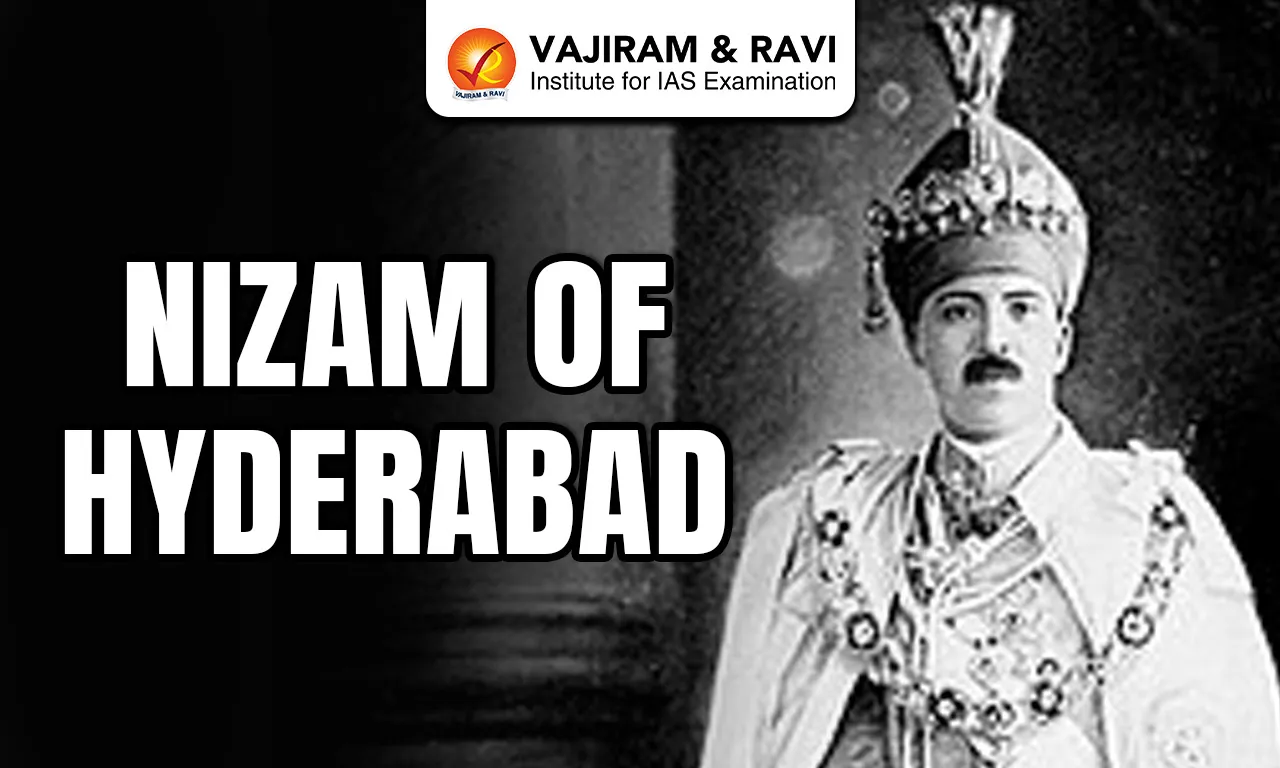
The Nizam of Hyderabad was the hereditary ruler of Hyderabad State, a vast princely dominion covering present day Telangana, Marathwada in Maharashtra and Kalyana Karnataka. The title originated from the Persian phrase Nizam-ul-Mulk, meaning “Administrator of the Realm,” first granted to Mir Qamar-ud-din Khan by Mughal Emperor Farrukhsiyar. Beginning in 1724, the Asaf Jahi dynasty governed this region for 224 years until Hyderabad’s integration into the Indian Union on 17 September 1948, shaping the political, economic and cultural character of the Deccan.
Nizam of Hyderabad
The word “Nizam” derives from Persian niẓām, meaning order or arrangement. The Nizams were semi-independent sovereigns who emerged from the weakening Mughal Empire and later functioned as princely allies under British paramountcy. Asaf Jahi Dynasty was founded by Chin Qilich Khan (Mir Qamar-ud-din Khan), titled Asaf Jah I and Nizam-ul-Mulk, the dynasty maintained nominal allegiance to the Mughal emperor while exercising autonomous control from Hyderabad. Over time, the Nizams navigated conflicts with the Marathas, treaties with the British East India Company and global political shifts. By the twentieth century, Hyderabad had become the largest princely state in India, ruled by seven officially recognized Nizams.
Nizam of Hyderabad History
The evolution of the Nizam of Hyderabad authority reflects Mughal decline, Maratha pressure and British expansion across the Deccan region.
- Appointment: In 1713, Mughal Emperor Farrukhsiyar appointed Mir Qamar-ud-din Khan as Viceroy of the Deccan and conferred the honorific Nizam-ul-Mulk, marking the formal beginning of Asaf Jahi authority.
- Early Mughal Career: Mir Qamar-ud-din earlier served under Emperor Aurangzeb and held prominent court positions, including the office of wazir under Emperor Muhammad Shah before returning permanently to the Deccan.
- Foundation of Autonomy: In 1724, he defeated Mubariz Khan and established effective independence in Hyderabad while continuing symbolic recognition of Mughal sovereignty through coinage and Friday sermons.
- Asaf Jahi Dynasty: The dynasty, named after the title Asaf Jah, ruled from Hyderabad city and maintained its own court, army and revenue system for more than two centuries.
- Period of Succession Conflict: After the death of Asaf Jah I in 1748, Nasir Jung, Muzaffar Jung and Salabat Jung contested succession for about 13 years, creating political instability without firm imperial recognition.
- Nizam-Maratha Conflicts: From the 1720s onward, the Nizams fought multiple campaigns against the Marathas, including battles at Palkhed, Bhopal, Rakshasbhuvan and Kharda, ultimately agreeing to pay Chauth as tribute.
- Nizam-British Relations: Following defeat at Kharda and changing power balances, the Nizam accepted British protection, aligning Hyderabad with the East India Company’s expanding authority.
- Treaty of Machilipatnam 1768: Asaf Jah II signed this treaty, surrendering coastal territories in exchange for fixed annual rent, formally deepening British influence in Hyderabad’s external affairs.
- Princely State under British Crown: After 1858, Hyderabad became part of the British Indian Empire as an autonomous princely state under the Crown, while retaining internal administrative control.
- Entitlement by British: The Nizams received the unique style “His Exalted Highness” and were regarded as “Faithful Ally of the British Government” for military support during key imperial conflicts.
- Berar Separation 1903: The Berar region was separated from Hyderabad and merged with the Central Provinces to form Central Provinces and Berar under British administration.
- Military Contribution in World War II: During the Second World War, around 80,000 troops raised by the Nizam formed the 19th Hyderabad Regiment, serving in Malaya, North Africa, Persia, Singapore and Burma.
- Hyderabad’s Territorial Extent: At its height, Hyderabad covered approximately 223,000 square kilometers, making it the largest princely state in India before independence.
- Revenue and Population: By 1948, Hyderabad had nearly 17 million inhabitants and generated an estimated annual revenue of £90,029,000, reflecting substantial economic capacity.
- Currency System: Hyderabad maintained its own currency known as the Hyderabadi Rupee until 1951, signifying fiscal autonomy even under British paramountcy.
- Golconda Mines: The prosperity of the state was linked to the Golconda mines, once the principal global source of diamonds before South African discoveries altered the market.
- Operation Polo 1948: On 13 September 1948, the Indian Army launched Operation Polo; within five days the Nizam surrendered and Hyderabad formally acceded to India on 17 September 1948.
- Post-Accession Role: After accession of Hyderabad, the last Nizam served as Rajpramukh of Hyderabad State before his death on 24 February 1967, marking the formal end of dynastic political authority.


Nizam of Hyderabad List of Rulers
Seven officially recognized Nizams governed Hyderabad between 1724 and 1948 under the Asaf Jahi line.
- Asaf Jah I (1724-1748): Mir Qamar-ud-din Khan founded the dynasty, secured Deccan autonomy in 1724 and maintained symbolic Mughal allegiance while exercising practical sovereignty from Hyderabad.
- Nasir Jung (1748-1750): Mir Ahmed Ali Khan briefly ruled during the succession crisis after his father’s death, reflecting instability rather than consolidated dynastic authority.
- Muzaffar Jung (1750-1751): Mir Hidayat Muhi-ud-din Sa’adullah Khan ascended with external backing but died within months, preventing durable governance.
- Salabat Jung (1751-1762): Mir Sa’id Muhammad Khan held power during continued turbulence until displaced, concluding the prolonged interregnum phase.
- Asaf Jah II (1762-1803): Mir Nizam Ali Khan restored stability, signed the 1768 Machilipatnam treaty and managed complex relations with both Marathas and the British.
- Asaf Jah III (1803-1829): Mir Akbar Ali Khan, known as Sikander Jah, ruled during expanding British supremacy, maintaining Hyderabad’s internal administration under indirect rule.
- Asaf Jah IV (1829-1857): Mir Farqunda Ali Khan governed amid fiscal challenges, navigating debt pressures and territorial adjustments with British authorities.
- Asaf Jah V (1857-1869): Mir Tahniyath Ali Khan’s tenure coincided with administrative reforms, including modernization of communication networks and infrastructure expansion.
- Asaf Jah VI (1869-1911): Mir Mahbub Ali Khan ascended as a minor and ruled during rapid institutional development, overseeing modernization in railways and civic services.
- Asaf Jah VII (1911-1948): Mir Osman Ali Khan became globally renowned for immense wealth, established Osmania University and ruled until Hyderabad’s Accession in 1948.
Nizam of Hyderabad Contributions
The Nizams significantly shaped governance, infrastructure, education, philanthropy and cultural institutions across Hyderabad State. The major contributions of the Nizam of Hyderabad include:
- Railway Development: The Nizam’s Guaranteed State Railway expanded connectivity across the Deccan, facilitating industrial growth and linking interior regions with major trade centers.
- Irrigation Reservoirs: Major reservoirs such as Osman Sagar and Himayat Sagar were commissioned to improve water supply, urban planning and agricultural sustainability.
- Nagarjuna Sagar Dam: Preliminary survey work for the Nagarjuna Sagar Dam began during Nizam rule, though final construction occurred after independence.
- Architecture: Landmark buildings including Telangana High Court, City College, Jubilee Hall, Asafia Library and the Assembly building were constructed during their reign. Grand residences such as Chowmahalla Palace, Purani Haveli, Falaknuma Palace, King Kothi Palace and Hill Fort Palace reflect architectural patronage.
- Medical Infrastructure: Institutions such as Niloufer Hospital and Osmania Medical College strengthened public healthcare and medical education in Hyderabad.
- Osmania University Establishment: Founded during the reign of the seventh Nizam, it became the first princely state university using Urdu as medium of instruction.
- Hyderabad Civil Service: Inspired by the Indian Civil Service model, the Nizams created a structured Hyderabad Civil Service for efficient internal administration.
- Military Organization: The Hyderabad State Forces, including the 19th Hyderabad Regiment, demonstrated organized military capacity within princely frameworks.
- Fiscal Administration Reform: Mir Osman Ali Khan cleared state debts, restored budget surplus and rationalized revenue management during his early reign.
- Global Wealth Recognition: In 1937, Mir Osman Ali Khan was regarded as the richest person globally, with an estimated ₹660 crores, later valued by adjusted calculations at over US$200 billion.
- Interfaith Philanthropy: The Nizams donated a large amount of financial and land grants to various Hindu temples, churches and Sikh gurudwaras.
- Modernization: Electricity, roadways and early aviation infrastructure were introduced, transforming Hyderabad into a modern administrative capital.

 Last updated on Oct, 2026
→ UPSC 2027 Notification will be released on 13 January 2027 at upsconline.nic.in.
→ Asian Games 2026 are being held in Aichi-Nagoya, Japan, from 19 September to 4 October.
→ Check Nobel Prize 2026 Winners List here.
→ Download PIB PRiSM Monthly Magazine 2026 here.
→ Check UPSC Monthly Current Affairs Magazine The Recitals here.
→ Check out the latest UPSC Syllabus here.
→ Download UPSC Model Answers for Mains 2026
→ UPSC Mains Question Paper 2026 is out now for Essay & GS Paper 1, 2, 3 & 4.
→ UPSC Calendar 2027 has been released.
→ Enroll in Vajiram & Ravi’s UPSC Mains Test Series 2027 for structured answer writing practice, expert evaluation, and exam-oriented feedback.
→ Join Vajiram & Ravi’s UPSC Mentorship Program 2027 for personalized guidance, strategy planning, and one-to-one support from experienced mentors.
→ Go through the UPSC Mains Previous Year Papers to enhance your preparation.
→ UPSC has released UPSC Toppers List 2025 with the Civil Services final result on its official website.
→ Also check Best UPSC Coaching in India
Nizam of Hyderabad FAQs
Q1. Who was the first Nizam of Hyderabad?+
Q2. How long did the Nizams rule Hyderabad?+
Q3. Why was the last Nizam of Hyderabad famous worldwide?+
Q4. What was Operation Polo?+
Q5. What were the major contributions of the Nizam of Hyderabad?+
Tags: history modern history nizam of hyderabad