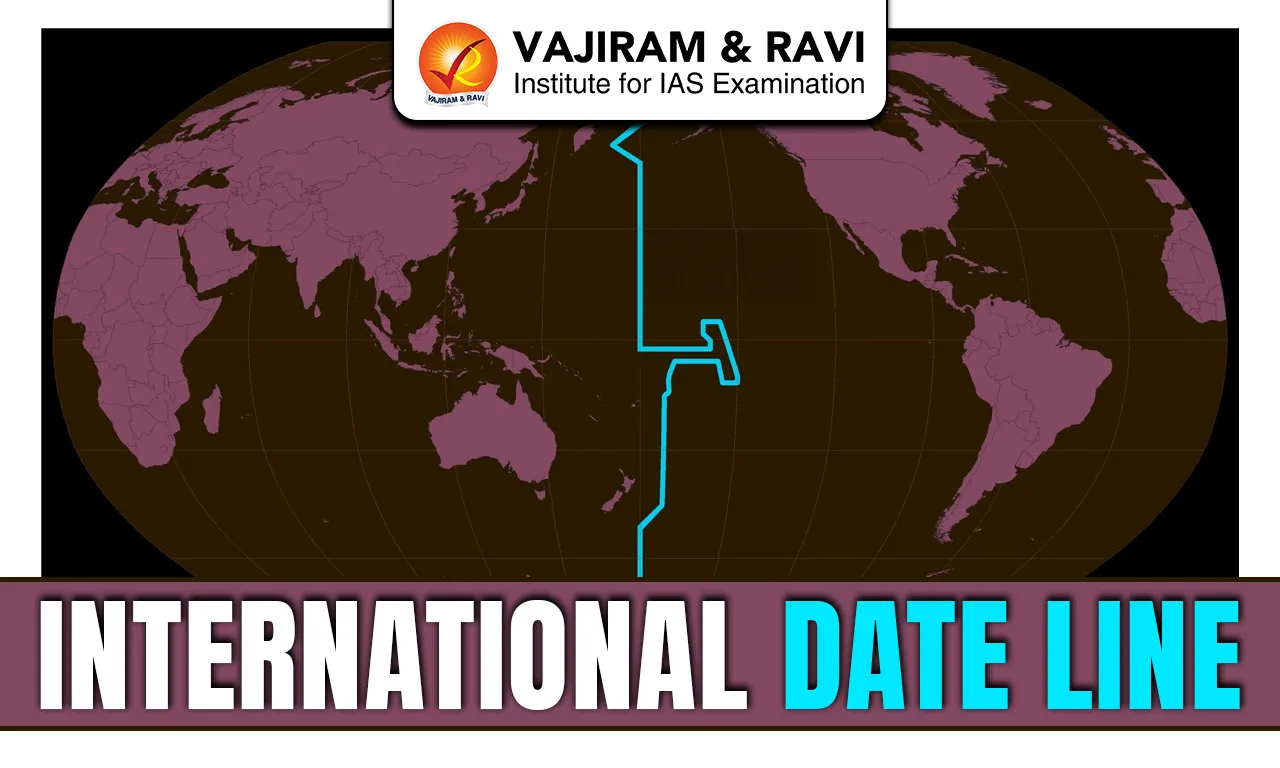
International Date Line (IDL) is an imaginary line on the Earth’s surface that separates two consecutive calendar dates. It roughly follows the 180° longitude and runs through the mid-Pacific Ocean from the North Pole to the South Pole.
It was formally recognized at the International Meridian Conference, Washington D.C., in 1884, where the 180th meridian was chosen as the basis of the date line because it passes largely through sparsely populated oceanic areas.
International Date Line (IDL) Location
- It originates at 180° longitude and passes through the Bering Strait.
- It is zigzag (not a straight line) to avoid dividing countries or islands into different dates, allowing nations to choose which time zone to follow.
- For example: It curves around island nations like Kiribati to keep the entire country on the same calendar day.
Also Read: Latitude and Longitude
International Date Line (IDL) Function and Significance
- The IDL acts as a “Line of Demarcation” between two calendar days.
- When the International Date Line is crossed, the date changes. Crossing westward adds one day, while crossing eastward subtracts one day.
- This system prevents confusion in global timekeeping and ensures uniform adjustment after circumnavigation of the globe.




International Date Line (IDL) Need
The International Date Line is a consequence of the global time zone system, where the Earth is divided into 24 time zones based on longitude. If a person travels around the world adjusting their watch by one hour in each time zone, they would end up with a one-day difference compared to those who stayed at the starting point. The IDL corrects this discrepancy by standardizing the date change at a single reference line.
International Date Line (IDL) Legal Status
- International Date Line (IDL) has no legal international status.
- Countries are free to decide their own time zones and date observance.
- Therefore, the line shifts when nations adjust their time zones for economic or political reasons.
- Examples: In 1994, Kiribati shifted the line eastward to keep all its islands on the same day. In 2011, Samoa moved west of the date line to improve trade links with Australia and New Zealand, effectively skipping December 30, 2011.

 Last updated on July, 2026
→ UPSC Prelims Result 2026 is now out.
→ UPSC IFoS Prelims Result 2026 is now out.
→ Enroll in Vajiram & Ravi’s UPSC Mains Test Series 2026 for structured answer writing practice, expert evaluation, and exam-oriented feedback.
→ Join Vajiram & Ravi’s UPSC Mentorship Program 2026 for personalized guidance, strategy planning, and one-to-one support from experienced mentors.
→ Join Vajiram & Ravi’s UPSC Mentorship Program 2027 for personalized guidance, strategy planning, and one-to-one support from experienced mentors.
→ UPSC Prelims Provisional Answer Key 2026 out for GS Paper 1 and CSAT.
→ UPSC Prelims Question Paper 2026 Out, Download GS Paper 1 PDF conducted on 24th May 2026.
→ UPSC Mains 2026 will be conducted from 21st August 2026 onwards, and UPSC Prelims 2027 will be held on 23rd May 2027.
→ UPSC Final Result 2025 is now out.
→ UPSC has released UPSC Toppers List 2025 with the Civil Services final result on its official website.
→ Anuj Agnihotri secured AIR 1 in the UPSC Civil Services Examination 2025.
→ UPSC Notification 2026 & UPSC IFoS Notification 2026 is now out on the official website at upsconline.nic.in.
→ UPSC Calendar 2027 has been released.
→ Check out the latest UPSC Syllabus 2026 here.
→ The UPSC Selection Process is of 3 stages-Prelims, Mains and Interview.
→ Shakti Dubey secures AIR 1 in UPSC CSE Exam 2024.
→ Also check Best UPSC Coaching in India
International Date Line FAQs
Q1. What is the International Date Line (IDL)?+
Q2. Where is the International Date Line located?+
Q3. What happens when the International Date Line is crossed?+
Q4. Why is the International Date Line necessary?+
Q5. Does the International Date Line have legal status?+
Tags: international date line