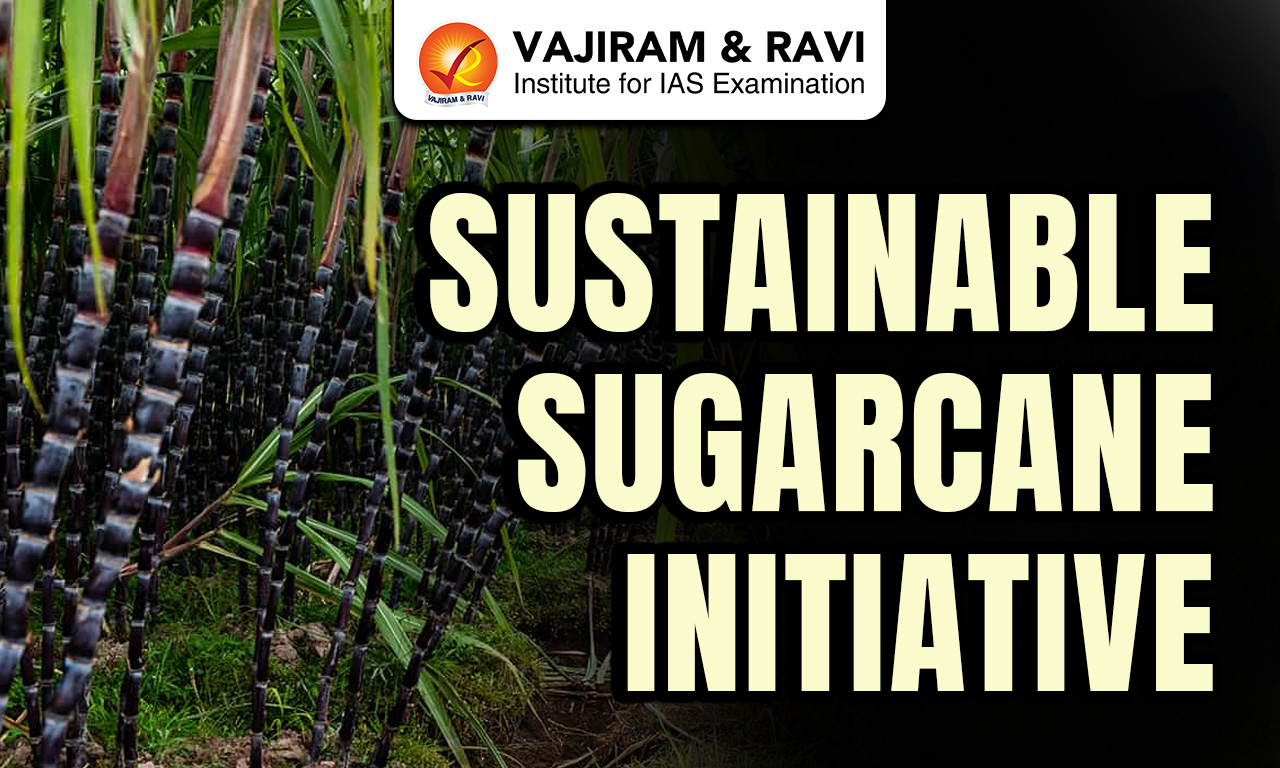
The Sustainable Sugarcane Initiative (SSI) is an improved method of cultivating sugarcane that focuses on higher productivity with lower use of water, seeds and fertilizers. It promotes practices such as planting young seedlings instead of cane sets, wider spacing between plants, and better soil and water management. SSI aims to increase farmers’ income while conserving natural resources and reducing environmental damage.
About Sustainable Sugarcane Initiative
- It is an improved method of sugarcane cultivation that focuses on higher yield with fewer resources.
- Farmers use fewer seeds and raise seedlings in nurseries instead of planting cane sets directly.
- It promotes wider spacing between plants and better management of water and nutrients.
- Sugarcane production can increase by around 20% while using about 30% less water and fewer chemical fertilizers.
- It reduces pressure on water resources and lowers environmental damage.
- The method benefits small and marginal farmers by reducing input costs and increasing income.
- It also allows intercropping, which provides additional income to farmers.
- The initiative has received technical and financial support under government programs like the Umbrella Programme for Natural Resource Management (UPNRM).
Sustainable Sugarcane Initiative Objectives
- To increase sugarcane productivity while reducing the use of seeds, water and chemical fertilizers.
- To encourage farmers to raise seedlings in nurseries using single-bud chips instead of planting traditional cane sets.
- To transplant healthy seedlings (25-35 days old) into the main field for better survival and growth.
- To maintain wider spacing (about 5 × 2 feet) between plants to improve yield.
- To promote efficient water management through methods like drip irrigation and fertigation.
- To encourage balanced nutrient management and greater use of organic and eco-friendly plant protection practices.


Sustainable Sugarcane Initiative Features
- The Sustainable Sugarcane Initiative is implemented with the support of organizations such as Maharashtra Sugar Cooperatives, NABARD and the Umbrella Programme for Natural Resource Management (UPNRM).
- India is the second-largest producer of sugarcane in the world and sugar production supports the livelihood of nearly 3.5 crore (35 million) farmers. SSI is therefore important for rural income and agricultural sustainability.
- The initiative promotes eco-friendly and scientific farming practices to improve productivity while conserving natural resources.
- Farmers are encouraged to adopt SSI through financial assistance, supply of quality seedlings at subsidized rates, exposure visits, and support for organic manure use.
- Institutions like the Vasantdada Sugar Institute (VSI), Pune, have supported farmers by providing single-bud seedlings and technical guidance.
- The method encourages intercropping with crops like groundnut and soybean to increase farmers’ income and ensure better land utilization.
- Large areas (around 280 acres in some projects) have been brought under drip irrigation and SSI cultivation, showing its scalability.
- Field experiments combining drip irrigation and SSI have significantly improved productivity from about 60 metric tonnes per acre under traditional flood irrigation to around 90 metric tonnes per acre.
Sustainable Sugarcane Initiative Advantages
- Efficient use of resources: SSI reduces the use of seeds, water and chemical fertilizers through drip irrigation and balanced fertigation. Water use can be reduced by 30-50%, helping conserve scarce water resources.
- Higher productivity with lower costs: Better spacing, healthy nursery seedlings and scientific practices increase yields by around 20-30%, while reducing cultivation costs by nearly 20-25%. Farmers can also earn extra income through intercropping.
- Improved crop quality and survival: Transplanting strong seedlings reduces plant mortality and the need for gap filling. Better sunlight and air circulation improve cane quality and sugar content.
- Higher farmer income and savings: Due to increased yield and reduced input costs, farmers can save a substantial amount per acre, improving their overall profitability.
- Employment and social benefits: Nursery raising of seedlings creates rural employment opportunities for both men and women and promotes awareness of scientific farming methods.
- Environmental sustainability: Reduced chemical use and lower water consumption help protect soil health, conserve ecosystems, and support long-term agricultural sustainability.
Sugarcane Industry in India
- Sugarcane is cultivated in most parts of India except the very cold and hilly regions such as Jammu & Kashmir, Himachal Pradesh, and Arunachal Pradesh, where low temperatures and short growing seasons are not suitable for the crop.
- In India, sugarcane is mainly grown in two major agro-climatic regions – the tropical region and the subtropical region based on differences in climate and growing conditions.
- The tropical region includes states such as Maharashtra, Karnataka, Tamil Nadu, Andhra Pradesh, Gujarat, Madhya Pradesh, Kerala, Goa, and the Union Territory of Puducherry. This region has a warm climate, longer growing season, and better sugar recovery rate. Maharashtra is the leading producer of sugarcane and sugar in this region.
- The subtropical region includes states like Uttar Pradesh, Bihar, Haryana, and Punjab. Although this region has relatively cooler winters and slightly lower sugar recovery rates, it has a large area under cultivation. Uttar Pradesh is the largest producer of sugarcane and sugar in this region as well as in India overall.
- The location of the sugarcane industry depends on factors such as suitable temperature (20-30°C), adequate rainfall or irrigation facilities, fertile alluvial or black soil, availability of labour, and proximity to sugar mills since sugarcane is bulky and must be processed quickly after harvesting.
Challenges to the Indian Sugar Industry
- Low productivity and fluctuating supply: Sugarcane yield per hectare in India is relatively low compared to major sugar-producing countries. In addition, farmers often shift to more profitable crops, leading to unstable sugarcane supply and irregular production for mills.
- Short crushing season and underutilization of capacity: Sugar mills operate only for about 4-7 months during the harvesting period. For the rest of the year, machinery and labour remain underutilized, increasing operational inefficiency and financial burden.
- High cost of production and low recovery rate: Outdated technology, small and inefficient mills, high labour and transportation costs, and low sugar recovery rates increase the overall cost of sugar production, making Indian sugar less competitive globally.
- Policy and regulatory constraints: Government interventions such as dual pricing of sugarcane (FRP and SAP), cane area reservation, minimum distance norms between mills, and export-import restrictions create financial stress and reduce operational flexibility.
- Labour and competition-related issues: Shortage of labour during peak season, rising wages, and diversion of sugarcane towards jaggery or ethanol production further affect the smooth functioning of sugar mills.
UPSC PYQ
What are the significances of a practical approach to sugarcane production known as the ‘Sustainable Sugarcane Initiative’? [UPSC 2024]
- Seed cost is very low in this compared to the conventional method of cultivation.
- Drip irrigation can be practiced very effectively in this.
- There is no application of chemical/inorganic fertilizers at all in this.
- The scope for intercropping is more in this compared to the conventional method of cultivation.
Select the correct answer using the code given below:
- 1 and 3 only
- 1, 2 and 4 only
- 2, 3 and 4 only
- 1, 2, 3 and 4
[Ans – (B)]

 Last updated on Sep, 2026
→ UPSC 2027 Notification will be released on 13 January 2027 at upsconline.nic.in.
→ Check out the latest UPSC Syllabus here.
→ Download UPSC Model Answers for Mains 2026
→ UPSC Mains Question Paper 2026 is out now for Essay & GS Paper 1, 2, 3 & 4.
→ UPSC Calendar 2027 has been released.
→ Enroll in Vajiram & Ravi’s UPSC Mains Test Series 2027 for structured answer writing practice, expert evaluation, and exam-oriented feedback.
→ Join Vajiram & Ravi’s UPSC Mentorship Program 2027 for personalized guidance, strategy planning, and one-to-one support from experienced mentors.
→ Go through the UPSC Mains Previous Year Papers to enhance your preparation.
→ UPSC has released UPSC Toppers List 2025 with the Civil Services final result on its official website.
→ Also check Best UPSC Coaching in India
Sustainable Sugarcane Initiative FAQs
Q1. What is the Sustainable Sugarcane Initiative (SSI)?+
Q2. How is SSI different from the traditional method?+
Q3. What are the main benefits of SSI?+
Q4. Which institutions support SSI?+
Q5. Where is sugarcane mainly grown in India?+
Tags: environment environment notes Sustainable Sugarcane Initiative