The Karkota Dynasty was one of the most influential ruling houses of early medieval Kashmir, flourishing roughly between 625 CE and 855 CE. It transformed Kashmir from a relatively isolated Himalayan region into a politically powerful and culturally vibrant kingdom. The dynasty is remembered for administrative consolidation, military expansion, and patronage of religion, art, and literature. Under rulers such as Durlabhavardhana and especially Lalitaditya Muktapida, Kashmir developed strong diplomatic links with Central Asia, China, and northern India. The Karkota period marked an important phase in the development of Kashmiri identity, architecture, intellectual traditions, and regional power in the early medieval Indian subcontinent.
Karkota Dynasty
The Karkota Dynasty ruled the Kashmir valley and surrounding northern regions from the 7th to the mid-9th century CE and is widely regarded as a golden age of Kashmiri political power and cultural achievements. The dynasty unified the region after earlier dynasties weakened and gradually expanded its influence across northern India and Central Asia. Its rulers strengthened administration, trade, and agricultural productivity, which brought prosperity to the valley. The dynasty’s most famous ruler, Lalitaditya Muktapida, built a large empire and promoted monumental temple construction. Even after its fall around 855 CE, the Karkota legacy continued to shape Kashmiri culture, scholarship, architecture, and religious traditions.
Karkota Dynasty History
The dynasty rose after earlier rulers weakened and gradually transformed Kashmir into a powerful regional kingdom with strong political influence.
- Foundation of the Dynasty: The Karkota Dynasty was founded by Durlabhavardhana around 625 CE. He originally served under the last Gonanda ruler and became king after marrying Princess Anangalekha, establishing a new ruling line in Kashmir.
- Origin of the Name Karkota: The dynasty derived its name from the mythical Naga deity Karkotaka, revered in Kashmiri tradition. This association symbolised divine legitimacy and reinforced the dynasty’s connection with regional religious traditions.
- Political Consolidation: During the early phase, rulers focused on stabilising Kashmir after earlier political turbulence. Administrative structures were strengthened and internal conflicts were reduced, allowing the kingdom to grow economically and militarily.
- Expansion of Territory: Over time the dynasty expanded its control beyond the Kashmir valley. Its influence extended to Punjab, parts of northern India, and areas linking the subcontinent with Central Asian trade networks.
- Rise of Imperial Power: The reign of Lalitaditya Muktapida in the 8th century marked the peak of Karkota political authority. Military campaigns reportedly extended Kashmiri influence from Afghanistan to the Gangetic plains.
- Diplomatic Relations with China: Chinese chronicles of the Tang dynasty record diplomatic missions between Kashmir and the Chinese imperial court. Envoys from Kashmir visited China and maintained trans-Himalayan political relations.
- Defence Against Foreign Threats: During Chandrapida’s reign, Kashmir faced Arab expansion in north-western India. Despite limited external assistance, the kingdom successfully defended its territory from such incursions.
- Sources of Historical Knowledge: Much of the history of the dynasty is reconstructed from literary works such as the Rajatarangini by Kalhana and accounts of Chinese travellers like Xuanzang, Yijing, and Wukong.


Karkota Dynasty Administration
The dynasty developed a structured administrative system combining royal authority, regional governance, taxation mechanisms, and military organisation.
- Centralised Monarchy: The king was the supreme authority in the Karkota administration. He controlled political, military, and judicial powers and was regarded as divinely ordained ruler responsible for maintaining order and prosperity.
- Council of Ministers: The ruler was assisted by ministers called amatyas. These officials supervised important departments such as finance, military affairs, justice, and religious administration.
- Provincial Administration: The kingdom was divided into provinces governed by officials known as deshadhipatis or vishayapatis. These officers supervised revenue collection, law enforcement, and local governance.
- Revenue System: Land revenue formed the backbone of the economy. Agricultural taxes were collected from farmers cultivating fertile crops such as rice, saffron, and fruits in the Kashmir valley.
- Trade Regulation: The state supervised trade routes connecting Kashmir with Central Asia, Punjab, and northern India. Customs duties and market taxes contributed significantly to state income.
- Currency and Exchange: Metallic coins issued by Karkota rulers circulated widely. Cowrie shells were also used in everyday economic transactions in local markets.
- Military Organisation: The Karkota army consisted of infantry, cavalry, and war elephants. Hill tribes skilled in mountain warfare also served as auxiliary forces.
- Taxation Practices: The state imposed several taxes including customs duties, market taxes, and specialised levies such as prostitution taxes and trade duties mentioned in literary sources.
Karkota Dynasty Rulers
Several rulers governed Kashmir during the Karkota period, but a few monarchs played particularly significant roles in expanding and shaping the kingdom.
- Durlabhavardhana (c. 625-662 CE): Founder of the dynasty who established political stability in Kashmir. His rule strengthened administration and laid the foundation for future expansion and prosperity.
- Durlabhaka Pratapaditya (c. 662-712 CE): Son of the founder who ruled for nearly fifty years. His reign witnessed growth in trade, agriculture, and artistic development within the kingdom.
- Chandrapida (c. 712-720 CE): Known for diplomacy with the Tang dynasty of China. He sent envoys seeking assistance against Arab invasions and maintained friendly international relations.
- Tarapida (c. 720-724 CE): His rule lasted only a few years and was marked by internal unrest. Literary sources describe him as a harsh ruler whose policies alienated sections of society.
- Lalitaditya Muktapida (c. 724-760 CE): The greatest ruler of the dynasty who expanded Kashmir’s influence across northern India, Afghanistan, and Central Asia through ambitious military campaigns.
- Kuvalayapida (mid-8th century CE): A short-reigning ruler who abdicated the throne after internal conflicts and reportedly withdrew to a religious life.
- Vajraditya (c. 760-770 CE): His reign witnessed political instability and raids from neighbouring regions. Literary accounts portray him as a controversial ruler.
- Jayapida (late 8th century CE): Known for military campaigns and patronage of literature and scholarship. His court attracted scholars, poets, and philosophers from different regions.
- Later Karkota Rulers: Kings such as Lalitapida, Samgramapida II, and Cippatajayapida ruled during the final phase. Their reigns witnessed growing political fragmentation and administrative weakness.
Also Read: Khilji Dynasty
Karkota Dynasty Art and Architecture
The Karkota period produced significant achievements in architecture, sculpture, literature, and artistic traditions across Kashmir.
- Temple Architecture: The dynasty developed a distinctive Kashmiri temple style featuring rectangular courtyards, stone colonnades, and pyramidal roofs influenced by Gandhara and Gupta traditions.
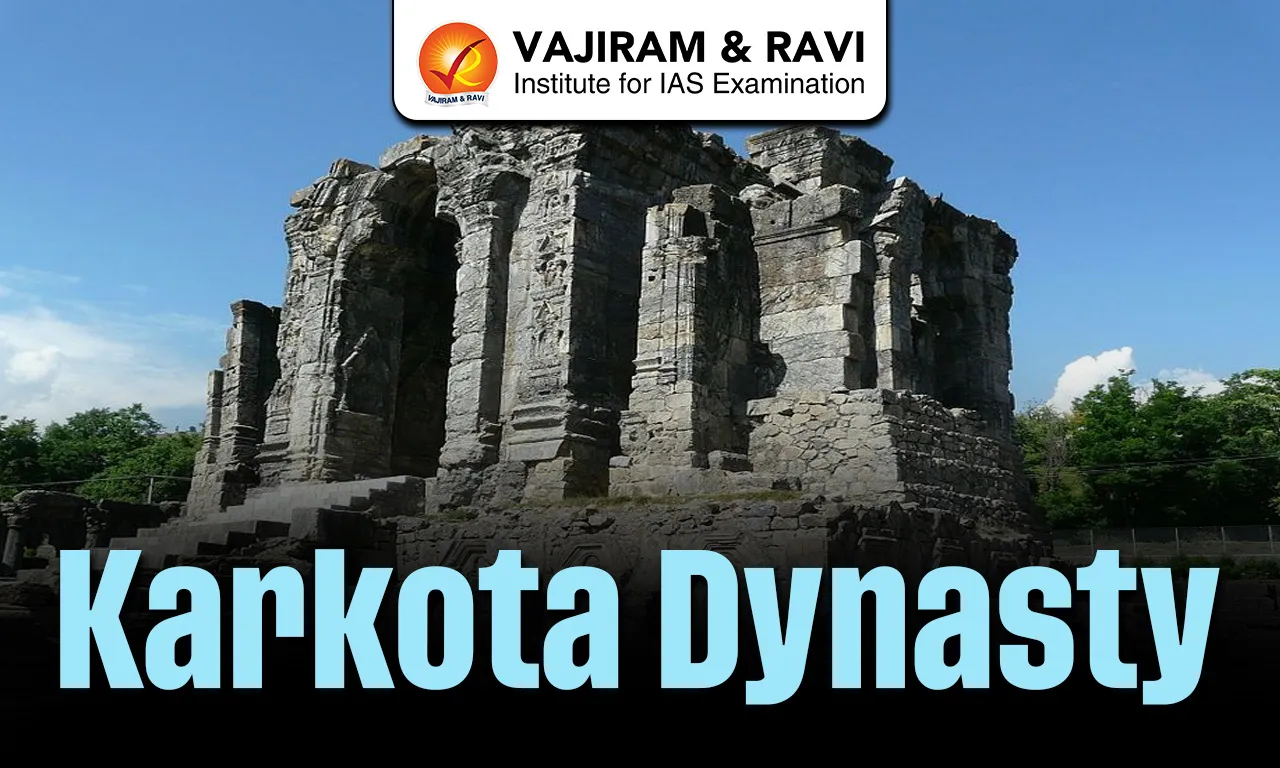
- Martand Sun Temple: Built by Lalitaditya near present-day Anantnag, the Martand Sun Temple was one of the largest temple complexes of early medieval India constructed from massive limestone blocks.
- Wangath Temple Complex: Another important temple group associated with Karkota architecture showing elaborate carvings and symmetrical layouts typical of Kashmiri stone architecture.
- Pandrethan Temple: This temple represents the refined architectural style of Kashmir with precise stone masonry and a square sanctum surrounded by decorative elements.
- Stone and Metal Sculpture: Sculptures depicting deities such as Vishnu, Shiva, and Surya reached a high level of artistic sophistication with graceful forms and intricate detailing.
- Literary Developments: Works such as the Nilamata Purana and Vishnudharmottara Purana provide insight into religion, geography, and cultural life during the early Karkota period.
- Scholarly Patronage: Jayapida’s court supported scholars like Vamana and Udbhatta who contributed to literary criticism, Sanskrit poetics, and philosophical debates.
- Major Literary Works: The Kuttanimata by Damodaragupta and Haravijaya by Ratnakara illustrate the flourishing of Sanskrit literature under Karkota patronage.
- Artistic Exchanges: The dynasty encouraged interaction with Central Asian and Indian artistic traditions, resulting in unique cultural synthesis in Kashmiri art.
Karkota Dynasty Culture
The dynasty fostered a vibrant cultural environment combining religion, learning, social traditions, and intellectual activity.
- Religious Diversity: Karkota rulers were primarily Hindu, particularly followers of Shaivism and Vaishnavism, but they also patronised Buddhism, creating a religiously tolerant environment.
- Buddhist Influence: Buddhist monasteries, stupas, and viharas continued to exist alongside Hindu temples, reflecting the coexistence of different religious traditions.
- Sanskrit Scholarship: Kashmir emerged as an important centre of Sanskrit learning where scholars studied philosophy, grammar, poetics, and theology.
- Migration of Scholars: Brahmin scholars from regions such as the Indus valley and southern India migrated to Kashmir and contributed to intellectual life.
- Transmission of Buddhist Thought: Scholars from Kashmir helped transmit Buddhist teachings to Central Asia and East Asia, strengthening cross-regional intellectual exchange.
- Social Structure: Society was hierarchical with strong influence of merchant communities. Urban trade and economic activity played a major role in social organisation.
- Cultural Practices: Hunting, theatrical performances, and dramatic arts were popular among elite groups. Literary texts mention organised theatre halls and cultural gatherings.
- Social Institutions: Practices such as the devadasi system and sati existed during the period, reflecting social customs prevalent in early medieval India.
Karkota Dynasty Decline
The dynasty weakened gradually due to internal instability, succession disputes, and external pressures that reduced its political authority.
- Succession Conflicts: After the reign of powerful rulers like Lalitaditya and Jayapida, repeated struggles for the throne weakened central authority within the kingdom.
- Weak Later Rulers: Several later kings lacked strong leadership abilities, which resulted in administrative disorder and declining imperial control.
- Rise of Powerful Nobles: Court factions and influential ministers increasingly controlled political decisions, reducing the authority of the Karkota monarchs.
- Regional Rebellions: Outlying territories began asserting independence as the central government lost its ability to enforce political control.
- External Threats: Invasions and pressure from neighbouring powers such as the Daradas and Tibetans further destabilised the kingdom.
- Political Fragmentation: Rival factions placed puppet rulers on the throne, leading to rapid changes of leadership and instability in governance.
- Assassination and Court Intrigues: Some rulers were assassinated or overthrown through conspiracies, reflecting the deep political divisions within the ruling elite.
- End of the Dynasty: Around 855 CE, Avantivarman overthrew the last Karkota ruler and established the Utpala Dynasty, bringing the Karkota rule to an end in Kashmir.

 Last updated on Oct, 2026
→ UPSC 2027 Notification will be released on 13 January 2027 at upsconline.nic.in.
→ Check Nobel Prize 2026 Winners List here.
→ Download PIB PRiSM Monthly Magazine 2026 here.
→ Check UPSC Monthly Current Affairs Magazine The Recitals here.
→ Check out the latest UPSC Syllabus here.
→ Download UPSC Model Answers for Mains 2026
→ UPSC Mains Question Paper 2026 is out now for Essay & GS Paper 1, 2, 3 & 4.
→ UPSC Calendar 2027 has been released.
→ Enroll in Vajiram & Ravi’s UPSC Mains Test Series 2027 for structured answer writing practice, expert evaluation, and exam-oriented feedback.
→ Join Vajiram & Ravi’s UPSC Mentorship Program 2027 for personalized guidance, strategy planning, and one-to-one support from experienced mentors.
→ Go through the UPSC Mains Previous Year Papers to enhance your preparation.
→ UPSC has released UPSC Toppers List 2025 with the Civil Services final result on its official website.
→ Also check Best UPSC Coaching in India
Karkota Dynasty FAQs
Q1. Who founded the Karkota Dynasty?+
Q2. Who was the most famous ruler of the Karkota Dynasty?+
Q3. What was the time period of the Karkota Dynasty?+
Q4. What were the cultural achievements of the Karkota Dynasty?+
Q5. Why did the Karkota Dynasty decline?+
Tags: karkota dynasty