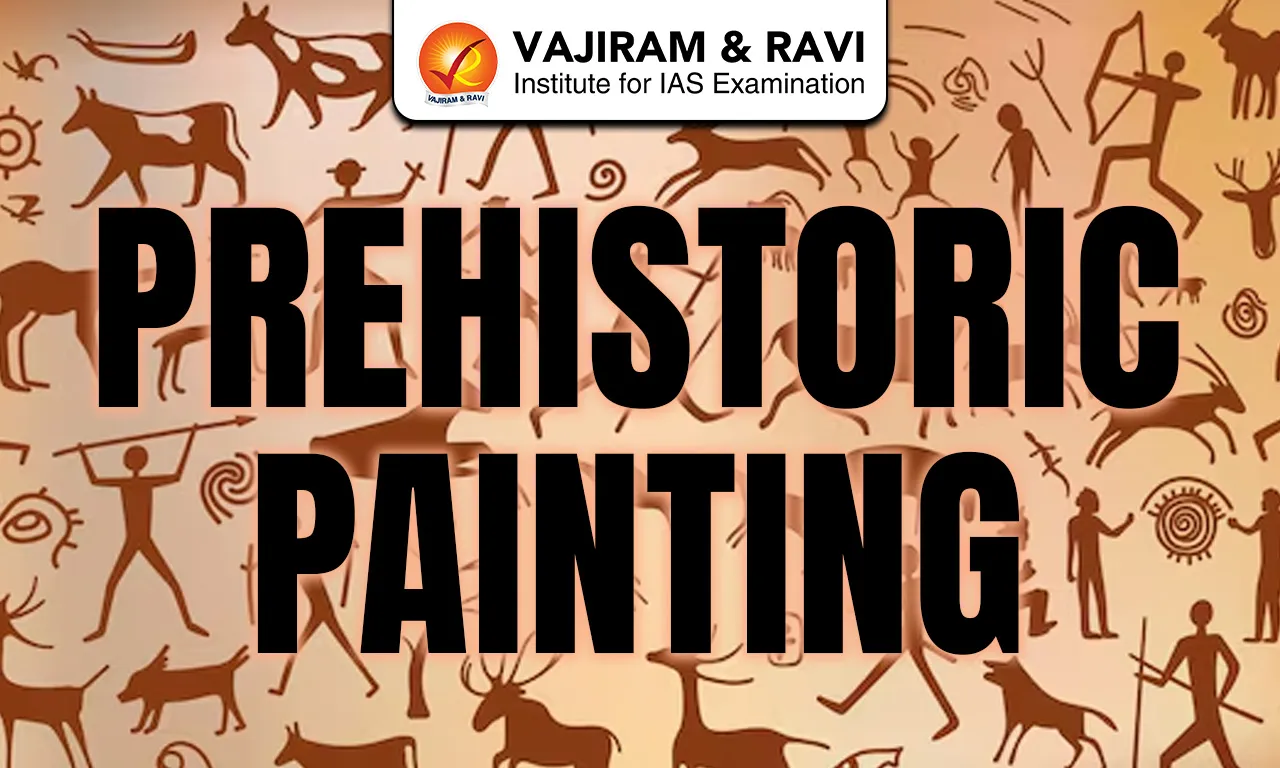
Prehistoric Painting refers to the earliest artistic expressions created by human beings during the time before the development of written language. These paintings were mainly made on cave walls and rock shelters using natural pigments. They provide valuable evidence about early human life, beliefs, and environment. Through these paintings scholars understand hunting practices, social organization, animals, and cultural evolution of early communities that lived thousands of years ago.
Prehistoric Painting Historical Evolution
The Prehistoric Paintings evolved gradually across several ancient cultural phases, reflecting changing lifestyles, technology, and social activities of early humans.
Upper Palaeolithic Period
- This phase shows the earliest clear evidence of Prehistoric Paintings. Artists used mineral colours such as red ochre, white and green on quartzite cave walls. Large animal figures like bison, elephants, rhinos, tigers and boars were painted along with stick like human figures. Green colours mostly represented dancers while red colours illustrated hunters.
- Painting Materials and Techniques: Prehistoric artists produced pigments by grinding coloured rocks into powder. Red colour was obtained from haematite known as geru in India, green from chalcedony stone and white from limestone. The powder was mixed with water along with sticky substances like animal fat, plant gum or resin. Brushes were made from plant fibres.
- Use of Natural Surfaces: Rock shelters formed by quartzite provided natural canvases for prehistoric painters. Many paintings were executed deep inside caves where sunlight could not easily damage them. The chemical reaction of mineral oxides present on rock surfaces helped preserve colours for thousands of years.
- Subjects of Early Paintings: The themes mainly included human figures, animals and geometric symbols. Stick like human shapes depicted activities such as hunting, dancing and movement. Geometric forms such as rectangles, wavy lines and groups of dots were frequently used as symbolic representations.
- Superimposition of Paintings: Many prehistoric rock shelters show several layers of paintings placed one above another. The earliest paintings were usually in black colour, later paintings appeared in red and the newest ones in white. This layering indicates continuous artistic activity across different prehistoric periods.
Also Read: Indian Paintings
Mesolithic Period
- During this phase paintings became more detailed and themes increased greatly. Hunting scenes dominated the artwork where groups of hunters carried barbed spears, arrows, bows and pointed sticks. Animals were often shown either chasing humans or being chased by hunters.
- Depiction of Social Life: Mesolithic paintings portray many aspects of community life. Women, children and elderly people appear in several images. Scenes of community dances, family groups and decorated hunters wearing ornaments or headgear indicate the development of social and cultural traditions.
- Naturalistic Representation of Animals: Animals were drawn more realistically compared to humans. Artists painted elephants, deer, antelope, bison, tiger, rhinoceros, birds, fish, frogs and reptiles. These paintings reflect the importance of wildlife in prehistoric survival and hunting economy.
Also Read: Mural Paintings
Chalcolithic Period
- The Chalcolithic or Copper Age introduced new themes related to early agricultural communities. Paintings show pottery, metal tools and objects used in daily life. Many designs resemble motifs found on Chalcolithic ceramics such as cross hatched squares and lattice patterns.
- Changes in Artistic Style: Compared to earlier phases, Chalcolithic paintings appear less vibrant. However they reveal increased interaction between cave dwellers and settled agricultural populations. Battle scenes, riders on animals and complex geometric shapes such as spirals, circles and rhomboids also appear.
- Types of Rock Art: Prehistoric artistic expressions are commonly grouped into three forms. Petroglyphs are engravings carved into rock surfaces, pictographs are painted images on rock walls, and earth figures are large designs created on the ground.
- Purpose and Symbolism: Many scholars believe Prehistoric Paintings had social or communicative functions. They may have served as signals, warnings or markers of territories. The paintings also show symbolic inspiration from nature and reveal early human attempts to express ideas using limited drawings.
Prehistoric Painting in India
India possesses one of the richest collections of Prehistoric Rock Paintings found across several regions, showing early artistic traditions.
- Discovery of Rock Paintings in India: The first prehistoric rock paintings in India were discovered in 1867-68 by archaeologist Archibold Carlleyle. This discovery happened about twelve years before the famous Altamira cave paintings were identified in Spain, highlighting India’s early contribution to the study of prehistoric art.
- Geographical Distribution: Prehistoric Paintings have been discovered in many Indian states including Madhya Pradesh, Uttar Pradesh, Andhra Pradesh, Telangana, Karnataka, Bihar and Uttarakhand. These paintings usually appear on the walls of natural caves and rock shelters located in hill ranges and forest regions.
- Kupgallu and South Indian Sites: In southern India, Prehistoric Paintings have been found at Kupgallu in Telangana and sites like Piklihal and Tekkalkotta in Karnataka. Granite rocks in these regions provided suitable surfaces for painting, where artists depicted animals, hunting scenes and symbolic geometric designs.
- Vindhya and Kaimur Ranges: The Vindhya hills of Madhya Pradesh and their extension into the Kaimur ranges of Uttar Pradesh contain some of the richest Prehistoric Painting remains. These regions show abundant evidence of both Palaeolithic and Mesolithic human settlements.
- Themes in Indian Rock Paintings: Indian Prehistoric Paintings mainly fall into three thematic categories: human figures, animals and geometric symbols. Human figures are generally shown in stick like form, animals are drawn in naturalistic style and geometric motifs include dots, wavy lines, grids and rectangular shapes.
- Animal Motifs in Early Art: Common animal representations include foxes, long snouted animals, lizards, deer, gazelles, bulls, elephants and horses. These images highlight the close relationship between prehistoric humans and wildlife, which played a crucial role in their survival.
- Cultural Significance: Prehistoric Paintings in India help reconstruct the lifestyle, economy and environment of early societies. They depict hunting, dancing, rituals, family life and interactions with animals, making them valuable historical records of human cultural evolution long before written history began.
Also Read: Pithora Painting


Bhimbetka Rock Paintings
The major features of the Bhimbetka Rock Paintings has been highlighted below:
- The Bhimbetka caves in the Vindhya ranges of Madhya Pradesh are among the most significant Prehistoric Painting sites.
- Discovered in 1957-58 by archaeologist V. S. Wakankar, the site contains nearly 400 painted rock shelters grouped into five clusters and shows continuous human occupation from about 100000 BCE to 1000 CE.
- Bhimbetka paintings depict animals such as elephants, bison, tigers and rhinoceroses along with human figures engaged in hunting and dancing activities.
- The colours used include red ochre, white, yellow, green and brown obtained from natural minerals.
- Some rock shelters contain up to twenty layers of paintings.
- Most paintings in Bhimbetka belong to the Mesolithic period.
- These artworks show hunters using bows, arrows, pointed sticks and barbed spears.
- The scenes often depict organized hunting groups, dancing communities and family gatherings, giving insight into early social organization.
Jogimara Cave Paintings
The key features of the Jogimara Cave Paintings is mentioned here:
- The Jogimara caves located in the Ramgarh hills of present day Chhattisgarh contain important prehistoric and early historic paintings.
- These paintings are believed to date around 1000 BCE and are considered among the earliest cave paintings in India preceding later artistic traditions.
Lakhudiyar Rock Paintings
The major highlighting features of the Lakhudiyar Rock Paintings has been listed below:
- Lakhudiyar in Uttarakhand is another major prehistoric site located near the banks of the Suyal River.
- The name literally means “one lakh caves.”
- The paintings include stick like human figures, animals, dancing groups and geometric patterns created using red ochre, black and white colours.

 Last updated on August, 2026
→ UPSC Mains 2026 commenced on 21st August 2026 and will continue through 30th August 2026, as per the official examination schedule.
→ UPSC Mains Question Paper 2026 is out now for Essay & GS Paper 1, 2, 3 & 4.
→ UPSC Mains GS Paper 1 2026 is out now.
→ UPSC Mains GS Paper 2 2026 is out now.
→ UPSC Mains GS Paper 3 2026 is out now.
→ UPSC Mains GS Paper 4 2026 is out now.
→ UPSC Mains Indian Language Paper & English Compulsory Paper are out now.
→ Check out the latest UPSC Syllabus 2026 here.
→ UPSC Mains Admit Card 2026 is now out.
→ Enroll in Vajiram & Ravi’s UPSC Mains Test Series 2027 for structured answer writing practice, expert evaluation, and exam-oriented feedback.
→ Join Vajiram & Ravi’s UPSC Mentorship Program 2027 for personalized guidance, strategy planning, and one-to-one support from experienced mentors.
→ Go through the UPSC Mains Previous Year Papers to enhance your preparation.
→ Download UPSC Mains Essay Paper 2025, UPSC Mains GS Paper-I 2025, UPSC Mains GS Paper-II 2025, UPSC Mains GS Paper-III 2025, UPSC Mains GS Paper-IV 2025, UPSC Mains English (Compulsory) Paper 2025, UPSC Mains Hindi (Qualifying) Paper 2025 here.
→ UPSC has released UPSC Toppers List 2025 with the Civil Services final result on its official website.
→ UPSC Calendar 2027 has been released.
→ Also check Best UPSC Coaching in India
Prehistoric Painting FAQs
Q1. What are Prehistoric Paintings? +
Q2. Which are the main phases of Prehistoric Paintings? +
Q3. Which colours were commonly used in Prehistoric Paintings? +
Q4. Where are major Prehistoric Painting sites found in India? +
Q5. Who first discovered Prehistoric Rock Paintings in India? +
Tags: indian history prehistoric painting