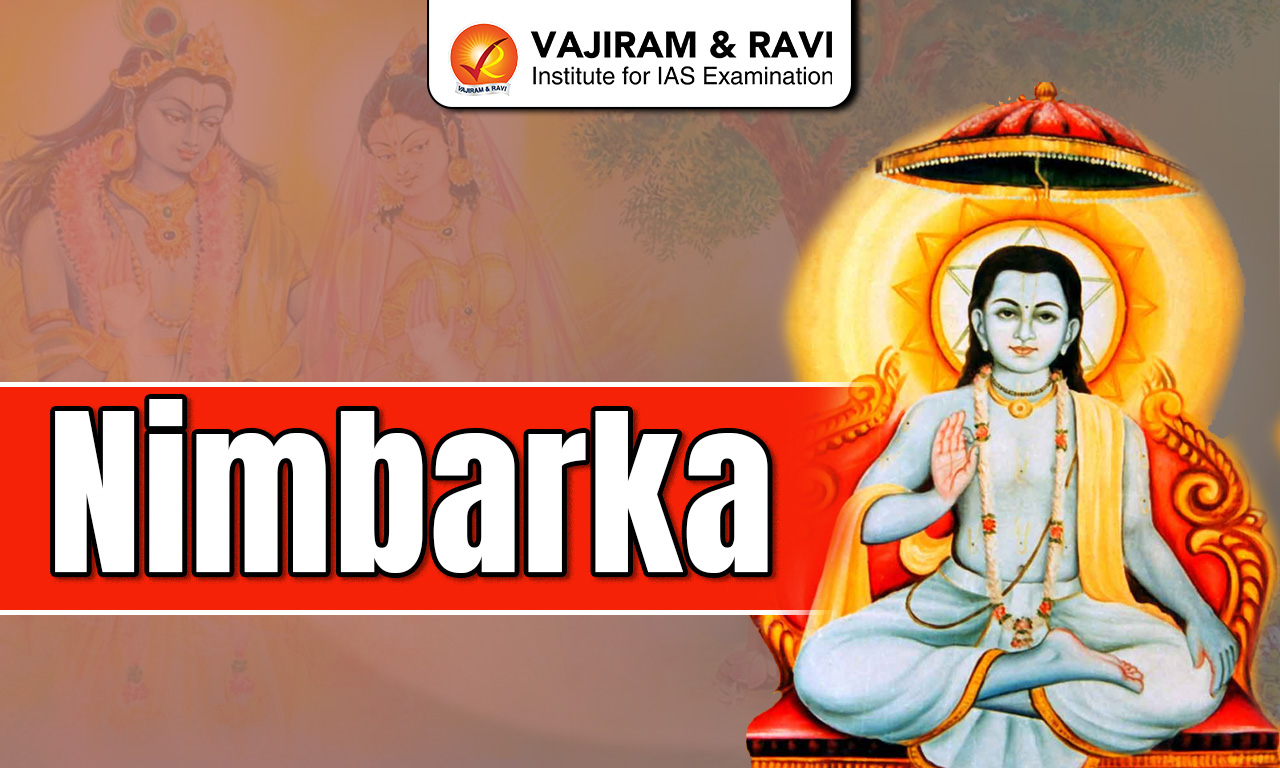
Nimbarka was a well-known Indian saint and thinker associated with the Bhakti tradition. He emphasized the importance of devotion, love, and faith in God. His teachings encouraged people to develop a personal connection with the divine through simple practices like prayer and devotion. He played an important role in spreading spiritual ideas in an easy and relatable way, helping people understand the path of devotion in everyday life.
Life and Background
- Nimbarka was an important Indian saint, philosopher, and spiritual teacher associated with the Bhakti tradition.
- He is generally believed to have lived between the 11th and 14th centuries CE, though his exact dates remain uncertain and debated among historians.
- He was a Telugu-speaking Brahmin, likely born in South India, but his major spiritual activities and influence later spread to North India, especially in the Mathura–Vrindavan region.
- Nimbarka lived the life of a yogi and teacher, guiding people towards spirituality through devotion (bhakti) rather than complex rituals or dry intellectualism.
- Some scholars identify him with an earlier philosopher named Bhaskara, but this identification is not universally accepted.
- He founded a devotional sect known as the Nimbarka Sampradaya (also called Nimandi or Nimavat sect).
- His followers, known as Nimbarkas, played a significant role in spreading his teachings across North and Eastern India.
- His teachings simplified spiritual ideas and made them more emotional, accessible, and relatable for common people.
Philosophy (Dvaita-Advaita / Bheda-Abheda)
- Nimbarka is best known for his philosophy of Dvaita-Advaita (dualistic non-dualism).
- This means that the soul and God are different, but at the same time closely connected.
- He also explained this idea through Bheda-Abheda (difference and non-difference).
- According to him:
- The world and Brahman (God) are both real
- The universe exists as a part or power of God
- He did not agree that the soul and matter are the body of God, as that would make God imperfect
- Instead, he believed that everything depends on God but still has its own identity


Bheda-Abheda Philosophy of Nimbarka
- Nimbarka’s philosophy is called Bheda-Abheda, meaning difference and non-difference at the same time. It is also known as Dvaita-Advaita.
- He divides reality into three main categories:
- God (Isvara) – the supreme and independent reality
- Souls (cit/jiva) – living beings
- Matter (acit/jagat) – the physical world
- God is independent, while souls and matter are dependent on God for their existence.
- Difference (Bheda):
- Souls and matter are distinct from God because they have their own qualities and identities.
- Non-difference (Abheda):
- Souls and matter are not completely separate from God, as they cannot exist without Him.
- This relationship is explained as natural difference and non-difference (svabhavika bhedabheda).
- Nimbarka uses simple examples to explain this idea:
- Sun and its rays
- Snake and its coil
- These show how something can be both connected and distinct at the same time.
- According to him, all three – God, souls, and matter are eternal, but only God is fully independent.
- He also explains their roles:
- God (Brahman) – controller (niyantra)
- Soul (jiva) – enjoyer/experiencer (bhokta)
- World (jagat) – object of enjoyment (bhogya)
- Major Works: Nimbarka contributed significantly to Vedantic literature. His important works include:
- Vedanta-Sutra-Bhasya
- Prapanca-Sutra-Bhasya
- Dashasloki
- These texts explain his philosophy of Bheda-Abheda and the importance of devotion.
Role in the Bhakti Movement
- Nimbarka is regarded as an important figure in the Bhakti Movement, which emphasized personal devotion to God.
- He strongly promoted the worship of Radha–Krishna (Radha-Madhav) as the highest form of divine reality.
- His path focused on Bhakti Yoga (the path of devotion) as the easiest and most effective way to attain liberation (moksha).
- He supported Saguna Bhakti, meaning the worship of God with form and attributes, unlike saints such as Kabir who promoted Nirguna Bhakti (formless God).
- His teachings encouraged love, surrender, and emotional connection with God, making religion more personal and meaningful.

 Last updated on Oct, 2026
→ UPSC 2027 Notification will be released on 13 January 2027 at upsconline.nic.in.
→ Check Nobel Prize 2026 Winners List here.
→ Download PIB PRiSM Monthly Magazine 2026 here.
→ Check UPSC Monthly Current Affairs Magazine The Recitals here.
→ Check out the latest UPSC Syllabus here.
→ Download UPSC Model Answers for Mains 2026
→ UPSC Mains Question Paper 2026 is out now for Essay & GS Paper 1, 2, 3 & 4.
→ UPSC Calendar 2027 has been released.
→ Enroll in Vajiram & Ravi’s UPSC Mains Test Series 2027 for structured answer writing practice, expert evaluation, and exam-oriented feedback.
→ Join Vajiram & Ravi’s UPSC Mentorship Program 2027 for personalized guidance, strategy planning, and one-to-one support from experienced mentors.
→ Go through the UPSC Mains Previous Year Papers to enhance your preparation.
→ UPSC has released UPSC Toppers List 2025 with the Civil Services final result on its official website.
→ Also check Best UPSC Coaching in India
Nimbarka FAQs
Q1. Who was Nimbarka?+
Q2. What is the philosophy of Nimbarka?+
Q3. What are the main elements of his philosophy?+
Q4. What is Bheda-Abheda in simple terms?+
Q5. What was his role in the Bhakti Movement?+
Tags: art and culture art and culture notes nimbarka