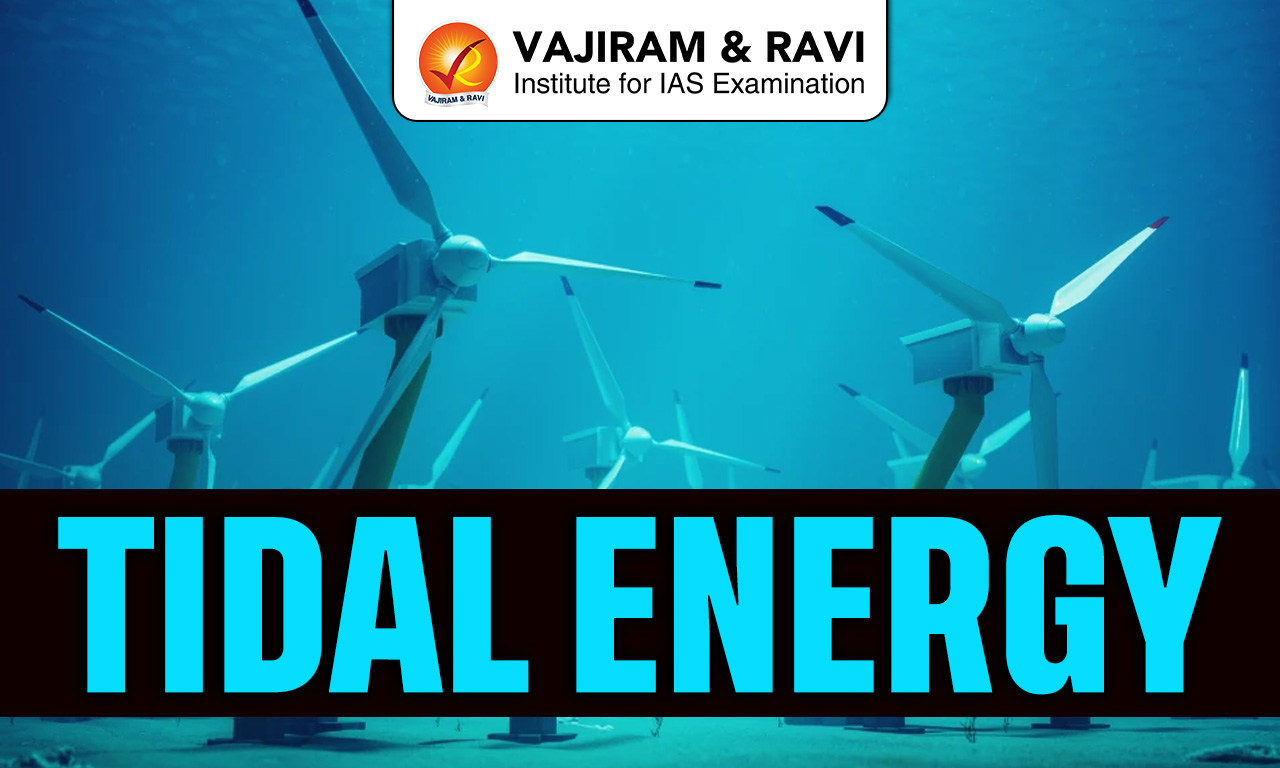
Tidal Energy refers to electricity produced by harnessing the natural rise and fall of ocean tides caused mainly by the gravitational interaction of the Earth, Moon, and Sun. The movement of seawater during tidal cycles contains kinetic and potential energy that can be converted into electricity using turbines and generators. Although its commercial use remains limited, technological improvements in turbine design and project development are increasing its potential as a reliable renewable energy source.
Tidal Energy Generation Methods
Different engineering techniques convert tidal movement into electricity by using turbines, reservoirs, and controlled water flow systems.
- Tidal Stream Generators: These systems use the kinetic energy of fast moving tidal currents to rotate underwater turbines. Installed in narrow straits or channels with strong water flow, turbines can be horizontal, vertical, open, or ducted. The movement of water directly drives generators similar to wind turbines.
- Tidal Barrage: A tidal barrage is a large dam constructed across the entrance of an estuary or bay. During high tide, water flows into a basin behind the dam and is stored as potential energy. When the tide recedes, the water is released through turbines to generate electricity.
- Tidal Lagoon: Tidal lagoons are artificial reservoirs created by constructing circular retaining walls along coastal areas. Turbines placed in these walls capture energy as water enters and exits the lagoon during tidal cycles. Some lagoon systems also use pumping mechanisms to stabilize electricity output.
- Dynamic Tidal Power (DTP): Dynamic tidal power is an emerging concept involving extremely long dams, sometimes 30-50 km in length, extending straight into the sea. These structures create phase differences in tidal currents, generating large water level differences that can drive turbines for electricity generation.
Also Read: Nuclear Energy in India
Tidal Power Plant
A Tidal Power Plant is a system that converts the energy of rising and falling ocean tides into electricity using turbines. The first large Tidal Power Station was established at the Rance River in France in 1966. The Sihwa Lake Tidal Power Station in South Korea, started operating in 2011 with an installed capacity of about 254 MW using ten turbines, is the largest Tidal Power Plant.


Tidal Energy in India
India has significant tidal resources along its coastline. The key features of Tidal Energy in India has been listed below:
- Tidal Energy Potential: Government estimates indicate that India possesses around 8,000 MW of tidal power potential. Approximately 7,000 MW lies in the Gulf of Cambay in Gujarat, about 1,200 MW in the Gulf of Kutch, and around 100 MW in the Sunderbans region of West Bengal.
- Government Initiatives: In 2011, the Gujarat government signed an agreement with Gujarat Power Corporation Limited, Atlantis Resource Corporation of the United Kingdom, and PMES of Singapore to develop a 250 MW tidal power project in the Gulf of Kutch.
- Mandavi Tidal Power Project: A tidal project at Mandavi in the Kutch district was planned with a capacity of 50 MW. The project aimed to demonstrate the feasibility of large scale tidal electricity generation along India’s western coastline.
- Sunderbans Demonstration Project: The Ministry of New and Renewable Energy approved a 3.75 MW demonstration tidal power project in 2008 at Durgaduani Creek in the Sunderbans of West Bengal. However, the project did not progress due to high financial costs.
- Coastal Advantage: India has a coastline of approximately 7,500 km, and several estuaries and gulfs experience large tidal variations. Such geographical features create favourable conditions for the installation of tidal power infrastructure.
Also Read: Solar Energy
Tidal Energy Significance
Tidal Energy is gaining importance because it provides a predictable and clean alternative for electricity generation.
- Tidal cycles follow the gravitational movement of the Moon and Sun and occur approximately every 12 hours. This regular pattern makes Tidal Energy far more predictable than wind or solar energy.
- Water density is nearly 800 times greater than air. As a result, tidal turbines can generate significant power even at relatively low flow speeds compared with wind energy systems.
- Certain Tidal Energy structures like lagoons and barrages can also provide secondary advantages such as coastal flood protection and wave energy reduction during extreme weather events.
Tidal Energy Challenges
Despite its potential, several technological, economic, and environmental issues restrict the large scale deployment of Tidal Energy projects as highlighted below:
- High Initial Construction Cost: Tidal power plants require expensive infrastructure such as dams, turbines, and underwater installations. In India, the estimated cost of the 3.75 MW Durgaduani project reached about ₹2.38 billion.
- Suspended Projects Due to Cost: A proposed 50 MW tidal power project in Gujarat’s Gulf of Kutch had an estimated cost of around ₹7.5 billion per megawatt. Such high investment requirements caused the project to be suspended.
- Environmental Concerns: Rotating turbine blades may harm marine organisms such as fish and dolphins. Turbines also generate underwater noise that can affect marine mammals which rely on echolocation for navigation and communication.
- Impact on Coastal Ecosystems: Large tidal barrages may alter natural tidal flows in estuaries. Reduced water circulation can increase turbidity, disturb sediment distribution, and affect breeding patterns of fish species.
- Corrosion and Maintenance Issues: Tidal power equipment operates in saltwater environments that cause corrosion of metal components. Special materials such as stainless steel, nickel alloys, copper-nickel alloys, and titanium are required to reduce damage.
- Limited Suitable Locations: Efficient Tidal Energy generation requires a tidal range of at least about five metres between high and low tides. Globally, only about twenty coastal regions possess such conditions.

 Last updated on Sep, 2026
→ UPSC 2027 Notification will be released on 13 January 2027 at upsconline.nic.in.
→ Check out the latest UPSC Syllabus here.
→ Download UPSC Model Answers for Mains 2026
→ UPSC Mains Question Paper 2026 is out now for Essay & GS Paper 1, 2, 3 & 4.
→ UPSC Calendar 2027 has been released.
→ Enroll in Vajiram & Ravi’s UPSC Mains Test Series 2027 for structured answer writing practice, expert evaluation, and exam-oriented feedback.
→ Join Vajiram & Ravi’s UPSC Mentorship Program 2027 for personalized guidance, strategy planning, and one-to-one support from experienced mentors.
→ Go through the UPSC Mains Previous Year Papers to enhance your preparation.
→ UPSC has released UPSC Toppers List 2025 with the Civil Services final result on its official website.
→ Also check Best UPSC Coaching in India
Tidal Energy FAQs
Q1. What is Tidal Energy? +
Q2. How is electricity generated from Tidal Energy? +
Q3. What is the Tidal Energy Potential of India? +
Q4. Which was the first large tidal power plant in the world? +
Q5. What is the major challenge of Tidal Energy? +
Tags: tidal energy