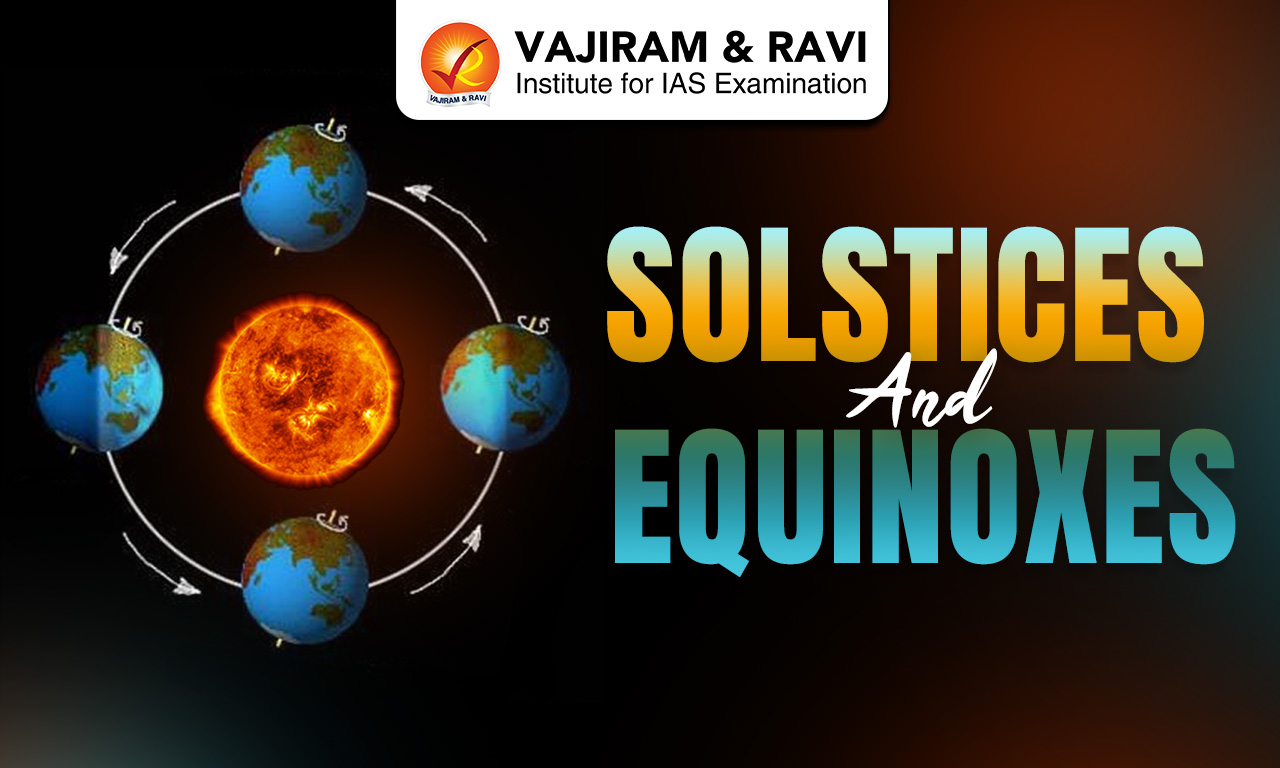
Solstices and Equinoxes are astronomical events produced by Earth’s 23.5° axial tilt and its revolution around the Sun. These events regulate the distribution of sunlight across the planet and mark seasonal transitions. A year normally contains two Solstices and two Equinoxes, occurring at specific positions in Earth’s orbit. Together, they define seasonal patterns and variations in daylight across different latitudes.
Solstices
A Solstice occurs when the Sun reaches its farthest north or south position relative to the celestial equator. This event happens twice each year, around 20-22 June and 20-22 December, producing the longest and shortest daylight durations. Solstices occur because Earth’s axis is tilted about 23.5°, causing one hemisphere to lean toward the Sun while the other tilts away. As a result, one hemisphere receives maximum sunlight while the opposite hemisphere experiences reduced daylight, creating seasonal contrasts across the globe.
Solstices Types
There are two types of Solstices as given below:
- Summer Solstice: Occurs between 20 and 22 June when the Northern Hemisphere tilts toward the Sun, producing the longest day and shortest night there.
- Winter Solstice: Occurs between 20 and 23 December when the Northern Hemisphere tilts away from the Sun, producing the shortest day and longest night.


Solstices Features
Solstices represent the extreme position of the Sun’s apparent movement in the sky, producing maximum difference in daylight duration across hemispheres.
- Solar Declination Position: During the June Solstice, solar declination reaches about 23.5° North at the Tropic of Cancer, where the Sun appears directly overhead at noon.
- Southern Hemisphere Reversal: When June produces summer in the Northern Hemisphere, the Southern Hemisphere simultaneously experiences winter because it tilts away from the Sun.
- December Solar Declination: At the December Solstice, the Sun’s vertical rays fall near 23.5° South at the Tropic of Capricorn, marking peak sunlight in the Southern Hemisphere.
- Maximum Axial Inclination Effect: Solstices occur when Earth’s axis reaches its maximum tilt toward or away from the Sun during orbital movement.
- Subsolar Point Extremes: The subsolar point, where the Sun is directly overhead, reaches its northernmost and southernmost positions during the two Solstices.
- Impact on Poles: Near polar regions, Solstices create phenomena such as continuous daylight called “midnight sun” or prolonged darkness known as “polar night”.
Also Read: Solar Energy
Equinoxes
An Equinox is the moment when the Sun appears directly above Earth’s equator, meaning solar rays fall perpendicular to the equatorial region. This event occurs twice annually, around 20 March and 23 September. During this time, Earth’s rotational axis is neither tilted toward nor away from the Sun. As a result, both hemispheres receive nearly equal sunlight. Equinoxes represent the points when the plane of Earth’s equator passes through the geometric center of the Sun’s disk, producing approximately equal day and night across most regions.
Equinoxes Types
There are two types of Equinoxes as highlighted below:
- Vernal/ Northward/ Spring Equinox: Occurring between 19 and 21 March, it marks the beginning of spring in the Northern Hemisphere and autumn in the Southern Hemisphere.
- Autumnal/ Fall Equinox: Occurring between 21 and 24 September, it signals autumn in the Northern Hemisphere and spring in the Southern Hemisphere.
Also Read: Solar Radiation
Equinoxes Features
Equinoxes mark the moment when the Sun crosses the celestial equator, creating nearly equal daylight and darkness across Earth.
- Equal Day and Night: During Equinoxes, daytime and nighttime durations are approximately equal worldwide, though slight differences occur due to atmospheric refraction and the Sun’s apparent size.
- Occurrence: Equinoxes normally occur around 20 March and 23 September, although leap years and orbital variations cause minor shifts in exact dates.
- Direct Solar Alignment: At Equinox, the Sun appears directly above the equator, meaning solar rays strike Earth at a right angle along the equatorial region.
- Solar Terminator: During Equinoxes, the solar terminator line dividing day and night runs almost directly through Earth’s poles.
- Sunrise and Sunset Direction: On the Equinox day, the Sun rises almost exactly due east and sets due west for most locations on Earth.
- Day Length Change: Around the March Equinox, daylight increases most rapidly in the Northern Hemisphere, while around September it decreases most quickly.
- Impact on Poles: Equinoxes are the only times when both the North Pole and South Pole receive sunlight at the same moment.

 Last updated on August, 2026
→ UPSC Mains 2026 commenced on 21st August 2026 and will continue through 30th August 2026, as per the official examination schedule.
→ UPSC Mains Question Paper 2026 is out now for Essay & GS Paper 1, 2, 3 & 4.
→ UPSC Mains GS Paper 1 2026 is out now.
→ UPSC Mains GS Paper 2 2026 is out now.
→ UPSC Mains GS Paper 3 2026 is out now.
→ UPSC Mains GS Paper 4 2026 is out now.
→ UPSC Mains Indian Language Paper & English Compulsory Paper are out now.
→ Check out the latest UPSC Syllabus 2026 here.
→ UPSC Mains Admit Card 2026 is now out.
→ Enroll in Vajiram & Ravi’s UPSC Mains Test Series 2027 for structured answer writing practice, expert evaluation, and exam-oriented feedback.
→ Join Vajiram & Ravi’s UPSC Mentorship Program 2027 for personalized guidance, strategy planning, and one-to-one support from experienced mentors.
→ Go through the UPSC Mains Previous Year Papers to enhance your preparation.
→ Download UPSC Mains Essay Paper 2025, UPSC Mains GS Paper-I 2025, UPSC Mains GS Paper-II 2025, UPSC Mains GS Paper-III 2025, UPSC Mains GS Paper-IV 2025, UPSC Mains English (Compulsory) Paper 2025, UPSC Mains Hindi (Qualifying) Paper 2025 here.
→ UPSC has released UPSC Toppers List 2025 with the Civil Services final result on its official website.
→ UPSC Calendar 2027 has been released.
→ Also check Best UPSC Coaching in India
Solstices and Equinoxes FAQs
Q1. What is a Solstice? +
Q2. How many Solstices occur in a year? +
Q3. What is an Equinox? +
Q4. When do Equinoxes occur each year? +
Q5. Why are Solstices and Equinoxes important? +
Tags: geography physical geography solstices and equinoxes