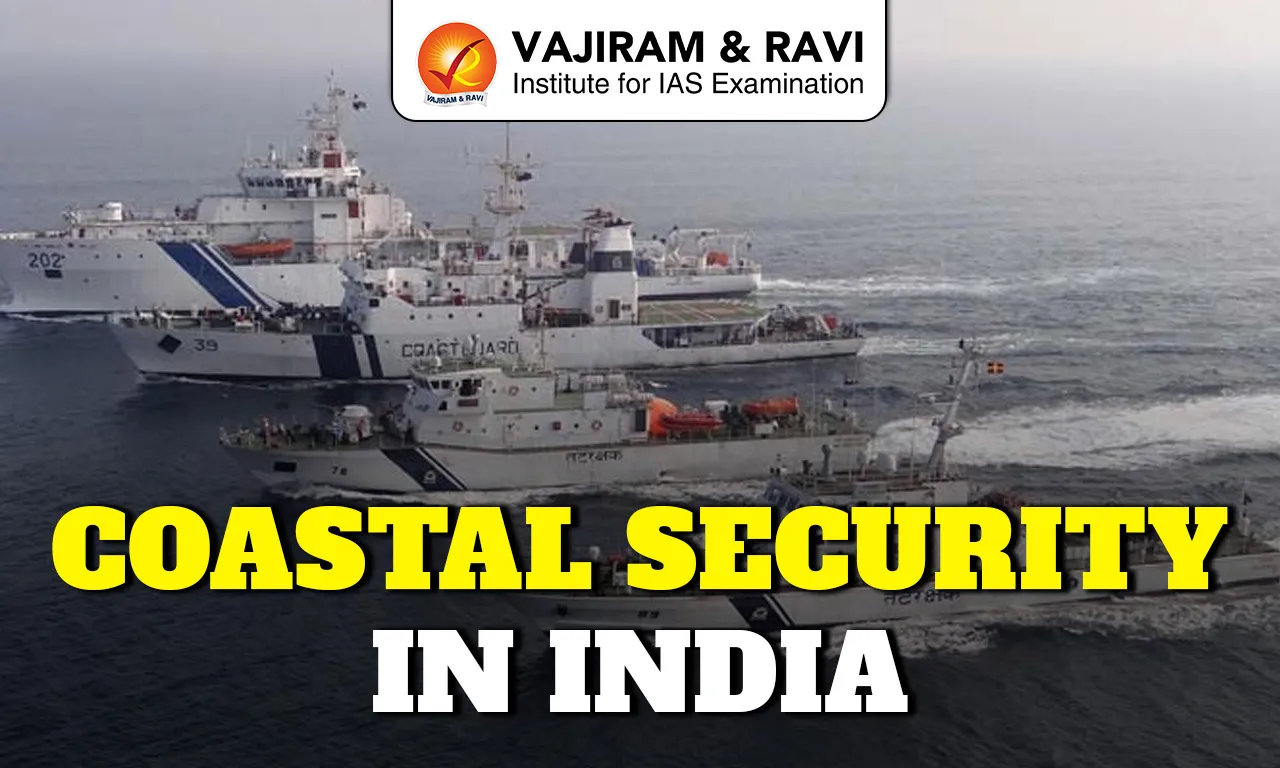
India’s coastline stretches over 11,098.81 km, encompassing nine coastal states and four Union Territories. This extensive coastline houses 13 major ports, over 200 minor ports, nuclear plants, and other critical infrastructure, making it both an economic lifeline and a potential target for security threats.
Coastal Security Meaning
Coastal security in India refers to the protection of the shoreline, nearshore waters, ports, offshore assets, and coastal communities from traditional and non-traditional threats, including terrorism, smuggling, piracy, illegal fishing, and natural disasters.
Key Threats to Coastal Security
Terrorist Attacks
- Coastal routes have been exploited for terrorism and infiltration.
- The 1993 Mumbai bombings and the 26/11 attacks (2008) highlighted how militants can infiltrate via the sea to reach urban targets.
- The threat is amplified by porous coastlines and limited patrolling in some areas.
Piracy
- Piracy is defined under UNCLOS as any illegal act of violence or detention committed for private ends by the crew or passengers of a ship against another vessel on the high seas.
- Piracy increases shipping costs through higher insurance premiums and can discourage traffic in critical trade routes
Smuggling and Money Laundering
- India’s coastline is a conduit for drugs, arms, gold, fake currency, and human trafficking.
- According to the Directorate of Revenue Intelligence (DRI), in FY 2023‑24, 623 smuggling cases were detected with seizures worth ₹3,500 crore, including 1,319 kg kg of gold.
- The Narcotics Control Bureau (NCB) seized over 10,500 kg of narcotics in 2024 via coastal routes.
- The economic consequences of such smuggling are severe, including revenue loss, disruption of legal trade, and funding of criminal networks.
Illegal Migration and Refugee Influxes
- India faces coastal infiltration from neighboring countries.
- For example, illegal migration through the Gujarat creeks from Pakistan has been reported, while other regions like Andaman and Nicobar Islands are vulnerable to refugee flows from Southeast Asia.
Fishermen Conflicts
- Fishermen often inadvertently trespass into the territorial waters of neighboring countries, leading to arrests and diplomatic tensions.
- Notable examples include the Sir Creek region between India and Pakistan and Katchatheevu Island between India and Sri Lanka.
Resource Constraints and Operational Challenges
- Despite these threats, India faces manpower shortages in its naval and coastal forces.
- The Navy has reported a 20.6% shortage of sailors and a 12.12% shortage of officers, while many marine police personnel are inadequately trained for counter-terrorism operations.
- Coordination between multiple agencies has historically been limited, creating gaps in surveillance and response.


Coastal Security Need
India’s extensive coastline and strategically important maritime domain make coastal security essential for safeguarding national sovereignty, protecting trade and energy routes, and preventing threats from terrorism, smuggling, and natural hazards.
- Safeguarding Trade and Energy Routes: With over 85% of crude oil and 50% of natural gas imports arriving via sea routes, secure coastlines ensure uninterrupted energy supply and protect India’s trade lifeline.
- Protection of Critical Infrastructure: Coastal areas host ports, offshore oil and gas rigs, and nuclear facilities, making them vulnerable to sabotage, terrorist attacks, and natural hazards.
- Preventing Smuggling and Illegal Activities: India’s coast is a conduit for drugs, arms, gold, and counterfeit currency, as well as human trafficking, which can undermine internal security and cause economic losses.
- Securing Coastal Communities and Livelihoods: Fishermen and coastal populations face threats from illegal fishing, piracy, and cross-border intrusions, necessitating protection for both human and economic security.
- Preserving National Sovereignty and Strategic Interests: A robust coastal security framework prevents unauthorized maritime incursions, supports India’s role as a net security provider in the Indian Ocean Region, and safeguards maritime sovereignty.
Challenges in India’s Coastal Security
Despite the critical importance of safeguarding its coastline, India faces several operational, strategic, and technological challenges that hinder effective coastal security.
- Resource Constraints
- The Indian Navy faces 20.6% shortage of sailors and 12.12% shortage of officers, limiting effective patrolling.
- Many marine police personnel lack specialized counter-terrorism training.
- Multi-Agency Coordination Gaps
- Multiple agencies including the Navy, Coast Guard, Marine Police, Customs, Intelligence Bureau, and state governments operate along the coast.
- Lack of clear coordination creates surveillance and response gaps.
- Geographical and Monitoring Limitations
- India’s 7,500 km coastline with 1,382 islands is difficult to monitor completely.
- Many small fishing vessels lack tracking or identification systems, increasing vulnerability to illegal activities.
- Transnational Threats
- Piracy, smuggling, and illegal fishing from foreign trawlers and ships in the Indian EEZ pose complex operational challenges.
- Cross-border tensions due to illegal fishing or trespassing add diplomatic sensitivity.
- Natural Hazards and Climate Change
- Coastal areas are prone to cyclones, tsunamis, coastal erosion, and sea-level rise, which can disrupt security infrastructure and human settlements.
Government Measures for Coastal Security
India’s approach to coastal security is multi-dimensional, combining technology, manpower, legal frameworks, and community participation. The system not only protects economic assets and energy imports but also strengthens national sovereignty, strategic deterrence, and India’s credibility as a net security provider in the Indian Ocean Region (IOR)
- Strengthening Security Architecture
- India has established a three-tier coastal security grid:
- The Indian Navy monitors offshore and deep-sea waters.
- Indian Coast Guard – responsible for near-shore patrolling, maritime law enforcement, and search-and-rescue operations.
- Marine Police – handles close-to-shore security and integrates local community reporting.
- Harbour Defence Units (HDUs) have been set up at critical ports to protect commercial and naval assets.
- The National Committee for Strengthening Maritime and Coastal Security, headed by the Cabinet Secretary, coordinates policies and oversees all coastal security matters.
- Enhanced Surveillance and Technology
- Coastal Surveillance Network (CSN): A chain of radars across the coastline and islands provides near-continuous monitoring.
- National Command Control Communication and Intelligence Network (NC3I): Integrates radar, Automatic Identification System (AIS), and Vessel Traffic Management System (VTMS) data to track vessels and detect suspicious activity.
- Information Management and Analysis Centre (IMAC): Located in Gurugram, it consolidates maritime intelligence for real-time operational decisions.
- Long-Range Identification and Tracking (LRIT): Tracks ships beyond India’s territorial waters to enhance maritime situational awareness.
- Capacity Augmentation
- Expansion of the Sagar Prahari Bal post-26/11 to enhance coastal patrolling and rapid response capabilities.
- Indian Coast Guard modernization: acquisition of interceptor boats, Dornier aircraft, and ALH helicopters.
- Coastal Security Scheme (CSS): Strengthens marine police in coastal states with modern equipment and training.
- Inter-Agency Coordination
- Joint Operation Centres (JOCs) in Mumbai, Kochi, Vizag, and Port Blair facilitate unified monitoring and operational response.
- Creation of the National Maritime Security Coordinator (2022) under the National Security Advisor ensures a coherent national-level strategy.
- National-level exercises like Sea Vigil and Sagar Kavach test inter-agency coordination and operational readiness.
- Community Engagement
- Fishermen are issued biometric ID cards to verify identity and integrate them into surveillance networks.
- Coastal Village Committees and community reporting networks enable early detection of suspicious activity.
- Awareness campaigns train local communities to act as the “eyes and ears” of coastal security.
- Legal and Policy Measures
- The Anti-Maritime Piracy Act, 2022 provides a legal framework to combat piracy, extending jurisdiction to India’s territorial waters, Exclusive Economic Zone (EEZ), and even the high seas.
- The Act prescribes stringent penalties including life imprisonment and death penalty for piracy-related deaths, enables extradition, and ensures speedy trial mechanisms.
- Operational examples include interception of hijacked vessels (INS Kolkata – MV Ruen, 2024) and rescue missions (Al-Kambar dhow, 2024), demonstrating enforcement capability.
- Integration with National Security and Energy Policy
- Coastal security initiatives are aligned with energy security, safeguarding offshore oil and gas infrastructure.
- Surveillance networks also contribute to maritime disaster response, ensuring rapid relief during cyclones and tsunamis.
Way Forward
To enhance coastal security, India must continue to adopt both technological and structural reforms:
- Invest in advanced surveillance systems including drones, satellites, and automated sensors to fill monitoring gaps.
- Strengthen inter-agency coordination between the Navy, Coast Guard, marine police, intelligence agencies, and state governments.
- Expand training programs for marine police to handle counter-terrorism and emergency situations.
- Engage local communities, particularly fishermen, to act as the first line of detection for suspicious activity.
- Promote regional cooperation with neighboring countries to tackle cross-border threats such as smuggling, piracy, and illegal migration.
- Integrate disaster management planning into coastal security to prepare for cyclones, tsunamis, and oil spills.

 Last updated on Sep, 2026
→ UPSC 2027 Notification will be released on 13 January 2027 at upsconline.nic.in.
→ Asian Games 2026 are being held in Aichi-Nagoya, Japan, from 19 September to 4 October.
→ Check out the latest UPSC Syllabus here.
→ Download UPSC Model Answers for Mains 2026
→ UPSC Mains Question Paper 2026 is out now for Essay & GS Paper 1, 2, 3 & 4.
→ UPSC Calendar 2027 has been released.
→ Enroll in Vajiram & Ravi’s UPSC Mains Test Series 2027 for structured answer writing practice, expert evaluation, and exam-oriented feedback.
→ Join Vajiram & Ravi’s UPSC Mentorship Program 2027 for personalized guidance, strategy planning, and one-to-one support from experienced mentors.
→ Go through the UPSC Mains Previous Year Papers to enhance your preparation.
→ UPSC has released UPSC Toppers List 2025 with the Civil Services final result on its official website.
→ Also check Best UPSC Coaching in India
Coastal Security in India FAQs
Q1. What is Coastal Security in India?+
Q2. Why is Coastal Security in India important?+
Q3. What are the major threats to Coastal Security in India?+
Q4. What are the main challenges in Coastal Security in India?+
Q5. How is Coastal Security in India managed?+
Tags: coastal security in india