India’s Position on West Asia Conflict Latest News
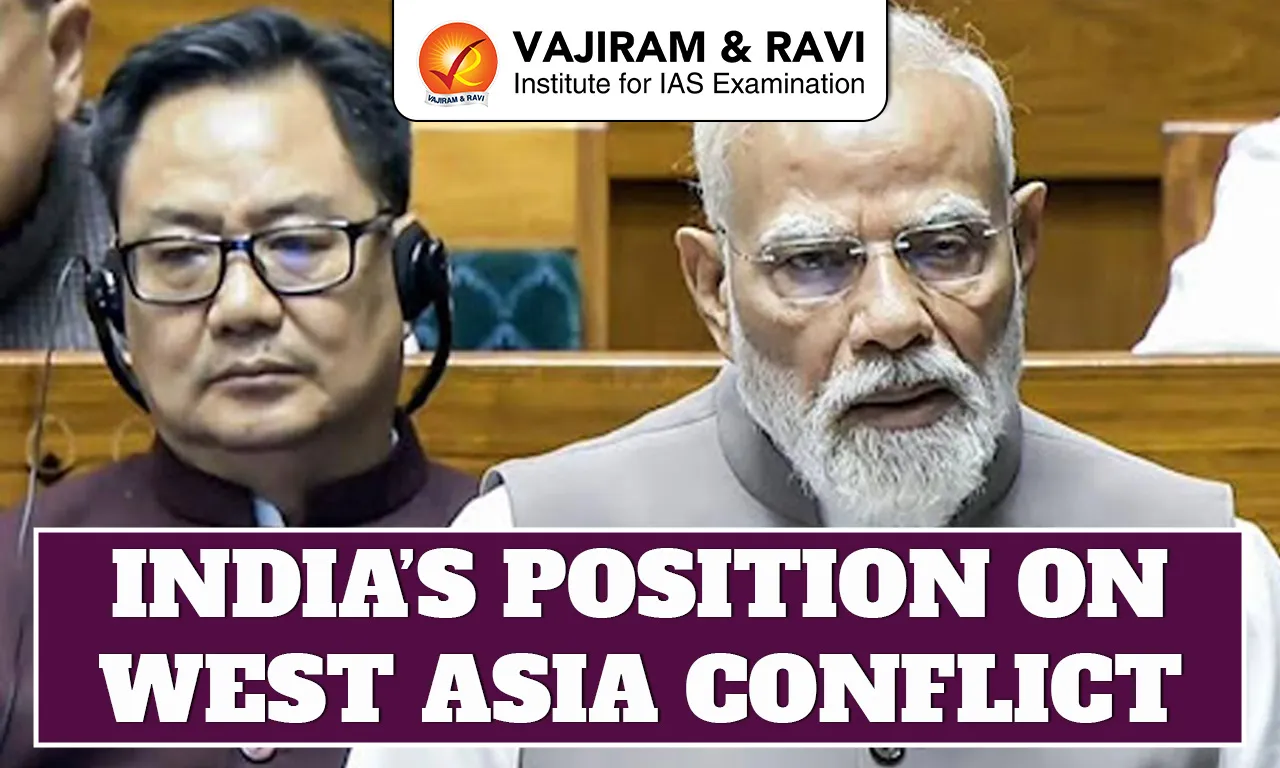
- PM Modi addressed the Lok Sabha during the Budget Session of Parliament, outlining India’s position on the escalating West Asia conflict, now in its fourth week.
- His statement carried five key diplomatic signals and touched upon energy security, the Indian diaspora, and India’s foreign policy approach.
Key Takeaways From PM Modi’s Lok Sabha Speech on West Asia Conflict
- Acknowledging the Crisis: Why Parliament Was Chosen
- PM Modi described the situation in West Asia as “concerning” and noted that the conflict has been ongoing for “more than three weeks”.
- Choosing Parliament as the platform to address the crisis is itself significant — it reflects the gravity of the situation and its direct impact on ordinary citizens’ lives, including supply chain disruptions affecting everyday goods.
- Economic Impact on India
- PM highlighted that India has extensive trade relations with countries both directly at war and those affected by the war in West Asia and the Gulf region.
- The Strait of Hormuz: A Critical Chokepoint
- The Strait of Hormuz is a narrow but strategically vital waterway through which approximately one-fifth of the world’s energy supply passes.
- PM Modi described any closure of the strait as “unacceptable“, underlining its importance to India’s trade and energy needs.
- Several Indian commercial ships and seafarers are directly affected in this region.
- Energy Security and LPG
- India imports 60% of its LPG requirements, and uncertain supply due to the conflict has prompted the government to prioritise domestic LPG production.
- Government is ensuring smooth supply of petrol and diesel across the country.
- Active monitoring of Gulf shipping routes to ensure safe passage; several stuck ships have since arrived in India.
- India currently holds a Strategic Petroleum Reserve of 53+ lakh metric tonnes.
- Work underway to expand this to 65+ lakh metric tonnes, in addition to reserves held by oil companies.
- Over the past 11 years, India has expanded its energy import sources from 27 to 41 countries, reducing dependence on any single region — a strategy that has proven its value in the current crisis.
- Indians Affected by the Conflict
- The Indian Diaspora in the Gulf
- Approximately one crore (10 million) Indians live and work in Gulf countries.
- They are primarily breadwinners from states like Kerala, Uttar Pradesh, Bihar, and West Bengal.
- Any prolonged conflict threatens their livelihoods, remittances, and safety — making this a deeply personal issue for millions of Indian families.
- Stranded Indian Seafarers
- Around 700 Indian seafarers aboard approximately 22 ships are currently stuck in the Strait of Hormuz.
- Indians make up a significant portion of crew members on commercial ships sailing these waters, amplifying India’s stakes in the crisis.
- Evacuation
- More than 3,75,000 Indians have safely returned to India since the war began.
- Approximately 1,000 Indians evacuated from Iran, including over 700 young medical students.
- CBSE has cancelled Class 10 and 12 board exams in Gulf countries and is working to ensure educational continuity.
- Consular Mechanisms Activated
- All Indian missions in affected countries are providing continuous help and issuing regular advisories.
- 24/7 control rooms and emergency helplines established both in India and in affected countries.
- The Indian Diaspora in the Gulf
- India’s Diplomatic Position: Dialogue Over Conflict
- PM Modi stated that he has personally spoken twice to all major leaders in the region — including those from Iran, Saudi Arabia, UAE, Qatar, Oman, Kuwait, and Bahrain.
- He reiterated that “dialogue and diplomacy are the only solutions“, echoing a position India had also taken during the Russia-Ukraine war.
- India has consistently positioned itself as a voice for peace in the interest of humanity, urging all parties to pursue a swift and peaceful resolution.
- India’s Strategic Silence: Reading the Diplomatic Signals
- One of the most notable aspects of PM Modi’s statement was what he did not say:
- He made no condemnation of US or Israeli actions in the conflict.
- He also expressed no condolences for the Iranian supreme leader — a silence that has been noted in Tehran.
- This deliberate ambiguity reflects India’s pragmatic foreign policy — a careful balancing act to protect its national interests without alienating any of the major players.
- This approach is often described as “strategic autonomy” — India avoids taking sides while actively engaging all parties diplomatically.
- One of the most notable aspects of PM Modi’s statement was what he did not say:


 Last updated on Sep, 2026
→ UPSC 2027 Notification will be released on 13 January 2027 at upsconline.nic.in.
→ Asian Games 2026 are being held in Aichi-Nagoya, Japan, from 19 September to 4 October.
→ Check out the latest UPSC Syllabus here.
→ Download UPSC Model Answers for Mains 2026
→ UPSC Mains Question Paper 2026 is out now for Essay & GS Paper 1, 2, 3 & 4.
→ UPSC Calendar 2027 has been released.
→ Enroll in Vajiram & Ravi’s UPSC Mains Test Series 2027 for structured answer writing practice, expert evaluation, and exam-oriented feedback.
→ Join Vajiram & Ravi’s UPSC Mentorship Program 2027 for personalized guidance, strategy planning, and one-to-one support from experienced mentors.
→ Go through the UPSC Mains Previous Year Papers to enhance your preparation.
→ UPSC has released UPSC Toppers List 2025 with the Civil Services final result on its official website.
→ Also check Best UPSC Coaching in India
India’s Position on West Asia Conflict FAQs
Q1. What is India’s position on West Asia conflict?+
Q2. Why is the Strait of Hormuz important for India?+
Q3. How is the conflict affecting India’s economy?+
Q4. How is India protecting its citizens abroad? +
Q5. What is India’s foreign policy approach in this conflict? +
Tags: India’s Position on West Asia Conflict mains articles upsc current affairs upsc mains current affairs