WTO Ministerial Conference Latest News
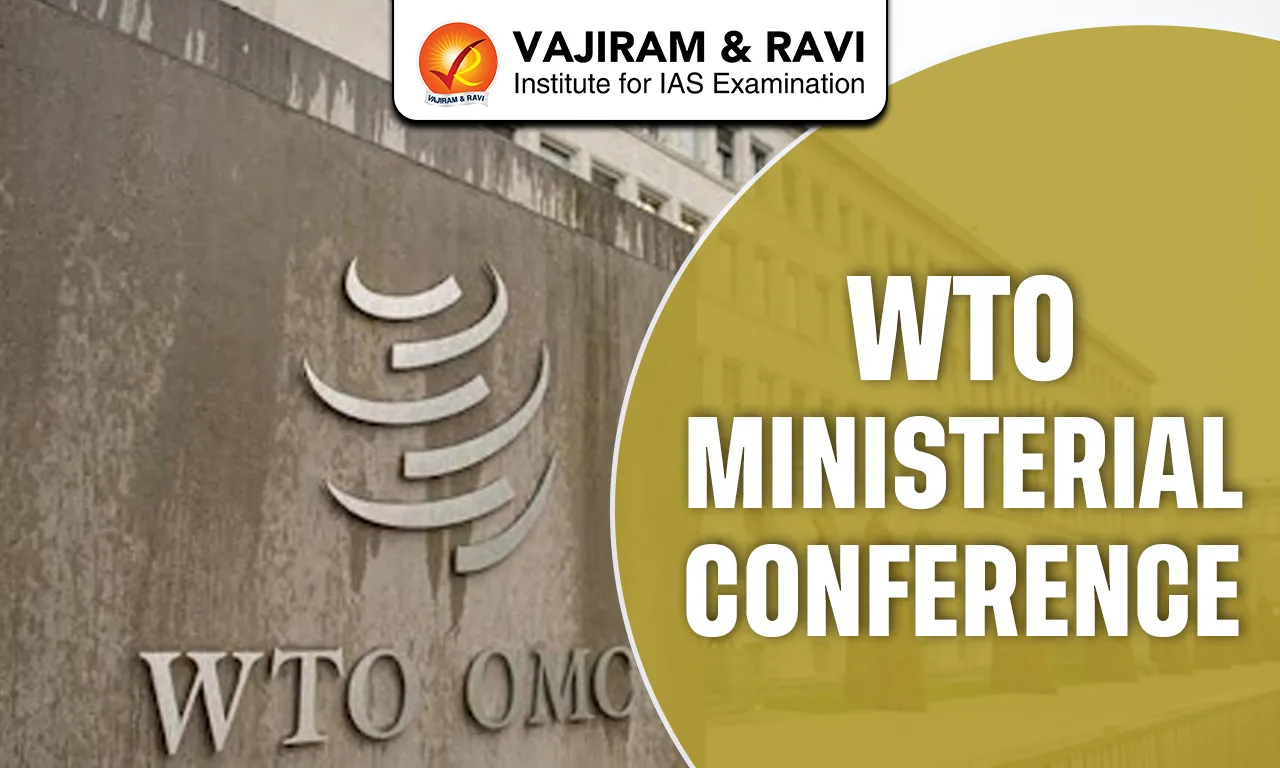
- The 14th Ministerial Conference of the World Trade Organisation has begun amid debates on global trade reforms and India’s policy stance.
World Trade Organization
- The World Trade Organisation (WTO) is a global international body established in 1995 to regulate and facilitate international trade among nations.
- Objectives
- Promote free and fair global trade.
- Ensure predictability and transparency in trade rules.
- Provide a platform for negotiation and dispute settlement.
- Support development through trade integration.
- Key Principles
- Most-Favoured Nation (MFN): Equal treatment to all member countries in trade.
- National Treatment: Imported goods should be treated equally with domestic goods.
- Consensus-based decision-making: Decisions are typically taken with agreement from all of the members.
- Institutional Mechanisms
- Ministerial Conference: The highest decision-making body, held every two years.
- Dispute Settlement Body: Resolves trade disputes among member countries.
- Trade Policy Review Mechanism: Monitors trade policies of member countries.
- Significance
- The WTO plays a crucial role in maintaining a stable global trade system.
- However, in recent years, it has faced challenges such as weakening dispute settlement mechanisms and rising protectionism.


News Summary
- The ongoing WTO Ministerial Conference (MC14) takes place in a context of a changing global trade order and growing tensions among major economies.
- Crisis of Relevance
- The WTO is facing a crisis of relevance due to disruptions in global trade rules.
- The dispute settlement mechanism has become ineffective because of the blocking of judge appointments by the United States.
- Push for WTO Reforms
- The United States is advocating significant reforms, including reconsideration of the MFN principle.
- There is also a push to incorporate plurilateral agreements, which involve a subset of countries instead of all members.
- This represents a shift away from the WTO’s traditional consensus-based approach.
- E-commerce Moratorium
- One of the key issues is the continuation of the moratorium on customs duties on electronic transmissions. It has been in place since 1998.
- Developed countries support its continuation.
- India, along with countries like Indonesia and South Africa, opposes it.
- India argues that:
- It may lead to significant revenue loss.
- It restricts policy space in the digital economy.
- Developing countries lack the technological capacity to benefit equally.
- Investment Facilitation Agreement
- Another major issue is the China-backed Investment Facilitation for Development (IFD) Agreement.
- Supported by over 120 countries.
- Aims to improve the flow of foreign direct investment.
- India opposes this agreement because:
- It is being introduced through a plurilateral route.
- It undermines the multilateral and consensus-based structure of the WTO.
- It may have strategic implications linked to global investment networks.
- Public Stockholding for Food Security
- India continues to push for a permanent solution on public stockholding.
- WTO rules limit agricultural subsidies to 10% of production value.
- India seeks flexibility to support farmers and ensure food security.
- This is crucial because:
- India supports millions of small farmers through MSP.
- Around 80 crore people receive free food grains under welfare schemes.
- Fisheries Subsidies and Livelihood Concerns
- India advocates a balanced approach to fisheries subsidies.
- It supports sustainability in fishing practices.
- It emphasises the protection of small fishers’ livelihoods.
- It calls for greater responsibility from developed nations engaged in distant water fishing.
- India’s Broader Trade Strategy
- India’s approach to the WTO is guided by the need to preserve policy space.
- India has a relatively low share in global trade but high growth potential.
- Past experiences, such as the Information Technology Agreement (ITA-1), influence its cautious approach.
- India aims to ensure that:
- Development concerns remain central to WTO reforms.
- Trade rules do not constrain domestic policy flexibility.
- Emerging sectors like digital trade are regulated fairly.
Source: IE

 Last updated on Sep, 2026
→ UPSC 2027 Notification will be released on 13 January 2027 at upsconline.nic.in.
→ Asian Games 2026 are being held in Aichi-Nagoya, Japan, from 19 September to 4 October.
→ Check out the latest UPSC Syllabus here.
→ Download UPSC Model Answers for Mains 2026
→ UPSC Mains Question Paper 2026 is out now for Essay & GS Paper 1, 2, 3 & 4.
→ UPSC Calendar 2027 has been released.
→ Enroll in Vajiram & Ravi’s UPSC Mains Test Series 2027 for structured answer writing practice, expert evaluation, and exam-oriented feedback.
→ Join Vajiram & Ravi’s UPSC Mentorship Program 2027 for personalized guidance, strategy planning, and one-to-one support from experienced mentors.
→ Go through the UPSC Mains Previous Year Papers to enhance your preparation.
→ UPSC has released UPSC Toppers List 2025 with the Civil Services final result on its official website.
→ Also check Best UPSC Coaching in India
WTO Ministerial Conference FAQs
Q1. What is the WTO Ministerial Conference?+
Q2. Why is the WTO facing a crisis of relevance?+
Q3. What is the e-commerce moratorium issue?+
Q4. Why does India oppose the Investment Facilitation Agreement?+
Q5. What is India’s key demand at the WTO?+
Tags: mains articles upsc current affairs upsc mains current affairs WTO Ministerial Conference