IAS Resignation Rules Latest News
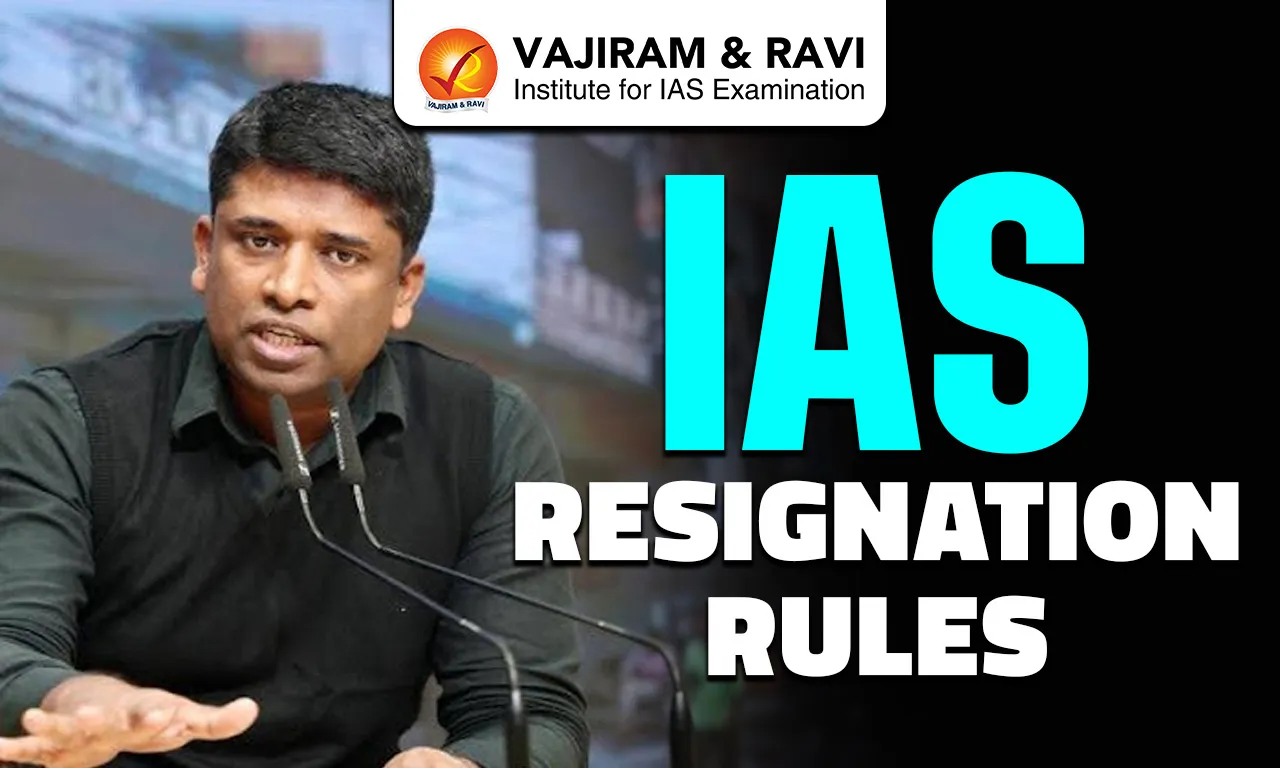
- Kannan Gopinathan, a former IAS officer who resigned in 2019 citing restrictions on freedom of expression in Kashmir, has alleged that the government has delayed accepting his resignation for over six years. This delay has prevented him from contesting elections.
- His resignation is still pending with the Ministry of Home Affairs, as the final recommendation has not yet been sent to the DoPT.
- Officials note that such prolonged delays are unprecedented, raising questions about the rules governing IAS resignations, timelines, and grounds for rejection.
Rules on IAS Officers and Political Activity
- Under the All India Services (Conduct) Rules, serving IAS officers are strictly prohibited from associating with political parties or participating in political activities.
- They are required to maintain political neutrality and uphold constitutional values at all times.
2014 Amendment and Political Neutrality
- The Conduct Rules were amended in November 2014, adding new clauses to reinforce the conduct expected of senior civil servants.
- Most notably, Rule 3(1) mandates that every government employee must, at all times, maintain political neutrality and remain committed to upholding the supremacy of the Constitution and democratic values.
- This rule essentially codifies the foundational expectation that civil servants — regardless of which government is in power — serve the Constitution and the public, not any political party or ideology.
Gopinathan’s Case and Legal Grey Area
- Kannan Gopinathan resigned from the IAS in 2019 and later joined a political party in 2024.
- However, since his resignation has not yet been formally accepted, his status remains that of a serving officer, placing him in violation of conduct rules if he engages in politics.
- Gopinathan has accused the government of deliberately delaying his resignation, calling it “harassment” and arguing that it is preventing him from participating in the democratic process.


Resignation Process for IAS Officers
- The resignation of officers from the All India Services—IAS, IPS, and Indian Forest Service—is governed by Rules 5(1) and 5(1)(A) of the All India Services (Death-cum-Retirement Benefits) Rules, 1958.
Procedure Based on Posting
- An officer serving in a state cadre must submit their resignation to the Chief Secretary of the state.
- If the officer is on central deputation, the resignation is submitted to the concerned ministry or department secretary, which then forwards it to the respective state cadre with its recommendations.
- In the case of AGMUT cadre officers, the process is routed through the Ministry of Home Affairs.
Key Conditions and Implications
- As per Rule 5, officers who resign are not entitled to retirement benefits.
- Additionally, Department of Personnel and Training (DoPT) guidelines require that the resignation must be clear and unconditional for it to be considered valid.
What Happens After an IAS Officer Submits Resignation
- After resignation is submitted, the state verifies if the officer has any pending dues, vigilance cases, or inquiries—resignations are usually rejected if such issues exist.
- The state then forwards its recommendation and details to the Union government.
- The final decision is taken by the competent authority:
- for IAS officers, the DoPT Minister (Prime Minister);
- for IPS, the Home Minister; and
- for Indian Forest Service officers, the Environment Minister.
Can the Government Delay IAS Resignations
- There is no fixed time limit for accepting an IAS officer’s resignation.
- However, a DoPT circular states that it is generally not in the government’s interest to retain an unwilling officer, so resignations should normally be accepted.
Conditions Where Resignation May Be Delayed or Rejected
- Resignations can be withheld in certain situations.
- If an officer is under suspension or facing disciplinary proceedings, the government must assess whether accepting the resignation serves public interest.
- In such cases, the Central Vigilance Commission (CVC) may also be consulted.
Other Grounds for Rejection
- The government also examines whether the officer has:
- Pending dues or obligations, or
- Executed service bonds (for training, scholarships, or fellowships).
- For example, Arvind Kejriwal faced penalties after resigning from the IRS due to a bond violation linked to a government-funded fellowship.
- If the officer holds an important position, the government may delay acceptance until suitable replacement arrangements are made, ensuring administrative continuity.
IAS Resignations Since 2010: Key Trends
- RTI data from the DoPT shows that 31 IAS officers have resigned since 2010, the year the CSAT was introduced in the UPSC exam.
- Of these, 11 resigned between 2010–2014 (UPA period) and 20 between 2015 and May 2025 (NDA period).
- Since the introduction of CSAT, many IAS entrants have been technocrats, and a growing number have chosen to resign for better opportunities in the private sector or to enter politics, reflecting evolving career preferences among civil servants.
Can IAS Officers Withdraw Their Resignation
- Yes, IAS officers can withdraw their resignation, but only under specific conditions laid down in the All India Services (Death-cum-Retirement Benefits) Rules.
- Under Rule 5(1A)(i), the Union government may allow withdrawal of resignation in public interest.
- However, as per a 2011 amendment, the gap between resignation and rejoining service cannot exceed 90 days.
- Also, withdrawal is not permitted if the officer resigned to pursue political activities.
- If an officer withdraws their resignation before it is formally accepted, it is automatically treated as withdrawn. This rule applies in cases where resignation processing is delayed.
- Shah Faesal, who resigned in 2019, was able to return to service in 2022 because his resignation had not been accepted, allowing automatic withdrawal.
- The timing of acceptance is crucial—before acceptance, withdrawal is easy; after acceptance, it is restricted and conditional, especially if linked to political activity.
Source: IE

 Last updated on Sep, 2026
→ UPSC 2027 Notification will be released on 13 January 2027 at upsconline.nic.in.
→ Asian Games 2026 are being held in Aichi-Nagoya, Japan, from 19 September to 4 October.
→ Check out the latest UPSC Syllabus here.
→ Download UPSC Model Answers for Mains 2026
→ UPSC Mains Question Paper 2026 is out now for Essay & GS Paper 1, 2, 3 & 4.
→ UPSC Calendar 2027 has been released.
→ Enroll in Vajiram & Ravi’s UPSC Mains Test Series 2027 for structured answer writing practice, expert evaluation, and exam-oriented feedback.
→ Join Vajiram & Ravi’s UPSC Mentorship Program 2027 for personalized guidance, strategy planning, and one-to-one support from experienced mentors.
→ Go through the UPSC Mains Previous Year Papers to enhance your preparation.
→ UPSC has released UPSC Toppers List 2025 with the Civil Services final result on its official website.
→ Also check Best UPSC Coaching in India
IAS Resignation Rule FAQs
Q1. What are IAS Resignation Rules?+
Q2. Can the government delay IAS resignation?+
Q3. Who approves IAS resignation?+
Q4. Can IAS officers withdraw resignation?+
Q5. What are grounds for rejection of IAS resignation?+
Tags: IAS Resignation Rule mains articles upsc current affairs upsc mains current affairs