Artemis II Mission Latest News
- NASA’s Artemis II mission will send four astronauts on a 10-day journey around the Moon, marking the first human mission to the Moon’s vicinity since 1972.
- The mission is a flyby and will not land on the Moon. A future mission, planned for 2028, aims to land astronauts on the lunar surface.
NASA’s Plan for a Permanent Moon Base
- NASA has unveiled a long-term roadmap to establish a permanent human presence on the Moon, aiming to support frequent and extended astronaut stays over the next decade. This marks a shift from short visits to sustained exploration.
- The plan comes alongside preparations for the Artemis II mission, which will send astronauts around the Moon and mark humanity’s return to lunar space after more than 50 years.
- Unlike the Apollo missions (1969–1972), which focused on brief landings, the new objective is long-term habitation.
Role of Artemis Missions
- The Artemis programme is central to this effort. Artemis I (2022) tested an uncrewed mission around the Moon.
- Artemis II will carry astronauts on a similar path, followed by another test mission and a planned human Moon landing in 2028.
- NASA aims for regular lunar missions every six months, involving international partners and private companies.


Travel Time: Fast vs Fuel-Efficient Routes
- The Artemis II mission will reach the Moon’s vicinity in 3–4 days, similar to the Apollo missions.
- More than 50 years ago, America’s Apollo missions made history when the first people set foot on the lunar surface.
- In contrast, recent uncrewed missions like Chandrayaan-3 took weeks or months, using slower but more fuel-efficient routes.
- Faster travel requires more powerful rockets. Artemis II uses NASA’s Space Launch System (SLS), currently its most powerful rocket, while Apollo missions used the Saturn V, the most powerful ever built.
- Both the SLS rocket and Orion spacecraft are relatively new and were first tested in the uncrewed Artemis I mission in 2022, which lasted about 25 days.
- Artemis II marks the first time these systems will carry astronauts on a lunar mission.
Artemis II Flight Path and Mission Significance
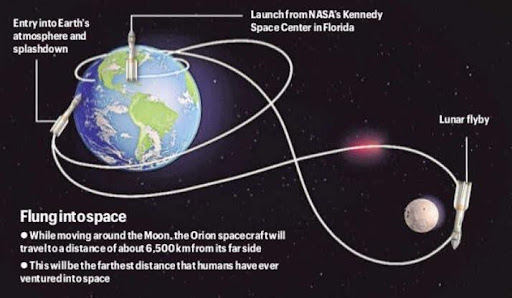
- The Artemis II mission will first orbit Earth twice before heading toward the Moon.
- It will circle the Moon and travel up to 6,500 km beyond its far side, marking the farthest distance humans have ever reached in space—far beyond Apollo missions, which stayed about 110 km above the lunar surface.
- This mission is a test flight to validate systems ahead of a planned Moon landing in 2028.
India’s Rise in the New Lunar Race
- When Apollo 11 landed on the Moon in 1969, ISRO had not yet been established—it was created just a month later.
- Today, India has emerged as both a collaborator and competitor in the new era of lunar exploration, reflecting a shift from the earlier US–USSR dominance to a multi-country space race involving China, Japan, and others.
India’s Moon Mission Ambitions
- India is planning a human landing on the Moon by 2040, while China is targeting 2030.
- Although Russia has been less active recently, multiple countries and European partners are expected to play significant collaborative roles in upcoming lunar missions.
Strategic Alignment with NASA
- India is a signatory to the Artemis Accords, aligning it with NASA’s framework for peaceful and sustainable space exploration.
- This opens avenues for closer cooperation between ISRO and NASA in lunar and deep-space missions.
- The strong partnership between ISRO and NASA is already visible in projects like the NISAR Earth observation mission.
- NASA’s plans also involve private players, academia, and international partners, giving India opportunities to gain practical experience and technological exposure as it prepares for its own long-term lunar goals.

 Last updated on Sep, 2026
→ UPSC 2027 Notification will be released on 13 January 2027 at upsconline.nic.in.
→ Asian Games 2026 are being held in Aichi-Nagoya, Japan, from 19 September to 4 October.
→ Check out the latest UPSC Syllabus here.
→ Download UPSC Model Answers for Mains 2026
→ UPSC Mains Question Paper 2026 is out now for Essay & GS Paper 1, 2, 3 & 4.
→ UPSC Calendar 2027 has been released.
→ Enroll in Vajiram & Ravi’s UPSC Mains Test Series 2027 for structured answer writing practice, expert evaluation, and exam-oriented feedback.
→ Join Vajiram & Ravi’s UPSC Mentorship Program 2027 for personalized guidance, strategy planning, and one-to-one support from experienced mentors.
→ Go through the UPSC Mains Previous Year Papers to enhance your preparation.
→ UPSC has released UPSC Toppers List 2025 with the Civil Services final result on its official website.
→ Also check Best UPSC Coaching in India
Artemis II Mission FAQs
Q1. What is the Artemis II Mission?+
Q2. Will Artemis II Mission land on the Moon?+
Q3. How long will Artemis II Mission take?+
Q4. What makes Artemis II Mission significant?+
Q5. How is Artemis II Mission different from Apollo missions?+
Tags: artemis II mission mains articles upsc current affairs upsc mains current affairs