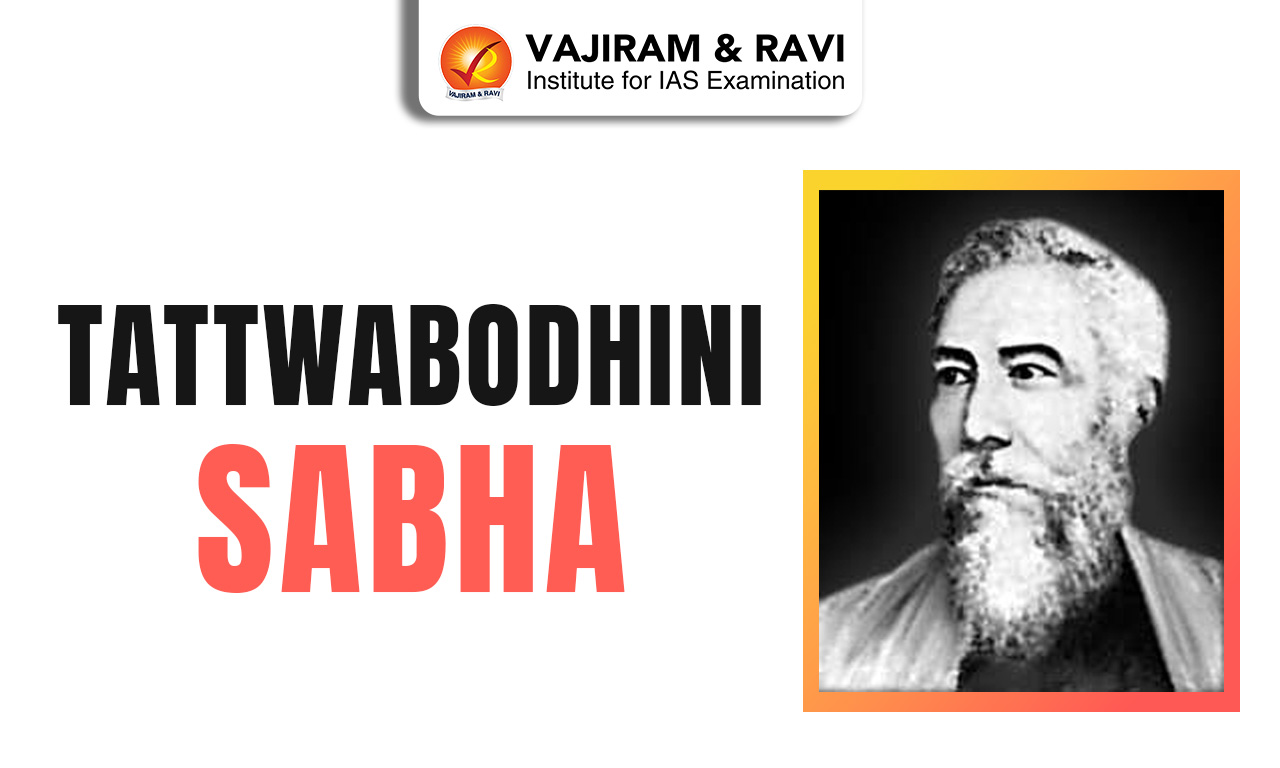
The Tattvabodhini Sabha, meaning “Truth Propagating Society,” was a group founded to promote rational, monotheistic Hinduism based on the Upanishads and Vedanta. Its main goal was to revive Indian society and religion by spreading knowledge of ancient scriptures and encouraging social reforms.
About Tattvabodhini Sabha
- Overview
- The Tattvabodhini Sabha was an important organization of the 19th-century Bengal Renaissance.
- It was founded on 6 October 1839 in Calcutta (now Kolkata) by Debendranath Tagore.
- The Sabha aimed to promote a rational and monotheistic form of Hinduism based on the Upanishads.
- It also worked for social and religious reforms and spread its ideas through the journal Tattvabodhini Patrika.
- Founder
- Debendranath Tagore was the founder of the Sabha.
- He was the eldest son of Dwarkanath Tagore and the father of Rabindranath Tagore.
- He was a key leader of the Brahmo Samaj and formed this Sabha to strengthen its ideas.
- Objectives
- To promote belief in one God (monotheism).
- To spread the teachings of the Upanishads and Vedanta.
- To reform Hindu society and remove outdated practices.
- To protect Indian culture and religion from excessive Western and missionary influence.
- To revive and study India’s ancient knowledge and traditions.
- Activities
- The Sabha published a journal called Tattvabodhini Patrika.
- The journal included articles on science, history, philosophy, and social issues in Bengali.
- It helped spread education, awareness, and reformist ideas among people.
- The Sabha attracted many scholars and intellectuals of that time.
- Role in Reform Movements
- The Sabha played an important role in reviving the Brahmo Samaj, which had weakened after the death of Raja Ram Mohan Roy.
- It helped revive and strengthen the Brahmo Samaj, especially after the death of Raja Ram Mohan Roy, and was later fully merged into it in 1859.
- It supported social reforms such as women’s education and reducing caste discrimination.
About Debendranath Tagore
- Debendranath Tagore was born on 15 May 1817 in Jorasanko, Calcutta (Kolkata).
- He was the son of Dwarkanath Tagore, a wealthy industrialist, and Digambari Devi.
- He was first educated at home and later studied at the Anglo Hindu College.
- From a young age, he developed a strong interest in philosophy and spirituality.
- In 1839, he founded the Tattvabodhini Sabha to promote rational thinking and religious reform.
- He joined the Brahmo Samaj in 1842 and played an important role in strengthening it.
- He also established an ashram at Santiniketan, which later became famous under his son Rabindranath Tagore.
- Major Contributions
- Brahmo Samaj: He gave new life to the Brahmo Samaj by promoting belief in one God and opposing idol worship.
- Revival of Brahmoism: After the death of Raja Ram Mohan Roy, he strengthened and organised the movement with clear ideas.
- Tattvabodhini Sabha: Founded in 1839, it encouraged the study of Upanishads and rational thinking; later it merged with Brahmo Samaj.
- Tattvabodhini Patrika: Started in 1843, this journal helped spread reformist and philosophical ideas among people.
- Promotion of Scriptures: He translated important texts like the Katha Upanishad and parts of the Rig Veda into Bengali to make them easier to understand.
- Writings: His works like Brahmo Dharma and Atmattvavidya explained moral and spiritual ideas clearly.
- Social Reforms: He supported widow remarriage, opposed child marriage and polygamy, and encouraged women’s education.
- Santiniketan: In 1863, he founded an ashram which later became a major centre of learning and spirituality.


 Last updated on Oct, 2026
→ UPSC 2027 Notification will be released on 13 January 2027 at upsconline.nic.in.
→ Asian Games 2026 are being held in Aichi-Nagoya, Japan, from 19 September to 4 October.
→ Check Nobel Prize 2026 Winners List here.
→ Download PIB PRiSM Monthly Magazine 2026 here.
→ Check UPSC Monthly Current Affairs Magazine The Recitals here.
→ Check out the latest UPSC Syllabus here.
→ Download UPSC Model Answers for Mains 2026
→ UPSC Mains Question Paper 2026 is out now for Essay & GS Paper 1, 2, 3 & 4.
→ UPSC Calendar 2027 has been released.
→ Enroll in Vajiram & Ravi’s UPSC Mains Test Series 2027 for structured answer writing practice, expert evaluation, and exam-oriented feedback.
→ Join Vajiram & Ravi’s UPSC Mentorship Program 2027 for personalized guidance, strategy planning, and one-to-one support from experienced mentors.
→ Go through the UPSC Mains Previous Year Papers to enhance your preparation.
→ UPSC has released UPSC Toppers List 2025 with the Civil Services final result on its official website.
→ Also check Best UPSC Coaching in India
Tattvabodhini Sabha FAQs
Q1. What is the Tattvabodhini Sabha?+
Q2. Who founded the Tattvabodhini Sabha?+
Q3. What were the main objectives of the Sabha?+
Q4. What was the role of Tattvabodhini Patrika?+
Q5. How did the Sabha contribute to the Brahmo Samaj?+
Tags: history history notes tattvabodhini sabha tattwabodhini sabha