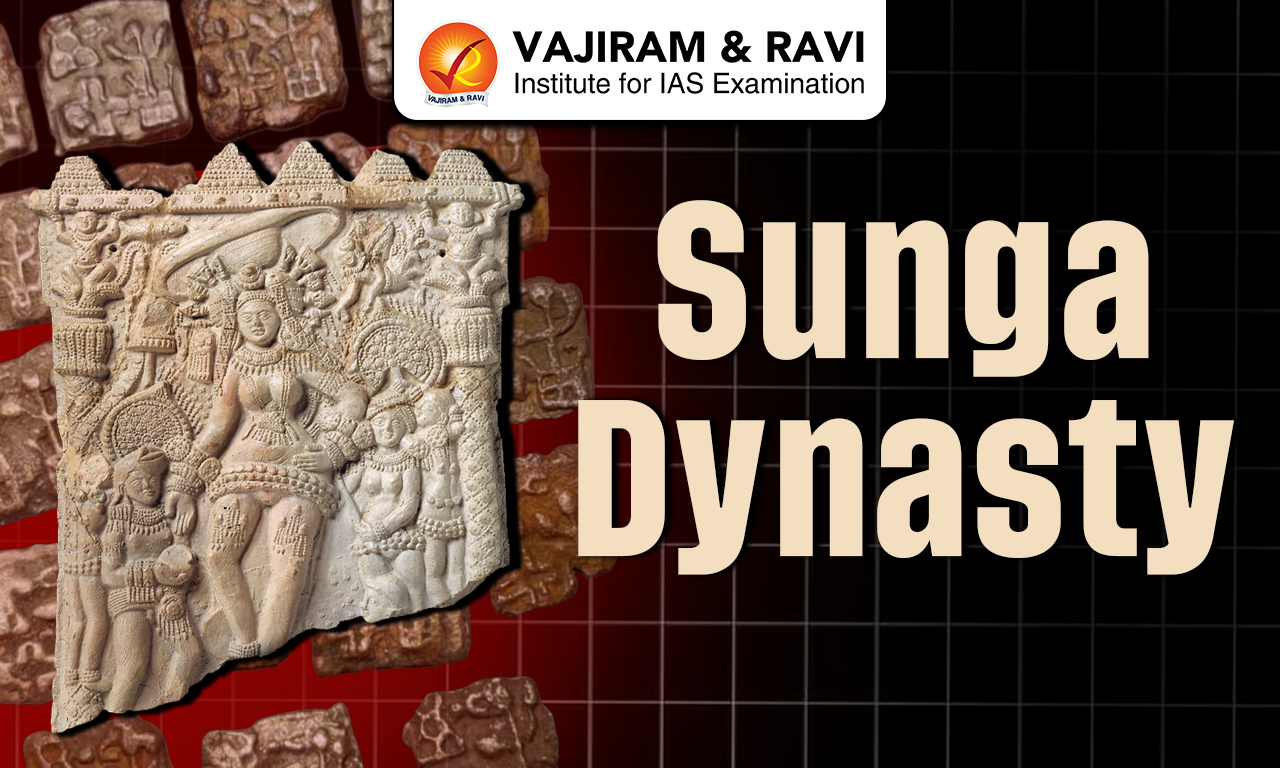
The Sunga Dynasty emerged in northern India after the fall of the Mauryan Empire and ruled from around 185 BCE to 73 BCE. The dynasty was founded by Pushyamitra Shunga. It marked a transition from Mauryan centralization to a more regionally controlled polity. The period is known for the revival of Brahmanical traditions, resistance against Indo-Greek invasions and significant contributions to art, architecture and Sanskrit literature in ancient India.
Sunga Dynasty Background
The Sunga Dynasty arose in a period of political instability following the decline of Mauryan authority and reflects a shift in power structures.
- Origin of Dynasty: Pushyamitra Shunga, the Senapati of Brihadratha, assassinated him during a military parade around 185 BCE and established the Sunga rule at Pataliputra, ending Mauryan sovereignty.
- Territorial Extent: The empire included Bihar, Uttar Pradesh, Madhya Pradesh, Rajasthan, Vidarbha and Punjab, with key centers like Pataliputra, Vidisha, Ujjain, Mathura and Saket forming administrative hubs.
- Political Context: The weakening of later Mauryas created instability, allowing military elites like Pushyamitra to seize power and reorganize governance with stronger military emphasis.
- Capital and Centers: Pataliputra remained the primary capital, while Vidisha later became an important political center, reflecting decentralization of authority within the empire.
- Sources of Information: Knowledge comes from texts like Harshacharita, Malavikagnimitram, Mahabhashya, Puranas, Divyavadana and inscriptions like Hathigumpha and Heliodorus Pillar.
Sunga Dynasty Administration
The Sunga Dynasty administration combined Mauryan administrative features with strong military control and Brahmanical influence.
- Nature of Kingship: The king retained supreme authority and Pushyamitra continued using the title Senapati, indicating the military origin and importance of armed forces in governance.
- Provincial Administration: Provinces were governed by viceroys, often royal princes, such as Agnimitra in Vidisha, ensuring control over distant regions and efficient administration.
- Bureaucratic Continuity: The Sungas largely continued Mauryan administrative structures but on a smaller scale, adapting centralized governance to regional needs and political realities.
- Military Organization: A strong standing army with infantry, cavalry, chariots and elephants was maintained to counter Indo-Greek invasions and internal rebellions.
- Role of Brahmanism: Administration emphasized Vedic traditions, rituals and Brahmanical authority, reflecting ideological changes from the Mauryan emphasis on Buddhism.


Sunga Dynasty Society and Culture
The Sunga Dynasty period witnessed a cultural shift marked by Brahmanical revival alongside continued religious diversity.
- Brahmanical Revival: The rulers promoted Vedic rituals, sacrifices like Ashvamedha and priestly authority, marking a strong resurgence of Brahmanism in political and social life.
- Position of Buddhism: Some texts like Divyavadana accuse persecution of Buddhists, but evidence suggests continued existence and even development of Buddhist sites like Sanchi and Bharhut.
- Social Structure: The varna system became more prominent, supported by texts like Manusmriti, reflecting strengthening of Brahmanical social order and hierarchy.
- Religious Diversity: Worship of Vishnu and Shiva increased, while Buddhist symbols like lotus and Bodhi tree remained present, indicating coexistence of multiple religious traditions.
- Cultural Synthesis: The period reflects a blend of Brahmanical and Buddhist influences, shaping a complex cultural environment with evolving religious practices and artistic expressions.
Sunga Dynasty Art and Architecture
The Sunga Dynasty period was marked by major artistic developments in sculpture, architecture, literature and script evolution.
- Stupa Architecture: Major expansions of stupas at Bharhut and Sanchi included stone railings, balustrades and narrative carvings depicting Jataka tales and daily life scenes.
- Stone Sculpture: Artistic style became more decorative with floral, geometric patterns and narrative reliefs, marking a shift from Mauryan simplicity to elaborate indigenous forms.
- Terracotta Art: Highly developed terracotta figurines depicting women, deities and animals reflected everyday life, religious beliefs and artistic creativity of the period.
- Literature: Sanskrit flourished as the court language, with works like Malavikagnimitram by Kalidasa and Mahabhashya by Patanjali providing insights into politics and grammar.
- Script Development: Brahmi script continued with more angular and developed forms, serving as the medium for Sanskrit and inscriptions across the empire.
- Intellectual Contributions: Patanjali’s Mahabhashya and Yoga Sutra played a crucial role in grammar and philosophy, shaping intellectual traditions for centuries.
- Monuments and Sites: Important centers like Bharhut, Sanchi, Vidisha and Pataliputra showcase architectural advancements and religious symbolism of the Sunga period.
Sunga Dynasty Economy
The Sunga Dynasty economy was based on agriculture, trade and regional economic centers, sustaining a decentralized political system.
- Agricultural Base: Agriculture remained the backbone, supported by fertile Gangetic plains, ensuring steady revenue through land taxes and agrarian production.
- Trade Networks: Trade routes connected major cities like Pataliputra, Vidisha and Ujjain, facilitating exchange of goods and cultural interactions across regions.
- Urban Centers: Cities like Mathura and Saket emerged as economic hubs, contributing to commercial growth and local administrative importance.
- Coinage System: Regional coinage and independent minting by local authorities indicate decentralization and reduced central control over economic activities.
- Resource Distribution: Economic resources were unevenly distributed due to regional autonomy, leading to emergence of smaller kingdoms and localized economies.
Sunga Dynasty Rulers and their Contributions
The Sunga Dynasty had several rulers who contributed to political stability, military defense and cultural development.
- Pushyamitra Shunga (c. 185-149 BCE): Founder who ruled for 36 years, performed two Ashvamedha Yajnas, resisted Indo-Greek invasions under Demetrius and Menander and revived Brahmanical traditions.
- Agnimitra (c. 149-141 BCE): Son of Pushyamitra, governed from Vidisha, known through Malavikagnimitram and maintained political control while supporting arts and culture.
- Vasumitra: Grandson of Pushyamitra, defeated Indo-Greek forces near the Sindhu region and strengthened military defense of the empire’s frontiers.
- Bhagabhadra (c. 114-83 BCE): Known from Heliodorus Pillar inscription, maintained diplomatic relations with Indo-Greek king Antialkidas and supported Vaishnavism.
- Devabhuti (c. 83-73 BCE): Last ruler, weak and ineffective, whose assassination by minister Vasudeva Kanva led to the end of the dynasty.
Sunga Dynasty Foreign Relations
The Sunga Dynasty actively engaged in military conflicts and diplomatic relations with neighboring powers and foreign invaders.
- Indo-Greek Conflicts: Pushyamitra and successors resisted invasions by Demetrius and Menander, preventing complete foreign control over Magadha and northern India.
- Battle Engagements: Vasumitra’s victory over Greek forces near the Sindhu river highlights military strength and strategic defense of frontiers.
- Diplomatic Relations: Heliodorus Pillar inscription shows diplomatic ties between Bhagabhadra and Indo-Greek king Antialkidas, indicating peaceful exchanges alongside conflicts.
- Regional Conflicts: The Sungas fought with Kalinga ruler Kharavela, Satavahanas and other regional powers, reflecting constant political competition in post Mauryan India.
- Territorial Challenges: Loss of regions like Mathura to Indo-Greeks and rise of independent states show limits of Sunga control in frontier areas.
Sunga Dynasty Decline
The decline of the Sunga Dynasty resulted from internal weakness, regional fragmentation and external pressures.
- Weak Successors: After strong rulers like Pushyamitra, later kings lacked administrative and military capabilities, leading to weakening central authority.
- Provincial Revolts: Governors and local rulers asserted independence, fragmenting the empire into smaller kingdoms and reducing central control.
- External Pressures: Continuous conflicts with Indo-Greeks, Satavahanas and Kalinga drained resources and weakened defensive capabilities.
- Political Instability: Rapid succession of rulers and lack of clear authority contributed to administrative inefficiency and instability within the empire.
- Assassination of Devabhuti: The last ruler was killed by his minister Vasudeva Kanva around 73 BCE, marking the end of the dynasty and beginning of Kanva rule.

 Last updated on Sep, 2026
→ UPSC 2027 Notification will be released on 13 January 2027 at upsconline.nic.in.
→ Asian Games 2026 are being held in Aichi-Nagoya, Japan, from 19 September to 4 October.
→ Check out the latest UPSC Syllabus here.
→ Download UPSC Model Answers for Mains 2026
→ UPSC Mains Question Paper 2026 is out now for Essay & GS Paper 1, 2, 3 & 4.
→ UPSC Calendar 2027 has been released.
→ Enroll in Vajiram & Ravi’s UPSC Mains Test Series 2027 for structured answer writing practice, expert evaluation, and exam-oriented feedback.
→ Join Vajiram & Ravi’s UPSC Mentorship Program 2027 for personalized guidance, strategy planning, and one-to-one support from experienced mentors.
→ Go through the UPSC Mains Previous Year Papers to enhance your preparation.
→ UPSC has released UPSC Toppers List 2025 with the Civil Services final result on its official website.
→ Also check Best UPSC Coaching in India
Sunga Dynasty FAQs
Q1. Who founded the Sunga Dynasty?+
Q2. What was the duration of the Sunga Dynasty?+
Q3. What was the main feature of Sunga Dynasty religious policy?+
Q4. Which important literary works are associated with the Sunga Dynasty period?+
Q5. How did the Sunga Dynasty come to an end?+
Tags: history history notes sunga dynasty