The Kalachuri Dynasty was a powerful medieval Indian dynasty that ruled between the 10th and 12th centuries CE, though its origins go back earlier. They governed important regions of India, mainly Central India (Chedi region) and parts of the Deccan (Haihaya region). Their capital was Tripuri, which became a major political and cultural center.
The Kalachuris are also mentioned in ancient texts like the Puranas and epics, linking them to the legendary Haihaya clan, which gave them historical and mythological importance.
Kalachuri Dynasty Origin
The Kalachuri Dynasty originated in early medieval India and is believed to have roots in the ancient Haihaya clan, mentioned in Puranic traditions. Their earliest political center was Mahishmati, from where they later expanded to Tripuri in Central India.
- Mythological Connection: The Kalachuris are linked to the Haihaya dynasty, a legendary Kshatriya lineage mentioned in Puranas and epics.
- Early Capital: Their earliest seat of power was Mahishmati, located on the banks of the Narmada River, an important trade and cultural center.
- Shift of Power: Over time, their political center shifted to Tripuri, which became the main capital of the powerful Chedi branch.
- Regional Roots: The dynasty initially emerged in Central India, especially in present-day Madhya Pradesh, before expanding to other regions.
- Multiple Branches: The Kalachuris developed different branches such as Tripuri, Ratanpur, and Deccan (Kalyani), indicating a widespread origin.
- Historical Debate: Historians have different views about their exact origin—some consider them local chiefs who rose to power, while others connect them to ancient royal lineages.
- Early Expansion: From their base in Mahishmati, they expanded into regions like Maharashtra, Gujarat, and Malwa.
- Political Rise: Their rise to prominence began around the 8th-9th century CE, reaching peak power under rulers like Kokalla I and Gangeyadeva.
Major Branches of the Kalachuri Dynasty
The Kalachuri Dynasty was not a single unified kingdom but consisted of several important branches that ruled different regions of India. These branches developed over time due to expansion, family divisions, and regional control.
Kalachuris of Tripuri (Chedi):
- The most powerful and prominent branch.
- Capital: Tripuri.
- Ruled Central India from the 8th to 12th century.
- Produced famous rulers like Kokalla I, Gangeyadeva, and Karna.
Kalachuris of Mahishmati:
- Considered the earliest branch of the dynasty.
- Based at Mahishmati.
- Controlled regions of northern Maharashtra, Malwa, and Gujarat.
- Declined after the rise of the Chalukyas.
Kalachuris of Kalyani (Deccan/Karnataka):
- Emerged in the Deccan region.
- Established by Bijjala II.
- Overthrew the Kalyani Chalukyas.
- Associated with the rise of the Lingayat movement.
Kalachuris of Ratanpur:
- Initially feudatories of the Tripuri Kalachuris.
- Became independent under Jajalladeva I.
- Later divided into Ratanpur and Raipur branches.
- Ruled parts of present-day Chhattisgarh.
Sarayupara Kalachuris:
- Ruled regions along the Sarayu River in present-day Uttar Pradesh.
- Territory extended from Bahraich to Gonda.
- Active between the 8th and 11th centuries.


Important Rulers of the Kalachuri Dynasty
The Kalachuri Dynasty reached its political and military peak under a series of strong rulers, especially from the Tripuri (Chedi) branch. These kings expanded the empire, formed strategic alliances, issued coins, and patronized art and literature, making the dynasty a major power in Central India.
1. Kokalla I (c. 845-855 CE)
- Founder of the powerful Tripuri branch and established authority at Tripuri, laying the foundation of Kalachuri rule in Central India.
- Expanded his kingdom towards the Konkan region and strengthened control over central trade routes.
- Formed a strategic alliance with Krishna II, helping him counter powerful enemies like the Pratiharas and Chalukyas.
- Had many sons (traditionally 18), which led to the spread of Kalachuri influence but also future division of the dynasty.
2. Samkaragana (Shankaragana I)
- Succeeded Kokalla I and focused on consolidating the empire rather than expanding aggressively.
- Defeated the Somavanshi rulers of South Kosala, strengthening control over present-day Chhattisgarh.
- Maintained strong matrimonial alliances with the Rashtrakutas to ensure political stability.
- Improved internal administration and maintained law and order in the kingdom.
3. Yuvraja I
- A powerful and ambitious ruler who defeated Rashtrakuta forces and asserted independence.
- Led military campaigns in northern regions including Kashmir and the Himalayan areas.
- Patronized literature and supported Rajasekhara, enhancing cultural growth.
- His achievements are mentioned in literary works like Viddhasalabhanjika, highlighting his fame.
4. Lakshmanaraja
- A strong conqueror who expanded the kingdom towards Bengal (Vangala) and Gujarat (Lata region).
- Defeated rulers of South Kosala and Gurjara regions, strengthening territorial control.
- Improved economic conditions by controlling important trade routes and fertile lands.
- Played a key role in establishing Kalachuri dominance in Central and Eastern India.
5. Samkaragana II & Yuvraja II
- Their reign was marked by internal conflicts and weakening central authority.
- Faced invasions from powerful rulers like Taila II of the Chalukyas.
- Lost several territories due to administrative weakness and lack of strong leadership.
- Their rule represents the beginning of decline before the later revival.
6. Gangeyadeva (c. 1015-1041 CE)
- Revived the Kalachuri power after a period of decline and instability.
- Assumed grand titles like Vikramaditya and Trikalingadhipati, reflecting imperial ambitions.
- Successfully resisted or avoided raids by Mahmud of Ghazni, maintaining sovereignty.
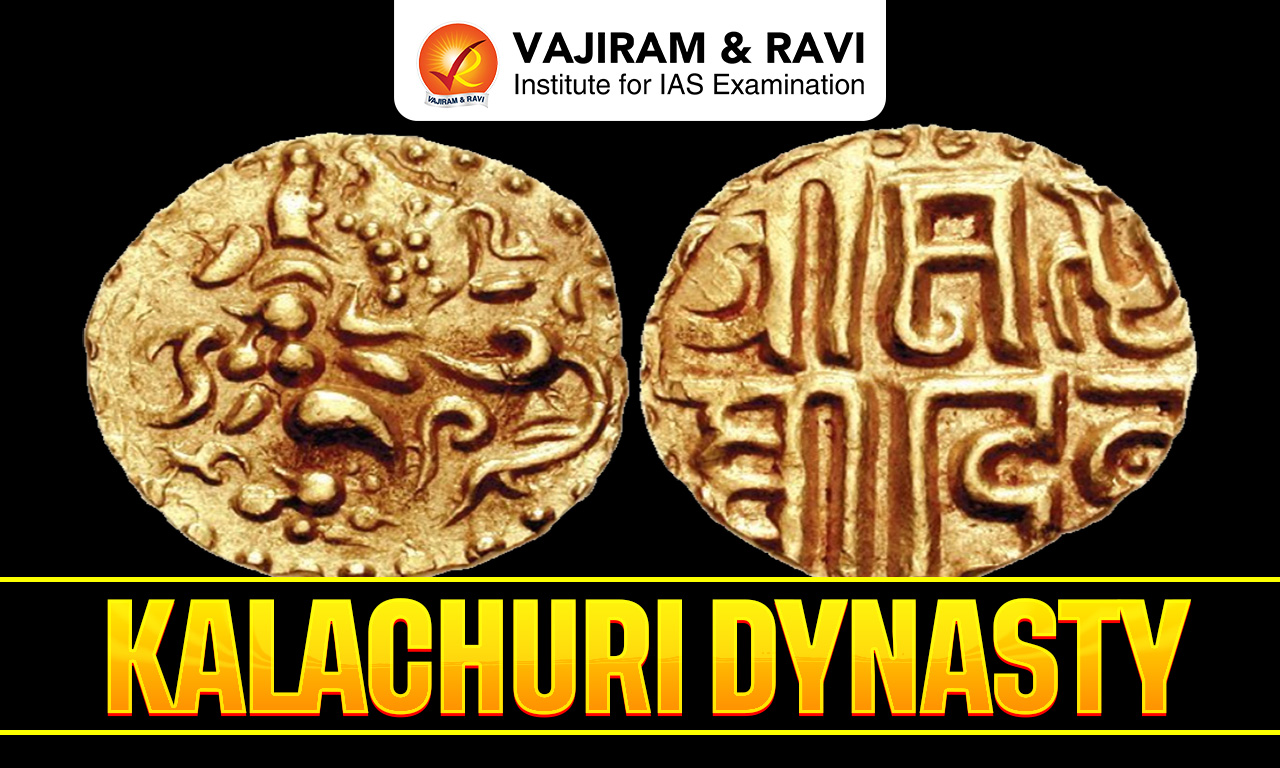
- Issued gold, silver, and copper coins, showing strong economic and political control.
7. Karna (c. 1041-1073 CE)
- The most powerful ruler who expanded the empire to its greatest extent.
- Conquered important regions like Varanasi and Prayagraj, extending influence to Bengal.
- Conducted successful campaigns against southern dynasties like Pallavas and Pandyas.
- Promoted religion, temple construction, and culture, and later abdicated in favor of his son.
8. Yashahkarna
- Successor of Karna who faced continuous defeats from rival dynasties.
- Lost control over key territories including Varanasi, weakening the empire.
- Could not maintain the administrative strength built by his predecessors.
- His reign marked the steady decline of the Kalachuri Dynasty.
Administration System
The Kalachuri Dynasty had a well-organized and efficient administrative system that helped them manage their vast territories in Central and Deccan India.
Central Authority of the King:
- The king was the supreme head of the state and controlled administration, military, and justice.
- He held titles like Maharajadhiraja and Vikramaditya to show power and prestige.
- The king was responsible for maintaining law, order, and protection of the kingdom.
Council of Ministers:
- The king was assisted by a group of ministers for governance.
- Important officials included:
- Prime Minister (Mahamantri)
- Military Chief (Senapati)
- Treasurer and Revenue Officers
- Ministers advised the king on political, military, and economic matters.
Provincial Administration:
- The empire was divided into provinces (mandalas or bhuktis) for easy administration.
- Each province was governed by officials or trusted nobles appointed by the king.
- These officials ensured implementation of royal orders and collected revenue.
Feudal System (Samanta System):
- Local rulers or chiefs called Samantas governed smaller regions.
- They paid tribute to the king and provided military support during wars.
- This system helped in controlling large territories but sometimes led to rebellions.
District and Village Administration:
- Provinces were further divided into districts and villages.
- Village administration was managed by local headmen and councils.
- Local bodies handled day-to-day matters like irrigation, agriculture, and disputes.
Revenue System:
- Land revenue was the main source of income.
- Taxes were collected from:
- Agriculture
- Trade and commerce
- Forest and mineral resources
- Revenue was used for administration, army, and public works.
Judicial System:
- The king was the highest judicial authority.
- Local courts handled minor disputes, while serious cases were decided at the royal court.
- Laws were based on Hindu scriptures and customs.
Military Administration:
- Maintained a strong army consisting of infantry, cavalry, and elephants.
- Military officers were appointed to manage defense and warfare.
- Feudal lords also contributed troops during conflicts.
Economic Administration:
- Encouraged agriculture by supporting irrigation systems.
- Promoted trade through control of important routes and markets.
- Issued coins in gold, silver, and copper for smooth economic transactions.
Record Keeping and Inscriptions:
- Important decisions and grants were recorded through inscriptions on stone and copper plates.
- These records provide valuable historical information about administration and society.
Religious Beliefs and Practices
- Dominance of Hinduism:
- The Kalachuri rulers mainly followed Hinduism, especially Shaivism (worship of Lord Shiva).
- Many rulers built Shiva temples and performed religious rituals.
- Religious Tolerance:
- Royal Titles and Faith:
- Kings adopted religious titles like Param Maheshvara (devotee of Shiva).
- Religion was closely linked with kingship and legitimacy.
- Temple Worship and Rituals:
- Temple-based worship became an important part of society.
- Rituals, festivals, and offerings were regularly performed.
Social and Cultural Life
- Caste System:
-
-
- Society was organized according to the traditional caste system.
- Brahmins were given special respect and land grants.
-
- Role of Religion in Society:
-
-
- Religion influenced daily life, customs, and traditions.
- Festivals and rituals played a major role in social unity.
-
- Education and Learning:
-
-
- Temples and monasteries acted as centers of education.
- Scholars were encouraged through royal patronage.
-
- Influence of Regional Culture:
-
- Local traditions and customs were integrated into mainstream culture.
- This created a blend of classical and regional cultural practices.
Architecture and Art
- Temple Architecture: Built mainly Shiva temples following the Nagara style, with features like shikhara (tower), mandapa (hall), and sanctum.
- Stone Construction: Used locally available stone, making structures strong, durable, and regionally distinctive.
- Intricate Carvings: Temple walls were decorated with detailed carvings of gods, goddesses, and mythological scenes.
- Sculptural Excellence: Created fine sculptures of Hindu deities like Shiva, Vishnu, and Devi with expressive and symbolic designs.
- Inscriptions & Cultural Records: Used stone and copper plate inscriptions to record temple grants, religious activities, and achievements.
Decline of the Kalachuri Dynasty
The Kalachuri Dynasty declined after the 11th century as strong rulers were followed by weak successors who could not maintain the vast empire. Continuous wars, internal conflicts, and the rise of powerful neighboring dynasties gradually reduced their political strength and led to their fall.
- Weak rulers after Karna failed to control the empire effectively.
- Internal conflicts and succession disputes weakened central authority.
- The feudal system led to powerful samantas who became independent.
- Continuous wars exhausted the kingdom’s military and economic resources.
- Strong rival dynasties like the Chandellas and Paramaras reduced their power.
- Loss of important regions like Varanasi weakened their political position.
- Economic decline due to reduced revenue and instability affected governance.
- Decline of central control allowed provinces to break away.

 Last updated on Oct, 2026
→ UPSC 2027 Notification will be released on 13 January 2027 at upsconline.nic.in.
→ Asian Games 2026 are being held in Aichi-Nagoya, Japan, from 19 September to 4 October.
→ Check Nobel Prize 2026 Winners List here.
→ Download PIB PRiSM Monthly Magazine 2026 here.
→ Check UPSC Monthly Current Affairs Magazine The Recitals here.
→ Check out the latest UPSC Syllabus here.
→ Download UPSC Model Answers for Mains 2026
→ UPSC Mains Question Paper 2026 is out now for Essay & GS Paper 1, 2, 3 & 4.
→ UPSC Calendar 2027 has been released.
→ Enroll in Vajiram & Ravi’s UPSC Mains Test Series 2027 for structured answer writing practice, expert evaluation, and exam-oriented feedback.
→ Join Vajiram & Ravi’s UPSC Mentorship Program 2027 for personalized guidance, strategy planning, and one-to-one support from experienced mentors.
→ Go through the UPSC Mains Previous Year Papers to enhance your preparation.
→ UPSC has released UPSC Toppers List 2025 with the Civil Services final result on its official website.
→ Also check Best UPSC Coaching in India
Kalachuri Dynasty FAQs
Q1. Who were the Kalachuris?+
Q2. What was the capital of the Kalachuri Dynasty?+
Q3. Who founded the Kalachuri Dynasty?+
Q4. Which was the most powerful branch?+
Q5. Who was the greatest ruler of the Kalachuris?+
Tags: history history notes kalachuri dynasty