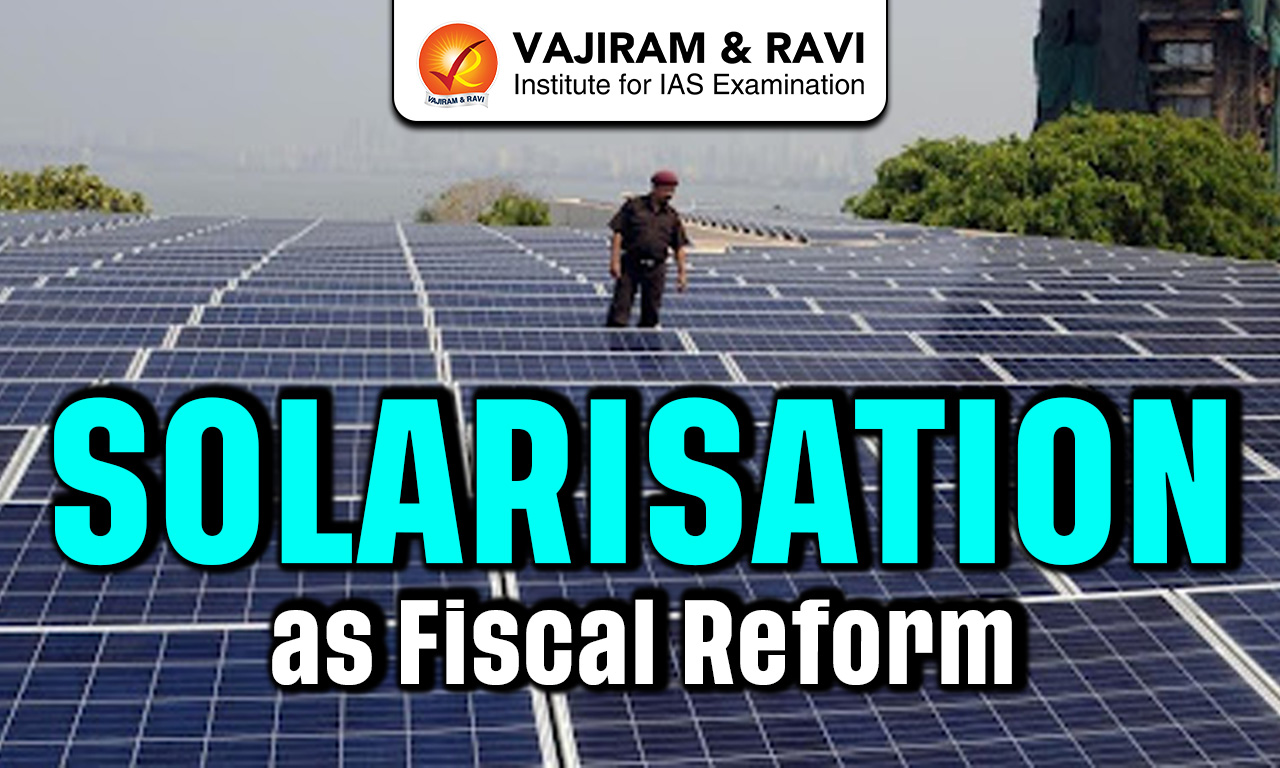
Solarisation as Fiscal Reform Latest News
- India’s States collectively spend nearly ₹2.4 lakh crore annually on electricity subsidies, primarily for agriculture and domestic consumers.
- The Union government is increasingly repositioning its flagship solar schemes not merely as clean energy initiatives, but as fiscal reform tools aimed at gradually eliminating this subsidy burden.
- With India’s installed power capacity reaching 535 GW (March 2026)—including about 150 GW solar and 54% from non-fossil sources—solarisation is emerging as a key instrument in both energy transition and public finance restructuring.
Reframing Solar Policy – From Climate to Fiscal Strategy
- Programmes like PM–KUSUM (for agriculture) and PM Surya Ghar (for households) are now being framed as mechanisms to –
- Replace subsidised grid electricity with low-cost solar power
- Reduce States’ recurring subsidy outgo
- Over time, solarisation could eliminate cross-subsidy burdens, especially those borne by industrial and commercial users.


Key Schemes Driving the Transition
- PM-KUSUM (Agricultural solarisation):
- Focus: Solarisation of agricultural feeders and installation of standalone solar pumps.
- Impact: Reduces dependence on expensive grid power and diesel pumps. Enables decentralised solar generation near substations.
- Case study (Maharashtra model):
- Mukhyamantri Saur Krishi Vahini Yojana (MSKVY): Launched in 2017 for installing decentralised solar plants of 2-10 MW capacity within a 5 km radius of agriculture-dominated substations.
- Outcomes: Reduction in cross-subsidy charges, ability to lower tariffs for consumers, and replacement of diesel pumps with solar pumps.
- MSKVY 2.0 target: 16 GW. Far exceeds Central Financial Assistance (CFA) under PM-KUSUM (~4.5 GW).
- PM Surya Ghar (Rooftop solar for households):
- Conventional model: Demand-driven, with about 35 lakh households covered. However, poor households with free/subsidised electricity lack incentive to adopt solar.
- Utility-Led Aggregation (ULA) model:
- Utility installs rooftop solar: Either through own capital or RESCO (renewable energy service company) model.
- Benefits: Zero upfront cost for consumers. States save on domestic subsidy expenditure.
- Coverage: Approved in States like Assam, Odisha, Bihar, Chhattisgarh, Andhra Pradesh.
- Target: 30 lakh installations through ULA and another 35 lakh through the normal mode, bringing the total to approximately 1 crore by March 2027 — the Surya Ghar scheme’s headline target.
Institutional and Policy Challenges
- Fragmented governance: The Union Ministry of New and Renewable Energy (MNRE) lacks administrative authority (Under the Electricity Act, 2003, and the Energy Conservation Act, 2001) over India’s renewable energy sector.
- Domestic manufacturing vs cost efficiency:
- The ALMM (Approved List of Models and Manufacturers) mandates use of domestic solar equipment in government-backed projects to promote Atmanirbhar Bharat in solar manufacturing.
- However, domestic equipment is costlier and in limited supply, and States may prefer cheaper imports (e.g., Chinese solar cells) potentially undermining domestic industry.
- Behavioural and structural constraints: Poor households lack economic incentive to shift to solar, vendors face supply constraints and cost pressures, and States vary in fiscal capacity and political willingness.
Way Forward
- Policy and institutional reforms:
- The MNRE should be recognised as the “Central Government” in all matters pertaining to renewables under the Electricity Act, 2003.
- Strengthen coordination between the MNRE, Ministry of Power, and the State DISCOMs.
- Scaling innovative models: Expand ULA for inclusive solar adoption. Replicate Maharashtra’s decentralised solar feeder model across States.
- Balancing domestic manufacturing and affordability: Rationalise ALMM norms to ensure availability and affordability of domestic equipment. Provide incentives for domestic manufacturing scale-up, and technology upgrades.
- Fiscal incentivisation for States: Link central assistance to reduction in subsidy burden, adoption of solarisation models.
Conclusion
- India’s solar push is undergoing a strategic shift—from a climate-centric narrative to a fiscal sustainability framework.
- By leveraging schemes like PM-KUSUM and PM Surya Ghar, the Centre aims to transform recurring subsidy liabilities into capital investments in clean energy.
- However, success hinges on resolving institutional fragmentation, manufacturing constraints, and behavioural barriers.
- If effectively scaled, solarisation could become a cornerstone of both India’s energy transition and fiscal federalism reform.
Source: TH

 Last updated on Sep, 2026
→ UPSC 2027 Notification will be released on 13 January 2027 at upsconline.nic.in.
→ Check out the latest UPSC Syllabus here.
→ Download UPSC Model Answers for Mains 2026
→ UPSC Mains Question Paper 2026 is out now for Essay & GS Paper 1, 2, 3 & 4.
→ UPSC Calendar 2027 has been released.
→ Enroll in Vajiram & Ravi’s UPSC Mains Test Series 2027 for structured answer writing practice, expert evaluation, and exam-oriented feedback.
→ Join Vajiram & Ravi’s UPSC Mentorship Program 2027 for personalized guidance, strategy planning, and one-to-one support from experienced mentors.
→ Go through the UPSC Mains Previous Year Papers to enhance your preparation.
→ UPSC has released UPSC Toppers List 2025 with the Civil Services final result on its official website.
→ Also check Best UPSC Coaching in India
Solarisation as Fiscal Reform FAQs
Q1. How is solarisation being repositioned as a fiscal reform tool in India’s power sector? +
Q2. What is the significance of feeder-level solarisation under PM-KUSUM?+
Q3. What is the Utility-Led Aggregation (ULA) model under PM Surya Ghar? +
Q4. What is the policy dilemma between promoting domestic solar manufacturing and ensuring cost-effective solar deployment? +
Q5. What are the institutional challenges in renewable energy governance in India? +
Tags: mains articles solarisation as fiscal reform upsc current affairs upsc mains current affairs