Electric cooking Latest News
- The recent West Asia conflict and resulting fuel disruptions have highlighted India’s vulnerability as an import-dependent energy economy, leading to LPG shortages and rising prices.
- This has triggered a shift in households toward electric cooking options like induction and infrared cooktops, with sales surging significantly. The government is also exploring measures to boost production of such appliances.
- While this transition may reduce reliance on LPG, it is likely to increase electricity demand, potentially adding strain to an already stressed power grid during peak periods.
Induction Cooktops as an Alternative to LPG
- A basic induction cooktop costs around ₹3,000–4,000, comparable to the price of an LPG cylinder in the black market.
- This makes it an affordable entry point for households considering a shift to electric cooking.
Working Mechanism
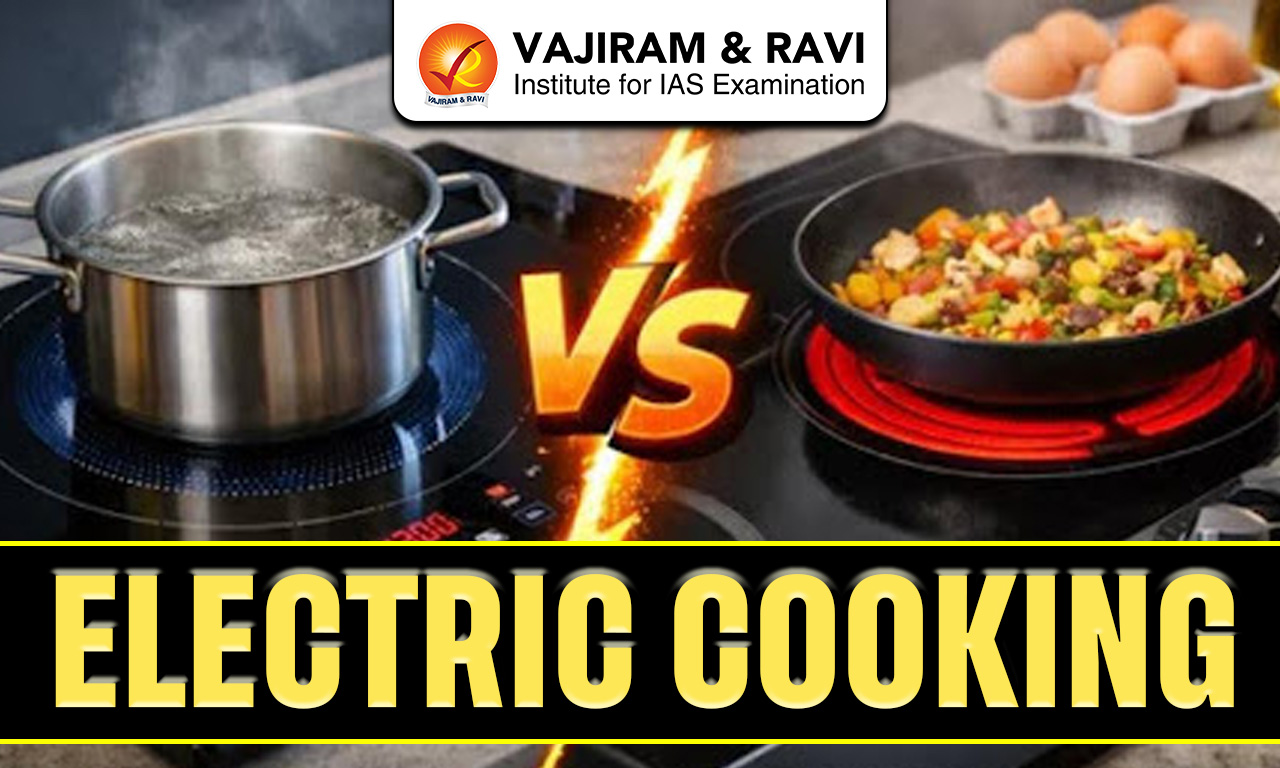
- Induction cooktops do not use an open flame.
- They generate a rapidly changing electromagnetic field, which heats the vessel directly.
- Heat is produced through electrical resistance, converting energy into thermal heat efficiently.
- Direct heating of the vessel ensures higher energy efficiency. Absence of flame makes induction cooktops safer and cleaner compared to gas stoves.
Compatibility Constraints
- Induction cooktops require ferromagnetic cookware such as cast iron or magnetic stainless steel.
- Not all traditional utensils are compatible due to differences in electrical resistance.
- Induction-compatible cookware is generally more expensive, making it less attractive for households planning only a temporary or partial transition from LPG.


Infrared Cooktops: Working Mechanism and Rising Adoption
- Infrared cooktops are gaining popularity despite higher costs due to their versatility and compatibility with all types of cookware.
How Infrared Cooktops Work
- Electricity heats a coil or halogen element beneath a ceramic glass surface.
- The element becomes red-hot, similar to a toaster coil.
- It emits infrared radiation, an invisible form of electromagnetic energy.
- Infrared radiation passes through the glass surface and is absorbed by the cookware.
- This causes molecules in the vessel to vibrate and generate heat, cooking the food.
Growing Market Demand
- Unlike induction, infrared cooktops work with steel, aluminium, glass, and ceramic vessels. This eliminates the need for specialised cookware.
- Demand has surged significantly, with sales increasing nearly fourfold on platforms like Amazon India.
- The ease of use and flexibility are key factors behind this trend.
Challenges of Infrared Cooktops
- Lower Energy Efficiency – Infrared cooktops operate at 70–80% efficiency, compared to 85–95% for induction cooktops. Heat is generated in stages—coil → glass → vessel—leading to greater energy loss.
- Higher Electricity Consumption – Due to indirect heating, infrared cooktops consume more electricity than induction cooktops for the same cooking task.
- Heat Control Limitations – Induction cooktops use advanced power electronics (like pulse-width modulation) to maintain efficiency even at low heat. Infrared cooktops rely on phase-angle control, switching the coil on and off to regulate heat.
- Power Quality Issues – Phase-angle control distorts the electrical waveform and reduces the power factor. This causes extra current flow that does not contribute to useful heating, leading to inefficiencies.
- Impact on Power Grid – Widespread use of infrared cooktops can increase losses in the distribution system. It may place additional stress on local electricity infrastructure, especially in high-demand areas.
Electric Cooking and Stress on Power Grid Infrastructure
- Peak-Time Demand Pressure – Electric cooking demand is concentrated during morning and evening hours. Even a 3–5 GW increase during these periods can significantly strain local distribution networks.
- Localised Load Challenges – The impact is often highly localised, with clusters of households or businesses shifting to electric cooking. This can overload distribution transformers, causing outages and infrastructure stress.
- Infrastructure Limitations – Existing grid infrastructure in many areas is not designed for sudden demand spikes. Managing these sharp increases poses a major operational challenge for utilities.
- Long-Term Demand Implications – A sustained shift away from LPG to electric cooking could lead to a persistent rise in electricity demand. This would require significant upgrades in infrastructure and power supply capacity.
- Seasonal and Supply Pressures – With expectations of a hotter-than-normal summer, electricity demand is already rising. The government may rely more on coal-based power and emergency measures to meet peak demand.
Source: IE

 Last updated on Oct, 2026
→ UPSC 2027 Notification will be released on 13 January 2027 at upsconline.nic.in.
→ Asian Games 2026 are being held in Aichi-Nagoya, Japan, from 19 September to 4 October.
→ Check Nobel Prize 2026 Winners List here.
→ Download PIB PRiSM Monthly Magazine 2026 here.
→ Check UPSC Monthly Current Affairs Magazine The Recitals here.
→ Check out the latest UPSC Syllabus here.
→ Download UPSC Model Answers for Mains 2026
→ UPSC Mains Question Paper 2026 is out now for Essay & GS Paper 1, 2, 3 & 4.
→ UPSC Calendar 2027 has been released.
→ Enroll in Vajiram & Ravi’s UPSC Mains Test Series 2027 for structured answer writing practice, expert evaluation, and exam-oriented feedback.
→ Join Vajiram & Ravi’s UPSC Mentorship Program 2027 for personalized guidance, strategy planning, and one-to-one support from experienced mentors.
→ Go through the UPSC Mains Previous Year Papers to enhance your preparation.
→ UPSC has released UPSC Toppers List 2025 with the Civil Services final result on its official website.
→ Also check Best UPSC Coaching in India
Electric cooking FAQs
Q1. Why is electric cooking increasing in India?+
Q2. How do induction cooktops work in electric cooking?+
Q3. How are infrared cooktops different in electric cooking?+
Q4. What challenges does electric cooking pose to the power grid?+
Q5. What is the long-term impact of electric cooking in India?+
Tags: Electric Cooking mains articles upsc current affairs upsc mains current affairs