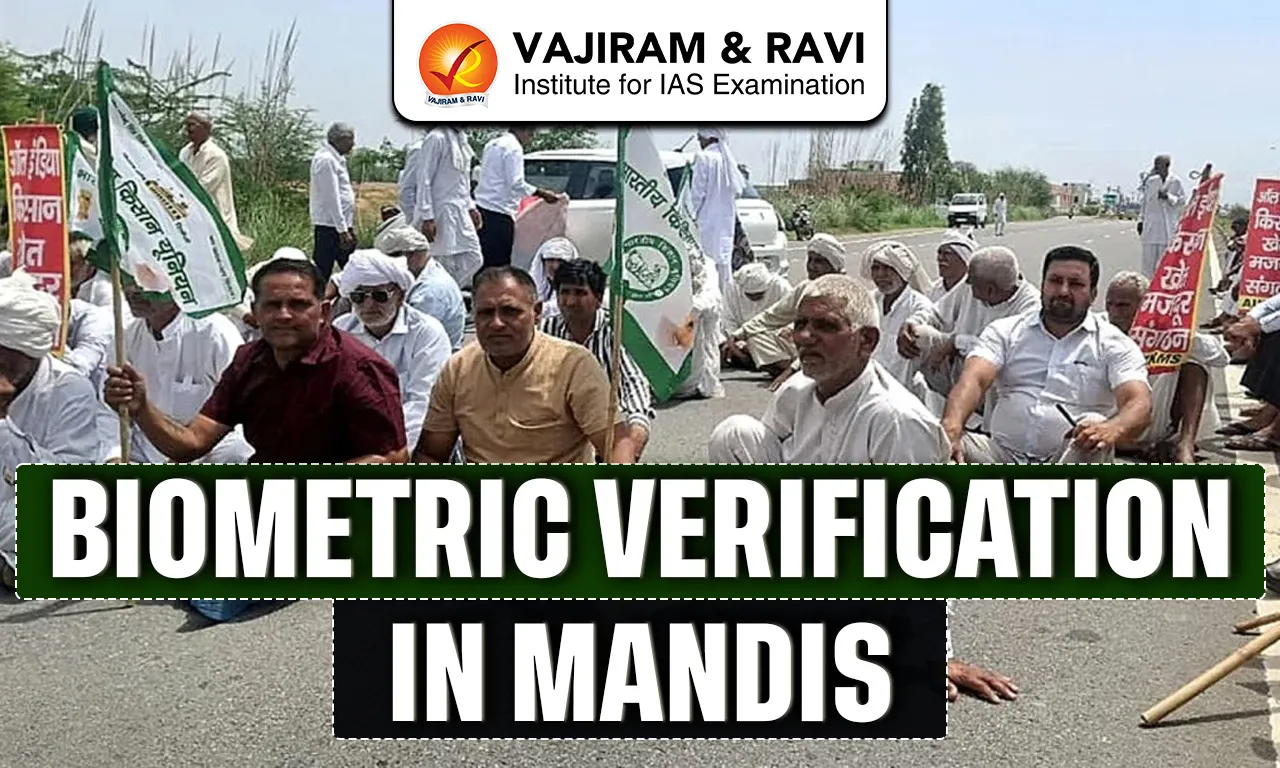
Biometric Verification in Mandis Latest News
- A section of farmers in Haryana protested against the mandatory biometric verification for selling crops in mandis, blocking highways and alleging it creates harassment and procedural hurdles.
- The state government, however, defended the move as a step to enhance transparency and accountability in the procurement system.
Mandi System in India
- The Mandi system is India’s regulated agricultural marketplace framework where farmers bring their produce for sale through a structured auction process.
- These mandis (wholesale markets) are established under the Agricultural Produce Market Committee (APMC) Acts enacted by individual state governments.
- The APMC Act designates specific geographical areas as market yards, and all agricultural trade within that area must compulsorily pass through the regulated mandi.
- Middlemen called arhatiyas (commission agents) facilitate transactions between farmers and buyers, charging a commission on every sale.
Issues and Challenges
- Structural Problems
- The mandi system has long been criticised for creating a monopoly of middlemen.
- The middlemen often advance loans to farmers, creating a cycle of debt bondage where farmers are compelled to sell exclusively through their creditor-agent regardless of price.
- Fragmented Market and Multiple Levies
- India’s mandi system is highly fragmented — a trader operating across states must obtain separate licences in each state and pay multiple layers of taxes including market fees, commission charges, and various local levies.
- This fragmentation increases transaction costs and discourages private investment in agricultural marketing infrastructure.
- Price Realisation Gap
- Farmers typically receive only 30-40% of the final consumer price of their produce, with the remainder absorbed by the chain of intermediaries.
- In the current setup, farmers are often price-takers rather than price-setters, leaving them vulnerable to exploitation especially during periods of surplus production.
- Infrastructure Deficits
- Many mandis suffer from inadequate storage, cold chain facilities, and processing infrastructure.
- Poor road connectivity to mandis, lack of weighing equipment, and absence of grading and sorting facilities result in significant post-harvest losses.
- Information Asymmetry
- Farmers — particularly small and marginal ones — lack access to real-time price information, making them heavily dependent on the arhatiya for price discovery.
Government Efforts at Reform and Integration
- Electronic National Agriculture Market (e-NAM) – Launched in April 2016, e-NAM is an online trading portal that networks existing APMC mandis across the country into a unified national market.
- Model APMC Act, 2003 – The central government circulated a Model APMC Act encouraging states to amend their legislations to allow direct purchase from farmers, establishment of private markets, and promotion of contract farming.
- However, adoption across states was uneven, with several states making only cosmetic changes.
- Gramin Haats and Primary Agriculture Cooperative Societies (PACS) – The government has been upgrading 22,000 Gramin Haats (rural periodical markets) into Farmer-Consumer Markets to enable direct farm-to-consumer trade, bypassing intermediaries.
- Simultaneously, PACS are being strengthened to provide collective bargaining power to small farmers.


Haryana’s Biometric Procurement System in Mandis
- Introduced in 2026, Haryana’s procurement system mandates Aadhaar-based fingerprint verification for farmers before selling crops in mandis, linked to the “Meri Fasal-Mera Byora” portal to ensure accurate registration and prevent discrepancies.
- The system also includes vehicle tracking, requiring tractor details and photos, and geofencing of procurement centres and storage points to enhance monitoring and prevent misuse.
- So far, hundreds of mandis and over a thousand storage locations have been brought under this digital oversight framework.
Reason Behind Biometric Verification in Haryana Mandis
- The biometric verification system was introduced following the 2025 Karnal paddy scam, where fake gate passes were used to sell paddy from other states in Haryana mandis.
- This led to fraudulent procurement records and siphoning of government funds, involving officials, traders, and millers.
- The scam resulted in multiple FIRs and arrests, prompting the government to implement biometric verification to prevent such fraud and ensure transparency in procurement.
Farmers’ Concerns Over Biometric Verification
- Farmers argue that procurement irregularities were due to collusion among officials and millers, not farmers themselves, yet the new system places the burden on them.
- They report long queues, slow verification, and procedural hassles, especially when the registered farmer cannot be physically present.
- Many see the process as excessive and humiliating, with union leaders calling it overly cumbersome and farmers feeling they are being treated with undue suspicion.
Government–Opposition Divide on Biometric Procurement
- The Haryana government defends biometric verification as a tool to enhance transparency, accountability, and efficiency, noting significant adoption in wheat procurement.
- It has also introduced relaxations, such as allowing nominated individuals and flexible vehicle documentation.
- However, opposition leaders criticise the system as bureaucratic and arbitrary, arguing it unfairly burdens farmers while ignoring the real issue of collusion among officials and traders.

 Last updated on Oct, 2026
→ UPSC 2027 Notification will be released on 13 January 2027 at upsconline.nic.in.
→ Check Nobel Prize 2026 Winners List here.
→ Download PIB PRiSM Monthly Magazine 2026 here.
→ Check UPSC Monthly Current Affairs Magazine The Recitals here.
→ Check out the latest UPSC Syllabus here.
→ Download UPSC Model Answers for Mains 2026
→ UPSC Mains Question Paper 2026 is out now for Essay & GS Paper 1, 2, 3 & 4.
→ UPSC Calendar 2027 has been released.
→ Enroll in Vajiram & Ravi’s UPSC Mains Test Series 2027 for structured answer writing practice, expert evaluation, and exam-oriented feedback.
→ Join Vajiram & Ravi’s UPSC Mentorship Program 2027 for personalized guidance, strategy planning, and one-to-one support from experienced mentors.
→ Go through the UPSC Mains Previous Year Papers to enhance your preparation.
→ UPSC has released UPSC Toppers List 2025 with the Civil Services final result on its official website.
→ Also check Best UPSC Coaching in India
Biometric Verification in Mandis FAQs
Q1. Why are farmers protesting biometric verification in mandis? +
Q2. What is biometric verification in mandis?+
Q3. Why was biometric verification in mandis introduced? +
Q4. What are the government’s arguments for biometric verification?+
Q5. What are the broader issues in the mandi system?+
Tags: Biometric verification in mandis mains articles upsc current affairs upsc mains current affairs