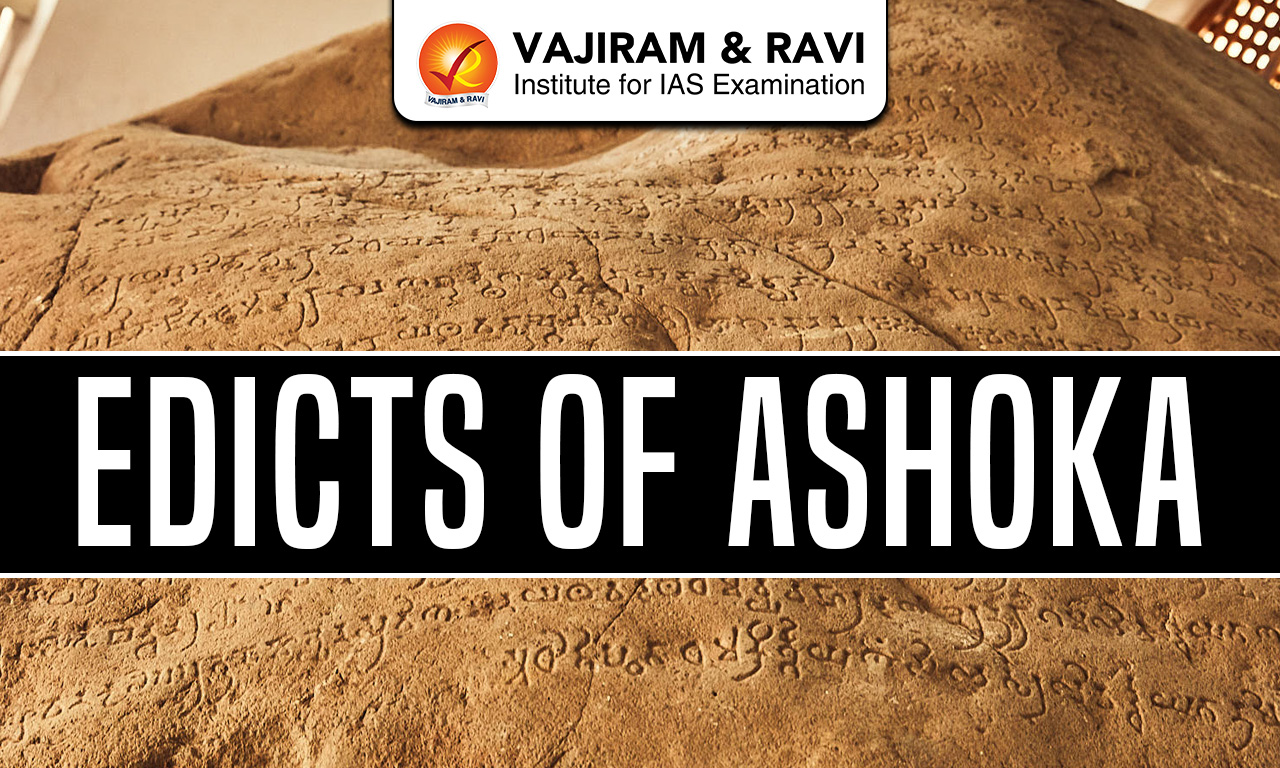
The Ashoka Edicts are among the most important sources of ancient Indian history. These inscriptions were issued by Ashoka, the great ruler of the Mauryan Empire, who ruled from 268 BCE to 232 BCE. Engraved on rocks and pillars across the Indian subcontinent, these edicts reflect his governance, moral philosophy, and commitment to Dhamma (righteous conduct).
What are Ashoka Edicts?
Ashoka Edicts are a collection of 33 inscriptions carved on rocks and pillars. These proclamations were meant to communicate the king’s policies, ethical teachings, and administrative instructions directly to the public. Most of these inscriptions were written in the Prakrit language using the Brahmi script, making them accessible to common people.
Discovery and Decipherment
The discovery and decipherment of Ashokan inscriptions was a major breakthrough in understanding ancient Indian history. These inscriptions were first successfully read in 1837 by James Prinsep. He identified the script and decoded the term “Devanampiya Piyadasi,” which referred to Emperor Ashoka. This helped historians confirm the authorship of the edicts and reconstruct the history of the Mauryan Empire.


Types of Ashoka Edicts
The edicts of Ashoka are classified based on the medium on which they were inscribed, such as rocks and pillars. These inscriptions provide valuable insights into administration, moral values, and the concept of Dhamma during the Mauryan Empire.
1. Major Rock Edicts
The Major Rock Edicts of Ashoka are a set of 14 detailed inscriptions carved on large rocks across the Mauryan Empire. These edicts mainly focus on the principles of Dhamma, welfare policies, non-violence, and moral governance.
- Engraved on large natural rock surfaces for public visibility
- Located mainly in frontier and strategic regions to spread royal messages
- Written primarily in Prakrit language using Brahmi script
- Some north-western inscriptions use Kharosthi, Greek, and Aramaic
- Reflect Ashoka’s transformation after the Kalinga War
- Focus on non-violence, religious tolerance, social welfare, and ethical conduct
- Introduce administrative officers like Dhamma Mahamatras
- Promote harmony between different religious sects
| Major Rock Edicts | ||
|
Edict No. |
Location |
Important Features |
|
Major Rock Edict I |
Girnar, Shahbazgarhi |
Complete ban on animal sacrifices in royal ceremonies; restriction on festive gatherings involving killing; reduction in slaughter in royal kitchens; promotes compassion towards all living beings |
|
Major Rock Edict II |
Girnar, Sopara |
Mentions southern kingdoms (Cholas, Pandyas, Satyaputras, Keralaputras); provision of medical facilities for humans and animals; construction of wells, roads, and planting of medicinal herbs and trees; reflects welfare state concept |
|
Major Rock Edict III |
Kalsi |
Orders respect towards Brahmanas and Shramanas; instructs officials (Yuktas, Rajukas, Pradesikas) to tour every five years; emphasizes obedience to parents, generosity, and moral discipline |
|
Major Rock Edict IV |
Dhauli, Jaugada |
Replacement of war drum (Berighosa) with Dhamma message (Dhammaghosa); decline in violent practices; highlights moral progress of society due to Dhamma |
|
Major Rock Edict V |
Girnar |
Appointment of Dhamma Mahamatras to oversee moral welfare; focus on care for prisoners, slaves, elderly, and women; encourages humane treatment and social justice |
|
Major Rock Edict VI |
Kalsi |
King’s accessibility to subjects at all times; prompt redressal of grievances; emphasis on efficient administration and continuous communication between ruler and people |
|
Major Rock Edict VII |
Dhauli |
Promotes religious tolerance and coexistence; encourages mutual respect among sects; highlights unity in diversity |
|
Major Rock Edict VIII |
Kalsi |
Mentions pilgrimage to Bodh Gaya; replaces hunting expeditions with Dharmayatras; encourages moral and spiritual upliftment |
|
Major Rock Edict IX |
Girnar |
Criticism of empty rituals and ceremonies; stresses importance of moral conduct, respect, and charity; encourages simple living |
|
Major Rock Edict X |
Kalsi |
Rejects desire for fame and glory; emphasizes that true achievement lies in spreading Dhamma and ethical behavior |
|
Major Rock Edict XI |
Dhauli |
Provides clear definition of Dhamma: respect for elders, kindness, truthfulness, generosity, and purity; promotes ethical way of life |
|
Major Rock Edict XII |
Girnar |
Strong appeal for religious tolerance; encourages dialogue and understanding among different sects; condemns religious intolerance |
|
Major Rock Edict XIII |
Dhauli, Jaugada |
Detailed account of the Kalinga War; expresses deep remorse for loss of life; promotes policy of Dhamma Vijaya (conquest through righteousness); mentions spread of Dhamma to foreign regions |
|
Major Rock Edict XIV |
Multiple locations |
Explains purpose of inscriptions; states variations in language and style for different regions; shows systematic communication strategy of the empire |
2. Minor Rock Edicts
The Minor Rock Edicts of Ashoka are earlier and shorter inscriptions that mainly reflect his personal beliefs, conversion to Buddhism, and practical aspects of Dhamma. These edicts are less elaborate than the Major Rock Edicts but are very important for understanding the early phase of his rule in the Mauryan Empire.
- Provide insight into Ashoka’s personal transformation after embracing Buddhism
- Focus more on individual moral conduct rather than detailed administration
- Written in simple language for common people
- Found mainly in remote and interior regions of the empire
- Important for identifying Ashoka as “Devanampiya Piyadasi”
- Some inscriptions directly mention the name Ashoka
| Minor Rock Edicts | ||
|
Edict Name |
Location |
Important Features |
|
Maski Edict |
Karnataka |
First inscription where the name “Ashoka” appears clearly; confirms identity as Devanampiya Piyadasi |
|
Brahmagiri Edict |
Karnataka |
Emphasizes moral conduct, obedience to elders, and following Dhamma |
|
Sasaram Edict |
Bihar |
Highlights Ashoka’s message of discipline and righteous living |
|
Rupanath Edict |
Madhya Pradesh |
Focus on self-control, moral behavior, and devotion |
|
Bhabru (Bairat) Edict |
Rajasthan |
Mentions Buddhist texts recommended for monks; shows Ashoka’s faith in Buddhism |
|
Gujarra Edict |
Madhya Pradesh |
Contains the name “Ashoka”; reinforces identity of the emperor |
|
Nittur Edict |
Karnataka |
Promotes ethical living and adherence to Dhamma |
|
Udegolam Edict |
Karnataka |
Encourages discipline and moral responsibility among people |
|
Ahraura Edict |
Uttar Pradesh |
Focuses on following righteous path and moral teachings |
3. Major Pillar Edicts
The Major Pillar Edicts of Ashoka are a set of seven inscriptions engraved on stone pillars, representing the mature phase of his rule in the Mauryan Empire. These edicts mainly focus on administration, justice, public welfare, and a detailed explanation of Dhamma.
- Total of 7 pillar edicts (I-VII)
- Inscribed on polished sandstone pillars, known for their high craftsmanship
- Belong to the later period of Ashoka’s reign
- Found mainly in Central and Northern India
- Written in Prakrit language using Brahmi script
- Provide detailed instructions about administration and duties of officials
- Emphasize justice, compassion, and ethical governance
- Highlight Ashoka’s concern for prisoners, animals, and common people
| Major Pillar Edicts | |
|
Pillar Edict |
Important Features |
|
Pillar Edict I |
Emphasizes protection and welfare of people; promotes moral behavior; highlights king’s responsibility towards subjects |
|
Pillar Edict II |
Defines Dhamma as compassion, charity, purity, truthfulness, and minimum sins; encourages ethical living |
|
Pillar Edict III |
Condemns sins such as anger, cruelty, pride, and jealousy; encourages self-control and moral discipline |
|
Pillar Edict IV |
Mentions duties and responsibilities of Rajukas (officials); ensures fair justice and administration |
|
Pillar Edict V |
Lists animals and birds that should not be killed; regulates slaughter; mentions release of 25 prisoners; reflects humanitarian approach |
|
Pillar Edict VI |
Explains policy of Dhamma; emphasizes quick decision-making and administrative efficiency; promotes welfare measures |
|
Pillar Edict VII |
Longest edict; summarizes Ashoka’s Dhamma policy; promotes religious tolerance, charity, kindness, and moral progress |
4. Minor Pillar Edicts
The Minor Pillar Edicts of Ashoka are a set of shorter inscriptions engraved on pillars that belong to the early phase of his reign in the Mauryan Empire. These edicts mainly focus on religious discipline, Buddhist Sangha regulations, and royal instructions, reflecting Ashoka’s growing inclination towards Buddhism.
| Minor Pillar Edicts | ||
|
Edict Name |
Location |
Important Features |
|
Schism Edict |
Sarnath, Sanchi |
Warns monks and nuns against creating divisions in the Sangha; strict punishment for those causing schism; ensures unity and discipline |
|
Queen’s Edict |
Allahabad |
Mentions charitable donations made by Ashoka’s queens; orders that these donations be properly recorded and credited |
|
Rummindei Pillar Edict |
Lumbini |
Records Ashoka’s visit to the birthplace of Buddha; grants tax reduction and special privileges to the village |
|
Nigali Sagar Pillar Edict |
Nigali Sagar |
Mentions Ashoka’s reverence for Kanakamuni Buddha; records enlargement of a stupa and religious devotion |
|
Kosambi (Allahabad) Edict |
Kaushambi |
Related to Sangha discipline; reinforces obedience to royal authority and Buddhist teachings |
Important Rock Edicts Features
The pillars of Ashoka are among the finest examples of ancient Indian art, architecture, and political communication during the Mauryan Empire. These monolithic sandstone pillars were not only symbols of authority but also carried inscriptions that conveyed Dhamma, administrative policies, and later historical records, making them invaluable historical sources.
1. Allahabad–Kaushambi Pillar (Prayagraj Pillar)
- Originally located at Kaushambi on the banks of the Yamuna River
- Later shifted to Prayagraj during the medieval period
- It is an Ashokan pillar (Ashoka Stambha) with inscriptions in Brahmi script and Prakrit language
- Contains six Major Pillar Edicts similar to other Ashokan pillars
- Also includes the famous Prayag Prashasti of Samudragupta
- This inscription was composed by Harishena in Sanskrit using Gupta script
- It praises Samudragupta’s military conquests and political achievements
- Later, Jahangir also added inscriptions on the same pillar
- Thus, this pillar represents a continuous historical record from Mauryan to Mughal period
2. Delhi-Meerut and Delhi-Topra Pillars
Delhi-Meerut Pillar
- Located on the Delhi Ridge in Delhi
- Originally from Meerut/Topra region, later transported by Firoz Shah Tughlaq
- Contains seven edicts of Ashoka in Brahmi script
- Includes several minor inscriptions and engravings added later
- Reflects Ashoka’s emphasis on morality, governance, and public welfare
Delhi-Topra Pillar
- Located in Feroz Shah Kotla
- Originally erected at Topra (Haryana) and moved to Delhi by Firoz Shah Tughlaq
- Inscribed in Brahmi script with Ashokan edicts
- Conveys core principles of Dhamma: virtue, social harmony, and piety
- Unique feature: includes references related to taxation policies, showing administrative depth
3. Lauria Nandangarh Pillar
- Located in West Champaran
- Contains six Ashokan pillar edicts in Prakrit language and Brahmi script
- Features a single lion capital, symbolizing royal authority
- Pillar surface includes engraved peacock figures, indicating artistic excellence
- Nearby archaeological remains include large burial mounds (stupas/tombs)
- These mounds are believed to belong to the pre-Mauryan period, possibly linked to ancient republics like Vrijjis and Mallas
- Indicates continuity of religious and cultural traditions
4. Lauria Areraj Pillar
- Located in East Champaran
- Erected around 249 BCE by Ashoka
- Made from a single block of polished sandstone
- Contains six pillar edicts
- Currently without its capital (top structure)
- Reflects Ashoka’s efforts to spread Dhamma in eastern regions
5. Rampurva Pillars
- Located in West Champaran
- Two Ashokan pillars discovered at the site
- One pillar has a bull capital, while the other has a lion capital
- The lion pillar contains inscriptions, while the bull pillar is without inscriptions
- The animal capitals symbolize strength, authority, and guardianship
- Represent high level of Mauryan art and craftsmanship
6. Kandahar Edicts
- Located in Kandahar
- Known as Kandahar Greek Edicts, part of Ashoka’s inscriptions
- Written in Greek and Prakrit (Aramaic influence)
- One of the rare bilingual inscriptions of Ashoka
- Shows Ashoka’s effort to communicate with Greek-speaking populations
- The region was historically linked to Alexander the Great
- Kandahar was a strategic trade and military center, connecting India with Central Asia and the Middle East
- Demonstrates the international scope of Mauryan Empire and Dhamma policy
7. Nigali Sagar Pillar Inscription
- Located in Nigali Sagar near Lumbini
- A Minor Pillar Edict of Ashoka
- Originally erected near the stupa of Kanakamuni (Konakamana) Buddha
- Records Ashoka’s enlargement of the stupa and later his visit to the site
- Chinese traveler Xuanzang mentioned seeing this pillar with a lion capital
- The capital and original stupa are now missing
- Provides strong evidence of Ashoka’s patronage of Buddhist pilgrimage sites
Edicts of Ashoka Significance
The edicts of Ashoka are one of the most valuable sources for understanding the political, social, and religious life of the Mauryan Empire. These inscriptions not only reflect Ashoka’s policies but also reveal his vision of a moral, welfare-oriented, and inclusive state.
- Provide authentic and reliable historical evidence about the Mauryan period and Ashoka’s rule
- Help historians reconstruct the political history and territorial extent of the empire
- Show the transformation of Ashoka from a conqueror to a promoter of peace and non-violence
- Reflect the concept of Dhamma as a universal moral code based on compassion, truth, and discipline
- Demonstrate the idea of welfare state, including medical care, roads, wells, and plantations
- Reveal the structure of administration through references to officials like Rajukas and Dhamma Mahamatras
- Show that the king maintained direct communication with people through inscriptions
- Emphasize religious tolerance, encouraging respect for all sects and beliefs
- Provide early and strong evidence of the spread and influence of Buddhism
- Encourage social values such as respect for elders, obedience to parents, and kindness to servants
- Oppose meaningless rituals and promote ethical and moral living instead
- Highlight concern for animal welfare and environmental protection
- Indicate development of infrastructure such as roads, rest houses, and water facilities
- Show the use of local languages like Prakrit, making messages accessible to common people
- Help in understanding ancient scripts like Brahmi and Kharosthi
- Reflect cultural unity across diverse regions of the empire

 Last updated on Sep, 2026
→ UPSC 2027 Notification will be released on 13 January 2027 at upsconline.nic.in.
→ Asian Games 2026 are being held in Aichi-Nagoya, Japan, from 19 September to 4 October.
→ Check out the latest UPSC Syllabus here.
→ Download UPSC Model Answers for Mains 2026
→ UPSC Mains Question Paper 2026 is out now for Essay & GS Paper 1, 2, 3 & 4.
→ UPSC Calendar 2027 has been released.
→ Enroll in Vajiram & Ravi’s UPSC Mains Test Series 2027 for structured answer writing practice, expert evaluation, and exam-oriented feedback.
→ Join Vajiram & Ravi’s UPSC Mentorship Program 2027 for personalized guidance, strategy planning, and one-to-one support from experienced mentors.
→ Go through the UPSC Mains Previous Year Papers to enhance your preparation.
→ UPSC has released UPSC Toppers List 2025 with the Civil Services final result on its official website.
→ Also check Best UPSC Coaching in India
Edicts of Ashoka FAQs
Q1. What are the Edicts of Ashoka?+
Q2. How many edicts of Ashoka are there?+
Q3. What is the main purpose of Ashoka’s edicts?+
Q4. In which language were Ashoka’s edicts written?+
Q5. Who deciphered the Ashokan inscriptions?+
Tags: ancient indian history edicts of ashoka indian history