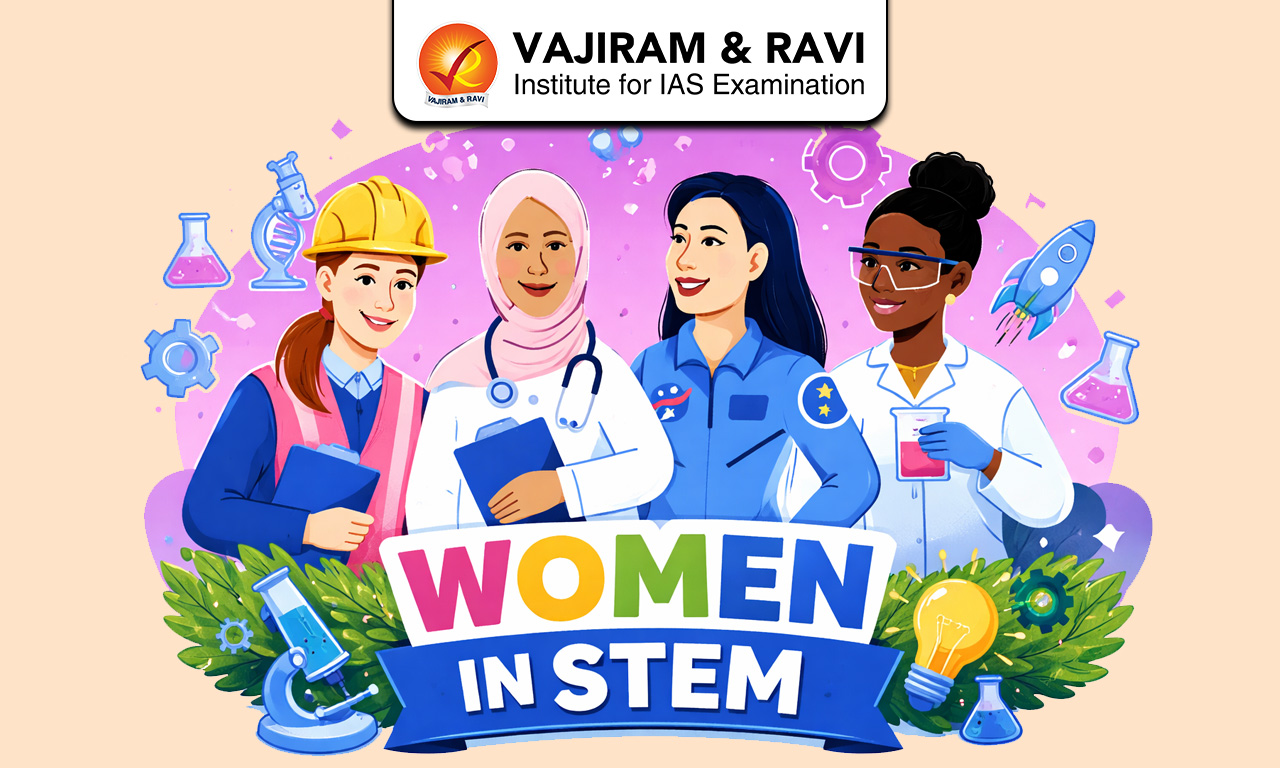
Women in STEM (Science, Technology, Engineering, and Mathematics) are central to driving innovation, research, and sustainable development in the modern world. While women have made remarkable contributions to scientific progress, their participation, especially in leadership and research roles, remains limited. In recent years, however, India has witnessed encouraging trends supported by data-driven policies and targeted government initiatives.
What is STEM?
STEM stands for Science, Technology, Engineering, and Mathematics, which are critical disciplines driving modern economies. These fields contribute to advancements in healthcare, infrastructure, digital technology, artificial intelligence, and environmental sustainability. Women’s participation in STEM ensures diversity of thought, better problem-solving, and inclusive innovation.
Historical Contributions of Women in STEM
Women have contributed significantly to science and technology throughout history, often overcoming systemic barriers.
- Vedic Period (Philosophy & Early Scientific Thought): Gargi Vachaknavi contributed to early inquiry into cosmology and nature through logical debates in ancient texts; Maitreyi explored knowledge systems related to existence and natural philosophy.
- 19th Century (Modern Medicine Begins): Anandibai Joshi became one of the first Indian women trained in Western medicine, while Kadambini Ganguly became one of the first practicing female doctors, advancing healthcare access.
- Early–Mid 20th Century (Scientific Research Growth): Janaki Ammal contributed to plant genetics and crop improvement; Asima Chatterjee developed drugs for malaria and epilepsy, strengthening pharmaceutical research.
- Late 20th Century (Space & Global Recognition): Kalpana Chawla became the first Indian-born woman in space, contributing to aerospace research and inspiring STEM participation.
- 21st Century (Space Technology Leadership): Ritu Karidhal played a key role in the Mars Orbiter Mission; Muthayya Vanitha led the Chandrayaan-2 mission, marking women’s leadership in space missions.
- Contemporary India (Defence, Health & Global Science): Tessy Thomas leads advanced missile projects; Gagandeep Kang contributes to vaccine research; Soumya Swaminathan plays a global leadership role in public health and scientific policy.


Current Status of Women in STEM
- High Participation in STEM Education: As per the All-India Survey on Higher Education (AISHE) 2021–22, women constitute 43% of total enrolment in STEM disciplines at the higher education level, indicating strong entry-level participation.
- Global Comparison Advantage: India has one of the highest shares of women STEM graduates globally (around 42–43%), higher than countries like the US, UK, and Germany, reflecting a strong academic base.
- Sharp Drop in Workforce Participation: Despite high enrolment, women account for only 18.6% of the STEM workforce in research and development (R&D), showing a significant gap between education and employment.
- Sector-wise Representation in R&D: Among women working in STEM R&D:
- 45.87% are employed in government institutions
- 27.62% in higher education
Government Initiatives to Promote Women in STEM
The Government of India has taken several initiatives to promote women in STEM. A few of the initiatives have been highlighted below.
- Women in Science and Engineering–KIRAN (WISE-KIRAN): Implemented by the Department of Science and Technology, this flagship scheme promotes participation and retention of women in STEM careers. It provides research grants, fellowships, and re-entry opportunities for women scientists, especially those who have taken career breaks, enabling them to resume work in basic and applied sciences.
- Women Scientist Scheme (WOS-A, WOS-B, WOS-C): A key initiative under DST that supports women researchers at different levels.
- WOS-A supports research in basic and applied sciences.
- WOS-B focuses on science and technology interventions for societal benefit.
- WOS-C (WISE-IPR) provides training in Intellectual Property Rights, helping women develop expertise in patent laws and innovation management.
- Vigyan Jyoti Programme: Launched to encourage girls from school level (especially Class 9–12) to pursue STEM education. It provides mentoring, exposure visits, science camps, and interaction with women scientists to build confidence and interest in scientific careers.
- INSPIRE Scheme (Innovation in Science Pursuit for Inspired Research): Conducted by the Department of Science and Technology, this program offers scholarships, fellowships, and internships to meritorious students, including girls, to pursue higher education and research in science.
- WISE–PhD and WISE–Post Doctoral Fellowship (PDF): These schemes provide financial and institutional support for women pursuing doctoral and post-doctoral research, ensuring career continuity and advancement in academic and research fields.
- WIDUSHI Programme (Women’s Instinct for Developing and Ushering in Scientific Heights & Innovation): Focuses on promoting innovation and leadership among women scientists by supporting advanced research, innovation projects, and capacity-building initiatives.
- Biotechnology Career Advancement and Re-orientation (BioCARe): Implemented by the Department of Biotechnology, this scheme supports women scientists in biotechnology by providing research grants and facilitating re-entry into active research after career breaks.
- CSIR-ASPIRE (A Special Call for Research Grants for Women Scientists): Launched in 2023 by the Council of Scientific and Industrial Research, this initiative promotes women-led research projects and supports career advancement in scientific fields through dedicated funding.
- AICTE Pragati Scholarship Scheme: Managed by the All India Council for Technical Education, this scheme provides financial assistance to girls pursuing technical education (engineering, technology, and diploma courses), helping reduce financial barriers.
Role of Education in Promoting Women in STEM
Education plays a foundational role in encouraging women to enter and succeed in STEM fields by building skills, confidence, and equal opportunities from an early stage. A strong and inclusive education system helps bridge gender gaps and ensures long-term participation of women in science and technology.
- Early Exposure to STEM Subjects: Introducing girls to science and mathematics at the school level helps develop interest, curiosity, and confidence in STEM careers.
- Breaking Gender Stereotypes: Gender-inclusive curricula and teaching practices challenge traditional beliefs that STEM is only for men.
- Access to Quality Education: Ensuring equal access to schools, laboratories, digital tools, and learning resources enables girls to compete equally.
- Scholarships and Financial Support: Financial assistance reduces economic barriers and encourages girls to pursue higher education in STEM fields.
- Role Models in Curriculum: Highlighting achievements of women scientists inspires students and provides relatable success stories.
- STEM-Based Activities and Practical Learning: Science fairs, innovation labs, coding programs, and hands-on experiments increase engagement and practical understanding.
- Mentorship and Career Guidance: Providing guidance through teachers, mentors, and industry interactions helps girls make informed career choices.
- Encouraging Higher Education and Research: Promoting participation in undergraduate, postgraduate, and doctoral programs ensures continuity in STEM careers.
- Digital Literacy and Skill Development: Training in digital tools, coding, and emerging technologies prepares women for modern STEM careers.
Challenges Faced by Women in STEM
Women in STEM face multiple structural, social, and institutional barriers that limit their entry, retention, and advancement in scientific and technical careers.
- Gender Stereotypes and Social Norms: Persistent beliefs that STEM fields are male-dominated discourage girls from pursuing science and technology from an early stage.
- Leaky Pipeline Phenomenon: Although women enter STEM education in large numbers, many drop out at different career stages due to personal, social, and workplace-related challenges.
- Career Breaks and Work-Life Balance: Responsibilities related to marriage, childcare, and family often lead to career interruptions, affecting long-term growth and opportunities.
- Workplace Bias and Discrimination: Women frequently face unequal pay, limited promotions, lack of recognition, and gender bias in hiring and evaluation processes.
- Lack of Mentorship and Networking: Limited access to mentors, professional networks, and role models restricts career guidance and advancement opportunities.
- Underrepresentation in Leadership Roles: Women are less likely to occupy senior positions, decision-making roles, and leadership posts in STEM organizations.
- Limited Opportunities in Core STEM Fields: Women are underrepresented in engineering, technology, and research-intensive domains compared to life sciences and education sectors.
- Safety and Mobility Concerns: In some regions, safety issues and lack of mobility restrict women’s access to education institutions and workplaces.
- Institutional Barriers: Lack of supportive policies such as flexible working hours, maternity benefits, and childcare facilities contributes to higher attrition rates.
- Digital and Resource Divide: Unequal access to technology, digital tools, and quality education resources limits participation, especially in rural areas.

 Last updated on Oct, 2026
→ UPSC 2027 Notification will be released on 13 January 2027 at upsconline.nic.in.
→ Check Nobel Prize 2026 Winners List here.
→ Download PIB PRiSM Monthly Magazine 2026 here.
→ Check UPSC Monthly Current Affairs Magazine The Recitals here.
→ Check out the latest UPSC Syllabus here.
→ Download UPSC Model Answers for Mains 2026
→ UPSC Mains Question Paper 2026 is out now for Essay & GS Paper 1, 2, 3 & 4.
→ UPSC Calendar 2027 has been released.
→ Enroll in Vajiram & Ravi’s UPSC Mains Test Series 2027 for structured answer writing practice, expert evaluation, and exam-oriented feedback.
→ Join Vajiram & Ravi’s UPSC Mentorship Program 2027 for personalized guidance, strategy planning, and one-to-one support from experienced mentors.
→ Go through the UPSC Mains Previous Year Papers to enhance your preparation.
→ UPSC has released UPSC Toppers List 2025 with the Civil Services final result on its official website.
→ Also check Best UPSC Coaching in India
Women in STEM FAQs
Q1. What does STEM stand for?+
Q2. What is the current status of women in STEM in India?+
Q3. Why are women underrepresented in STEM careers?+
Q4. What is the “leaky pipeline” in STEM?+
Q5. How can women participation in STEM be increased?+
Tags: engineering technology women in stem