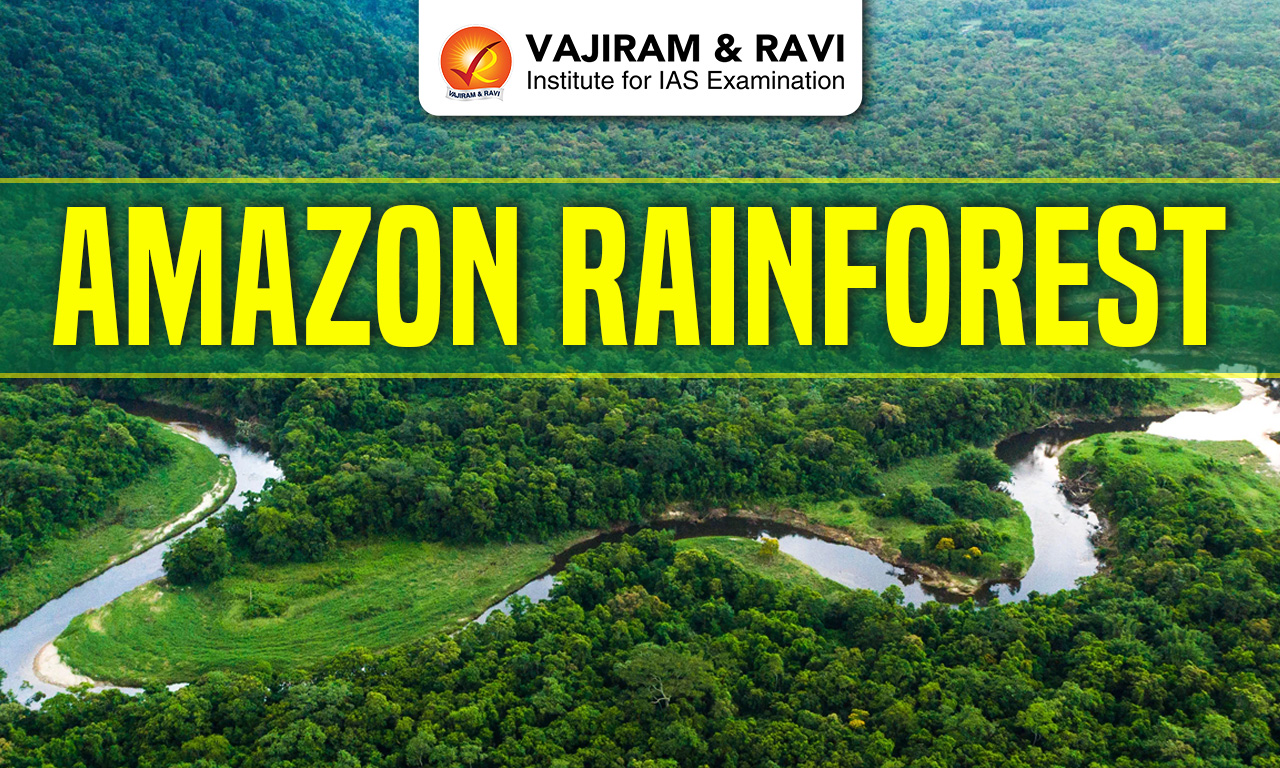
The Amazon Rainforest is the largest tropical rainforest in the world, often called the “Lungs of the Earth” due to its crucial role in oxygen production and carbon absorption. It spreads across nine countries, mainly Brazil, Peru, and Colombia. Covering about 5.5 million square kilometers, the Amazon Basin is drained by the mighty Amazon River, which is the largest river in the world by volume of water.
Amazon Rainforest Characteristics
The Amazon Rainforest is a classic example of a tropical rainforest ecosystem, known for its dense vegetation, high rainfall, and rich biodiversity. Its unique climatic and ecological features make it one of the most complex natural systems on Earth.
- Equatorial Climate: Located near the equator, it experiences high temperatures (around 25-30°C) and heavy rainfall throughout the year.
- Heavy Rainfall: Receives more than 2000 mm of rainfall annually, with no distinct dry season.
- Dense Forest Cover: Thick evergreen forests with multiple layers like emergent, canopy, understory, and forest floor.
- High Humidity: Humidity levels often exceed 80%, creating a moist and warm environment.
- Rich Biodiversity: Home to millions of plant and animal species, making it a global biodiversity hotspot.
- Poor Soil Quality: Soils are heavily leached and low in nutrients despite dense vegetation.
- Rapid Nutrient Cycling: Nutrients are quickly recycled within the ecosystem due to decomposition of organic matter.
- Extensive River System: Dominated by the Amazon River and its tributaries.
- Evergreen Vegetation: Trees do not shed leaves seasonally, maintaining greenery throughout the year.
- Adaptations of Plants: Features like drip-tip leaves and buttress roots help plants survive heavy rainfall and poor soil.
Carbon Fertilisation Effect
The Carbon Fertilisation Effect refers to the process where increased levels of carbon dioxide (CO₂) in the atmosphere enhance plant growth.
- Higher CO₂ levels increase photosynthesis, leading to faster plant growth.
- The Amazon acts as a carbon sink, absorbing large amounts of CO₂.
- This helps in reducing the impact of global warming.
- However, recent studies show that due to deforestation and climate stress, the Amazon’s ability to absorb carbon is declining.


Amazon Rainforest Key Facts
- Location & Size: The Amazon Rainforest is the largest tropical rainforest, covering about 5.5-6 million sq. km, nearly twice the size of India.
- Geographical Spread: About 60% lies in Brazil, while the rest extends across Peru, Colombia, Venezuela, Ecuador, Bolivia, Guyana, Suriname, and French Guiana.
- Amazon River Basin: The rainforest lies in the basin of the Amazon River, the largest river system in the world.
- Natural Boundaries:
- North: Guiana Highlands
- West: Andes Mountains
- South: Brazilian Plateau
- East: Atlantic Ocean
- Climate Characteristics:
- Equatorial climate with high rainfall (2000 mm+)
- High humidity (above 80%)
- Warm temperatures (25-30°C) throughout the year
- Biodiversity Hotspot: Hosts around 10% of the world’s known species, making it one of the richest ecosystems globally.
- Protected Areas: Important conservation regions include Yasuni National Park (Ecuador), Manu National Park (Peru), and Jaú National Park (Brazil).
- Global Importance: Acts as a major carbon sink, helps regulate global climate, and supports biodiversity (often called the “Lungs of the Earth”).
- Amazon River System: Originates in the Andes (Peru) and flows into the Atlantic Ocean; major tributaries include Rio Negro, Madeira, and Xingu.
- Overall Significance: A critical ecosystem for climate stability, biodiversity conservation, and environmental balance worldwide.
Amazon Rainforest Flora and Fauna
The Amazon Rainforest is one of the most biologically diverse regions on Earth, hosting an incredible variety of plant and animal species. Its dense vegetation and warm, humid climate create ideal conditions for the growth and survival of countless life forms.
Flora (Plant Life)
- Huge Plant Diversity: More than 40,000 plant species are found in the Amazon.
- Layered Vegetation: Forest structure includes emergent layer, canopy, understory, and forest floor.
- Evergreen Trees: Trees remain green throughout the year due to continuous rainfall.
- Important Trees: rubber tree, mahogany, rosewood, Brazil nut, palm, acacia, and cedar are widely found.
- Epiphytes and Climbers: Plants like orchids, mosses, and lianas grow on other plants for support.
- Drip-tip Leaves: Leaves have pointed tips to quickly shed excess rainwater.
- Medicinal Plants: Many plants are used in modern and traditional medicine.
Fauna (Animal Life)
- Extremely Rich Animal Diversity: Home to millions of species, many still undiscovered.
- Mammals: Includes species like the Jaguar, Sloth, and monkeys.
- Reptiles: Presence of large reptiles like the Anaconda and caimans.
- Amphibians: Brightly colored species like the Poison Dart Frog are common.
- Birds: Rich birdlife including parrots, toucans, and macaws.
- Insects: Around 2.5 million insect species, making it the most insect-rich region.
- Aquatic Life: Rivers support fish like piranhas and river dolphins.
Amazon Rainforest Significance
The Amazon Rainforest is vital for maintaining both regional and global ecological balance. Its role extends beyond geography, influencing climate, biodiversity, and human survival.
Global Climate Regulation: Helps stabilize Earth’s climate by controlling temperature and atmospheric circulation.
- Carbon Sink: Absorbs vast amounts of carbon dioxide, reducing the impact of global warming.
- Oxygen Production: Contributes to oxygen generation through photosynthesis, earning the name “Lungs of the Earth.”
- Biodiversity Conservation: Supports millions of plant and animal species, many of which are endemic and undiscovered.
- Water Cycle Maintenance: Releases moisture into the atmosphere through transpiration, influencing rainfall patterns even beyond South America.
- Indigenous Communities: Provides habitat and livelihood for numerous tribal groups with rich cultural traditions.
- Medicinal Value: Source of many important medicines and potential future drugs.
- Economic Importance: Provides resources like timber, rubber, and food products.
- Soil Protection: Dense vegetation prevents soil erosion and maintains land fertility.
- Global Environmental Balance: Acts as a buffer against climate change and ecological degradation.
Threats to the Amazon Rainforest
The Amazon Rainforest is facing serious environmental threats due to human activities and climate change. These threats are not only endangering biodiversity but also affecting global climate balance.
- Deforestation: Large-scale clearing of forests for cattle ranching, agriculture (especially soybean cultivation), and logging is the biggest threat.
- Forest Fires: Frequent and often human-induced fires destroy vast forest areas and release massive carbon emissions.
- Climate Change: Rising global temperatures and changing rainfall patterns are weakening the rainforest ecosystem.
- Illegal Mining: Gold mining and other activities cause deforestation, water pollution, and habitat destruction.
- Infrastructure Development: Construction of roads, dams, and settlements leads to fragmentation of forests.
- Loss of Biodiversity: Many plant and animal species are becoming endangered due to habitat loss.
- Overexploitation of Resources: Unsustainable extraction of timber, rubber, and other forest products.
- Soil Degradation: Removal of forest cover leads to soil erosion and loss of fertility.
- Displacement of Indigenous Tribes: Tribal communities lose their habitat and traditional way of life.
- Tipping Point Risk: Continuous damage may push the Amazon towards a savanna-like ecosystem, reducing its ability to act as a carbon sink.

 Last updated on Sep, 2026
→ UPSC 2027 Notification will be released on 13 January 2027 at upsconline.nic.in.
→ Asian Games 2026 are being held in Aichi-Nagoya, Japan, from 19 September to 4 October.
→ Check out the latest UPSC Syllabus here.
→ Download UPSC Model Answers for Mains 2026
→ UPSC Mains Question Paper 2026 is out now for Essay & GS Paper 1, 2, 3 & 4.
→ UPSC Calendar 2027 has been released.
→ Enroll in Vajiram & Ravi’s UPSC Mains Test Series 2027 for structured answer writing practice, expert evaluation, and exam-oriented feedback.
→ Join Vajiram & Ravi’s UPSC Mentorship Program 2027 for personalized guidance, strategy planning, and one-to-one support from experienced mentors.
→ Go through the UPSC Mains Previous Year Papers to enhance your preparation.
→ UPSC has released UPSC Toppers List 2025 with the Civil Services final result on its official website.
→ Also check Best UPSC Coaching in India
Amazon Rainforest FAQs
Q1. Where is the Amazon Rainforest located?+
Q2. Why is the Amazon Rainforest called the “Lungs of the Earth”?+
Q3. Which is the main river of the Amazon Rainforest?+
Q4. How important is the Amazon Rainforest for climate?+
Q5. What are the main threats to the Amazon Rainforest?+
Tags: amazon rainforest biology