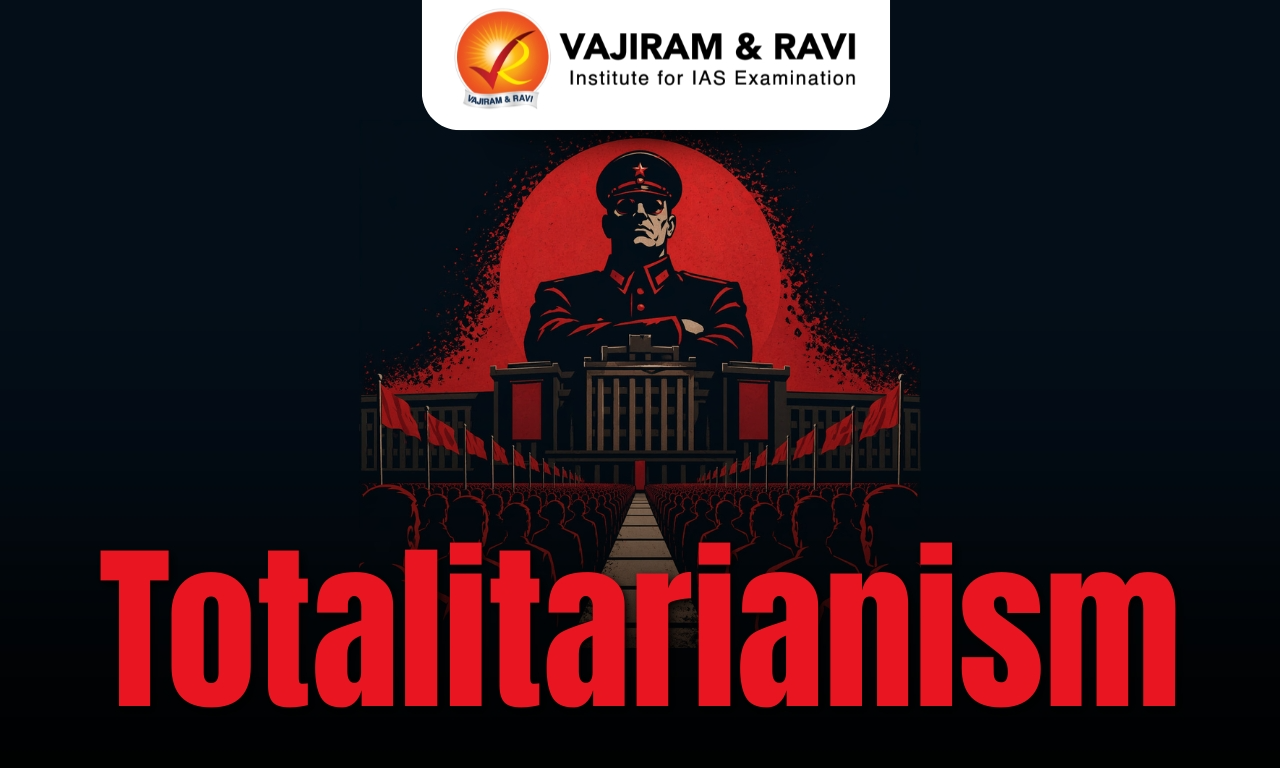
Totalitarianism is a system of government where the state has complete control over society and people’s lives. Individual freedom is very limited, and the government often controls ideas, media, and daily activities. In such systems, power is usually held by a single leader or party. People are expected to follow the rules strictly, with little or no opposition allowed.
About Totalitarianism
- Totalitarianism is a type of government where the state has complete control over people’s lives and individual freedom is almost completely absent. The government tries to control not just politics, but also people’s thoughts, actions, and daily activities.
- The term was first used by Benito Mussolini in the early 1920s to describe his fascist rule in Italy. He believed that everything should be under the control of the state, with no opposition allowed.
- By the time of World War II, totalitarianism became associated with strict, one-party rule that suppresses freedom. Examples include the Soviet Union under Joseph Stalin, Nazi Germany under Adolf Hitler, China under Mao Zedong, and North Korea ruled by the Kim dynasty.
Totalitarianism Features
- Totalitarianism is a system where a strong central authority controls all aspects of people’s lives – political, social, and even personal, often using force and strict rules.
- Early examples include the Mauryan Dynasty, Qin Dynasty, and the rule of Shaka Zulu, while modern forms like Nazi Germany under Adolf Hitler and the Soviet Union under Joseph Stalin gained mass support through charismatic leadership and modern communication.
- It differs from dictatorship by completely replacing old political, legal, and social systems with new ones controlled by the state, removing traditional institutions and practices.
- The state focuses on a single major goal (like industrialization or expansion) and directs all resources toward it, supporting anything that helps achieve it and suppressing anything that does not.
- A strong ideology is used to justify all actions of the state, leaving no room for opposition; any dissent is treated as a threat or enemy.
- Traditional social and religious institutions are weakened, and people are encouraged or forced to join state-controlled organizations, reducing individual identity and promoting uniform thinking.
- Large-scale violence is often justified, with specific groups blamed for problems such as Jews in Nazi Germany and kulaks in the Soviet Union to gain public support.
- The police and security forces have extreme and often unpredictable powers, creating fear; even if laws exist, real authority lies with the leader, such as Adolf Hitler and Joseph Stalin, who can change or ignore them at will.


Totalitarianism Vs Authoritarianism
Totalitarianism and Authoritarianism are systems of government where power is concentrated in the hands of one leader or a small group, with limited freedom for people. While both restrict opposition, totalitarianism goes further by controlling almost every aspect of life. Their key differences and features are discussed below.
| Totalitarianism Vs Authoritarianism | ||
|
Aspect |
Authoritarianism |
Totalitarianism |
|
Meaning |
A system where power is concentrated in one central authority, such as a single ruler or a small group. |
A modern and more extreme form of autocracy where the state controls almost every aspect of life. |
|
Power Structure |
Power is absolute and held by one centre, with little or no accountability. |
Power is also absolute but extends deeply into society, influencing both public and private life. |
|
Control Method |
Relies mainly on force and authority to suppress opposition. |
Uses force along with propaganda, ideology, and mass mobilization to control people. |
|
Role of Institutions |
Institutions like courts or assemblies may exist but have limited or no real power. |
Democratic-like institutions (parliament, elections, parties) are created, but they are mostly symbolic and act as a facade. |
|
Constitution & Laws |
Laws may exist but do not effectively limit the ruler’s authority. |
Constitutions often use democratic language, but in practice they do not check the power of the ruling authority. |
|
Ideology |
May not depend on a strong or fixed ideology. |
A strong official ideology is imposed, explaining and justifying all actions of the state. |
|
Freedom of Opinion |
Limited freedom; opposition is controlled or suppressed. |
Almost no freedom of thought or expression; disagreement is treated as a threat to the state. |
|
Use of Police |
Police are used to maintain order and suppress resistance. |
Secret police and state agencies actively monitor, control, and punish people to enforce obedience and ideology. |
|
Political System |
May allow multiple parties or none at all, depending on the ruler. |
Usually a single-party system, fully controlled and made up of loyal supporters. |
|
Social Control |
Focuses mainly on political control and maintaining authority. |
Extends control to social life, culture, beliefs, and even personal thinking, creating uniformity. |
|
Example |
Venezuela under Hugo Chávez, and Cuba under Fidel Castro |
Soviet Union under Joseph Stalin, Nazi rule in Germany under Adolf Hitler. |

 Last updated on Oct, 2026
→ UPSC 2027 Notification will be released on 13 January 2027 at upsconline.nic.in.
→ Check Nobel Prize 2026 Winners List here.
→ Download PIB PRiSM Monthly Magazine 2026 here.
→ Check UPSC Monthly Current Affairs Magazine The Recitals here.
→ Check out the latest UPSC Syllabus here.
→ Download UPSC Model Answers for Mains 2026
→ UPSC Mains Question Paper 2026 is out now for Essay & GS Paper 1, 2, 3 & 4.
→ UPSC Calendar 2027 has been released.
→ Enroll in Vajiram & Ravi’s UPSC Mains Test Series 2027 for structured answer writing practice, expert evaluation, and exam-oriented feedback.
→ Join Vajiram & Ravi’s UPSC Mentorship Program 2027 for personalized guidance, strategy planning, and one-to-one support from experienced mentors.
→ Go through the UPSC Mains Previous Year Papers to enhance your preparation.
→ UPSC has released UPSC Toppers List 2025 with the Civil Services final result on its official website.
→ Also check Best UPSC Coaching in India
Totalitarianism FAQs
Q1. What is Totalitarianism?+
Q2. Who introduced the term Totalitarianism?+
Q3. What are the key features of Totalitarianism?+
Q4. How is Totalitarianism different from Authoritarianism?+
Q5. How does a Totalitarian state maintain control?+
Tags: totalitarianism world history