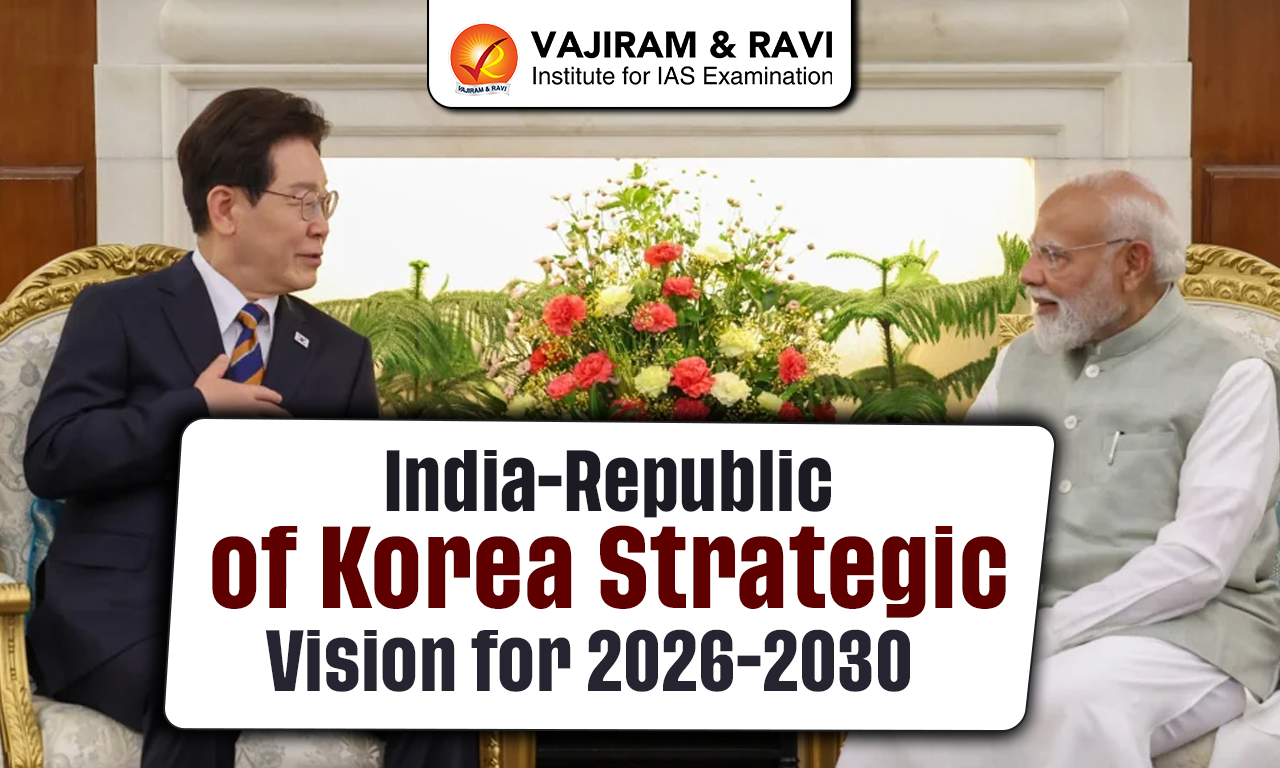
The India-Republic of Korea (ROK) Strategic Vision 2026-2030 is a comprehensive five-year roadmap aimed at deepening the Special Strategic Partnership between the two countries. It focuses on strengthening cooperation in areas such as defence, trade, technology, sustainability, and people-to-people ties, while promoting peace and stability in the Indo-Pacific region. This vision was announced during the State Visit of Lee Jae Myung to India from 19-21 April 2026 at the invitation of Narendra Modi.
India-Republic of Korea Strategic Vision for 2026-2030
The following are the major highlights of the India-Republic of Korea Strategic Vision (2026-2030).
Political and Institutional Cooperation
- Regular Leadership Engagement: Both countries agreed to institutionalize annual summit-level meetings to provide continuous political direction and review progress of the partnership.
- Strengthening Ministerial Dialogues: Key mechanisms such as the Joint Commission led by Foreign Ministers, Finance Ministers’ meetings, and Science and Technology Joint Committee will be held regularly, along with the launch of a new Industrial Cooperation Committee.
- Parliamentary and Youth Exchanges: India and the Republic of Korea will promote exchanges between parliamentarians and launch programs for young leaders, diplomats, and media professionals to build long-term understanding.
- Sub-National and City-Level Cooperation: The partnership will expand through state-to-province and city-to-city cooperation, including existing linkages such as Busan-Mumbai, Incheon-Kolkata, and Ulsan-Chennai.
Strategic and Security Cooperation
- Shared Indo-Pacific Vision: Both nations reaffirmed their commitment to a free, open, and rules-based Indo-Pacific region, with South Korea joining India’s Indo-Pacific Oceans Initiative.
- Institutionalised Defence Dialogue: A 2+2 Dialogue involving Defence and Foreign Affairs officials will be established, along with regular security consultations.
- Defence Industry Collaboration: The countries will expand cooperation in defence manufacturing and technology, including joint production and future defence platforms.
- Counter-Terrorism Cooperation: Both sides strongly condemned terrorism in all forms and agreed to cooperate in eliminating terrorist networks, financing channels, and cross-border threats.
Economic and Industrial Cooperation
- Expansion of Industrial Partnerships: Cooperation will focus on sectors such as automobiles, semiconductors, shipbuilding, chemicals, telecom equipment, batteries, green hydrogen, and nuclear energy.
- Maritime and Logistics Cooperation: A comprehensive framework will promote collaboration in shipbuilding, port development, shipping, and maritime logistics infrastructure.
- Strengthening Business Engagements: Regular India-ROK Business Forums and industry-level interactions will be institutionalized to boost investment and collaboration.
- Support for Small and Medium Enterprises: An agreement on SMEs will help small businesses connect, collaborate, and access each other’s markets more effectively.
- Steel Sector Cooperation: An Annual Steel Dialogue will promote trade, technological collaboration, and green steel production, along with major investment projects in India.
Trade, Finance and Economic Security
- Upgradation of CEPA: India and South Korea have agreed to revive and fast-track the upgradation of the Comprehensive Economic Partnership Agreement through a Joint Declaration. The focus is on correcting the existing trade imbalance and addressing non-tariff barriers that restrict the growth of Indian exports in the South Korean market.
- Financial and Fintech Cooperation: India and South Korea have strengthened financial collaboration through a significant Memorandum of Understanding between the National Payments Corporation of India Limited and the Korea Financial Telecommunications and Clearings Institute.
- Role of Korean Financial Institutions: Korean financial entities will expand their presence in India, contributing to infrastructure, manufacturing, and financial sector growth.
- Economic Security and Supply Chains: The India-ROK Economic Security Dialogue aims to de-risk supply chains by reducing dependence on China and promoting diversification of critical resources and technologies.
Technology and Future-Oriented Cooperation
- India-Korea Digital Bridge: The India-Korea Digital Bridge is a newly launched initiative aimed at strengthening cooperation in critical and emerging technologies. It involves the creation of joint task forces in areas such as Artificial Intelligence, data governance, and semiconductor design and manufacturing, guided by inclusive principles like “AI for All” and human-centric innovation under the “MANAV” approach.
- Defence Innovation Ecosystem: The Korea-India Defence Accelerator (KIND-X) will connect startups, industries, and research institutions to promote innovation.
- Space Cooperation: Both countries will collaborate through a Joint Working Group between their space agencies, focusing on satellite systems and space technology.
Sustainability and Climate Cooperation
- Energy Resource Security: South Korea welcomed India’s participation in the Pax Silica initiative, while India acknowledged South Korea’s leadership in the Forum on Resource Geostrategic Engagement, a United States-led effort launched in 2026 to strengthen and diversify critical mineral supply chains. Both countries agreed to cooperate in securing essential resources such as naphtha during supply disruptions and to expand trade in critical materials.
- Climate Action and Carbon Markets: Both countries established a framework under Article 6.2 of the Paris Agreement to cooperate on carbon credit trading and joint emissions reduction projects.
- Institutional Climate Partnerships: South Korea has become a member of the India-based International Solar Alliance, while India has joined the Seoul-based Global Green Growth Institute. This reciprocal engagement strengthens their collaboration through global climate institutions and reflects a balanced and cooperative approach to sustainable development.
Cultural and Soft Power Cooperation
- Cultural Exchange Programme: Both countries agreed to deepen cultural cooperation by extending the Cultural Exchange Programme (2026-2030), declaring 2028-29 as the Year of Friendship.
- Creative Industry Collaboration: Both countries will promote cooperation in films, animation, and visual effects, including co-productions and technology sharing.
- Promotion of Shared Heritage: Efforts will be made to highlight shared Buddhist heritage and strengthen cultural awareness through exchanges and artefact sharing.
- Sports Cooperation: Collaboration in sports will include exchange of expertise, training methods, and sports science knowledge.
People-to-People Relations
- Education and Academic Collaboration: Universities and institutions will collaborate through student exchanges, joint research, and partnerships in AI and STEM fields.
- Language and Cultural Learning: Both countries will promote language learning, including Korean in India and Indian languages in South Korea.
- Scholarships and Skill Development: Scholarship programs and capacity-building initiatives will be expanded to enhance educational ties.
- Mobility and Connectivity: Efforts will be made to simplify visa processes and improve air connectivity to boost travel and exchanges.
Global and Multilateral Cooperation
- Cooperation in Global Forums: India and South Korea will work together in platforms such as G20 and WTO to promote a fair and rules-based global order.
- Commitment to International Law: Both countries emphasized freedom of navigation, peaceful dispute resolution, and adherence to international law including UNCLOS.
- Regional and Global Peace Efforts: They called for diplomacy and dialogue in global conflict regions and supported peace initiatives.India supports South Korea’s efforts for peace and denuclearization on the Korean Peninsula.
- United Nations Reforms: Both sides reiterated their support for comprehensive reforms of the United Nations Security Council to reflect present global realities.
About India-ROK Relations
India and the Republic of Korea share a long-standing and friendly relationship that has grown into a Special Strategic Partnership over time. The roots of this relationship go back to ancient times, with the popular belief that Princess Suriratna from Ayodhya travelled to Korea in 48 AD and married King Kim-Suro. Cultural connections are also strengthened by the shared legacy of Buddhism and the admiration for Rabindranath Tagore’s poem “Lamp of the East” in Korea.
India played a constructive role during the Korean War (1950-53) by sending a medical unit and supporting peace efforts. Over the years, relations have expanded beyond goodwill into strong cooperation in trade, investment, defence, technology, and culture.


India-ROK Relations Significance
India-ROK relations are important for several strategic and economic reasons.
- First, both countries are major economies in Asia and their partnership helps in boosting trade and investment. South Korean companies such as Samsung, Hyundai, Kia, and LG have a strong presence in India, contributing to manufacturing, employment, and exports.
- Second, the partnership is significant in the context of the Indo-Pacific region. Both countries support a free, open, and rules-based regional order, which is important for maintaining peace and stability.
- Third, cooperation in advanced technologies such as semiconductors, artificial intelligence, and digital payments makes the relationship future-oriented. South Korea’s technological strength and India’s large market and skilled workforce complement each other.
- Fourth, defence cooperation, including projects like the K9 Vajra, strengthens India’s efforts towards self-reliance in defence manufacturing.
- Finally, strong cultural and people-to-people ties, including the popularity of Korean culture in India and the presence of Indian professionals in Korea, create a positive foundation for long-term relations.
Challenges in India-ROK Relations
Despite strong ties, some challenges continue to affect the full potential of the relationship.
- One major issue is the widening trade deficit, which is in favour of South Korea. Indian exports face non-tariff barriers and limited market access, even in competitive sectors.
- Another challenge is the delay in upgrading the Comprehensive Economic Partnership Agreement (CEPA), which has slowed the expansion of trade and investment.
- Defence cooperation, although promising, remains limited. Projects like the K9 Vajra are successful, but broader cooperation is affected by concerns over technology transfer and intellectual property.
- Geopolitical factors also play a role. South Korea’s economic dependence on China and security concerns related to North Korea sometimes make its alignment with India cautious.
- There is also an implementation gap, where many agreements and MoUs are not fully executed due to bureaucratic delays.
- Additionally, limited people-to-people interaction and low awareness among businesses restrict deeper engagement. The relationship is still largely driven by large companies rather than broader societal links.
Way Forward
To strengthen India-ROK relations further, a focused and practical approach is required.
- India should aim for better integration into Korean supply chains, especially in sectors like electronics, automobiles, and green technologies, instead of focusing only on reducing tariffs.
- The CEPA agreement needs to be upgraded with clear and targeted reforms, focusing on priority sectors to ensure faster results.
- In defence, both countries should move from a buyer-seller model to joint development and co-production, with greater emphasis on technology transfer and innovation.
- To manage geopolitical challenges, India and South Korea can cooperate through flexible partnerships and issue-based groupings, especially in areas like maritime security and critical minerals.
- Improving implementation is equally important. Creating dedicated industrial corridors and faster approval systems can help attract more Korean investments.
- People-to-people ties should be strengthened by promoting skill mobility, education exchanges, and easier visa processes.
- Finally, both countries should build a strong technology partnership by increasing joint research in areas like semiconductors, artificial intelligence, and next-generation communication technologies.

 Last updated on Oct, 2026
→ UPSC 2027 Notification will be released on 13 January 2027 at upsconline.nic.in.
→ Check Nobel Prize 2026 Winners List here.
→ Download PIB PRiSM Monthly Magazine 2026 here.
→ Check UPSC Monthly Current Affairs Magazine The Recitals here.
→ Check out the latest UPSC Syllabus here.
→ Download UPSC Model Answers for Mains 2026
→ UPSC Mains Question Paper 2026 is out now for Essay & GS Paper 1, 2, 3 & 4.
→ UPSC Calendar 2027 has been released.
→ Enroll in Vajiram & Ravi’s UPSC Mains Test Series 2027 for structured answer writing practice, expert evaluation, and exam-oriented feedback.
→ Join Vajiram & Ravi’s UPSC Mentorship Program 2027 for personalized guidance, strategy planning, and one-to-one support from experienced mentors.
→ Go through the UPSC Mains Previous Year Papers to enhance your preparation.
→ UPSC has released UPSC Toppers List 2025 with the Civil Services final result on its official website.
→ Also check Best UPSC Coaching in India
India-Republic of Korea Strategic Vision for 2026-2030 FAQs
Q1. What is the India-Republic of Korea Strategic Vision (2026-2030)?+
Q2. What is the main objective of the India–ROK Strategic Vision (2026-2030)?+
Q3. What are the key areas of cooperation under the India-Republic of Korea Strategic Vision (2026-2030)?+
Q4. Why are India-Republic of Korea relations important?+
Q5. What are the main challenges in India-Republic of Korea relations?+